

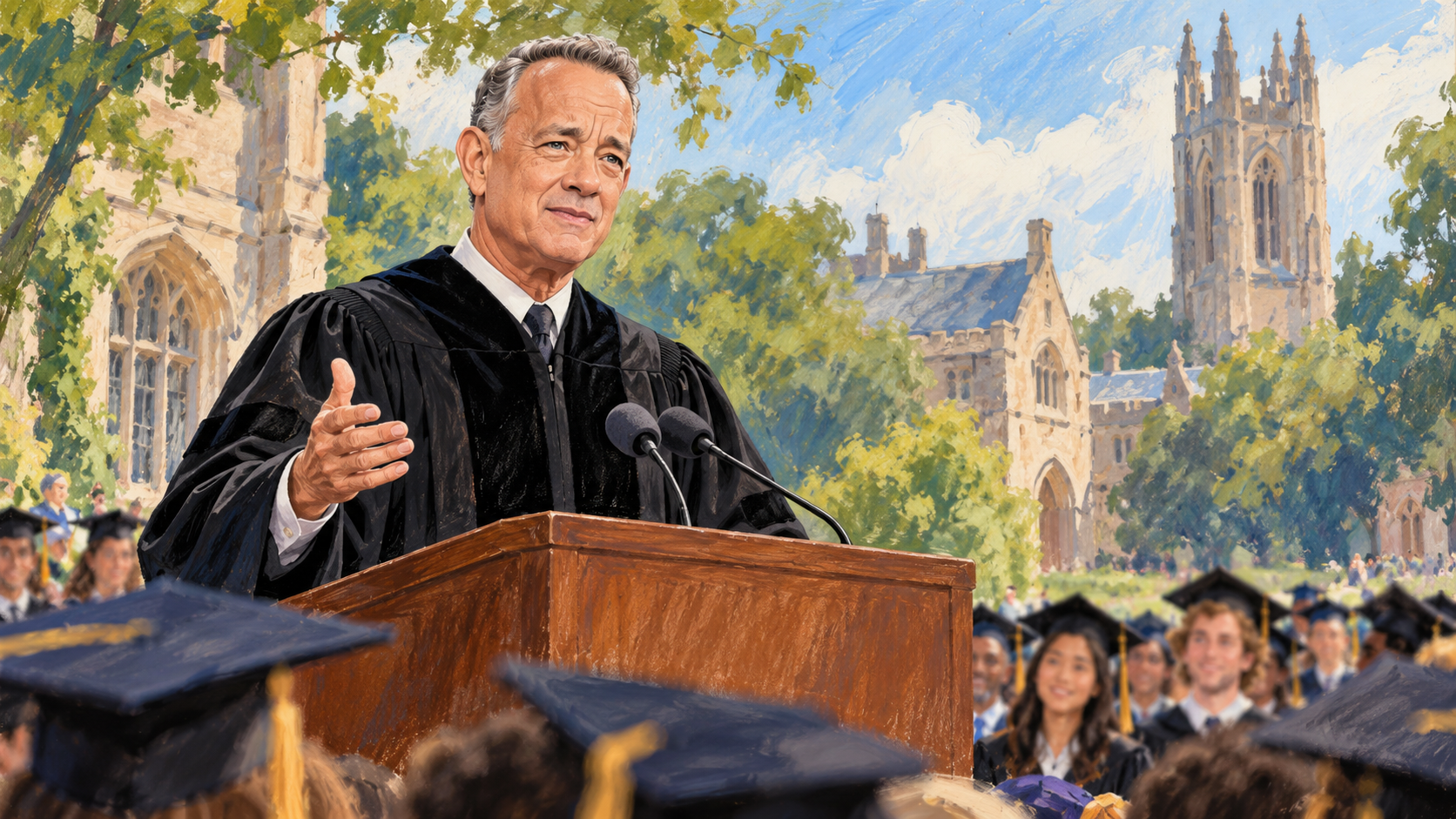
“Every day, every year, and for every graduating class, there is a choice to be made.”
Tom Hanks delivered the sentence at Harvard’s 2023 commencement while describing a recurring contest between truth, justice, and what he called the American way on one side and indifference on the other. Drawing on the language of superheroes, he avoided promising that a single graduation class would permanently resolve that contest. The choice returns daily because public life is made from repeated decisions: whether to learn the facts, whether to treat a neighbor as part of the same community, and whether inconvenience becomes an excuse for withdrawal.
The line carries special force from an actor associated with characters whose decency appears ordinary rather than superhuman. Popular culture often organizes moral choice around a villain and a final victory, but civic life rarely provides such neat closure. Institutions require maintenance, falsehoods return in new forms, and people who once acted courageously can become complacent. Hanks shifts the focus from possessing virtue to practicing it, making responsibility less glamorous but more widely available.
Choice is not the whole story. Laws, wealth, discrimination, health, and access determine which options are realistically available and how costly a decision may be. Civic rhetoric can become unfair when it treats structural barriers as failures of personal character. Nor is every public conflict a simple contest between heroes and villains. The value of Hanks’s sentence lies in refusing helplessness while leaving room for complexity: individuals act within systems, and those systems can also be changed through organized action.
Pick one recurring public responsibility that has become abstract—local news, voting, school governance, mutual aid, or a professional standard—and turn it into a scheduled habit. Read a primary document, attend one meeting, support reliable reporting, or ask how a decision affects people outside your usual circle. Then decide when the next action will occur. The quote’s challenge is not to feel heroic for an afternoon. It is to make the better choice recognizable enough to repeat when no ceremony, camera, or audience is present. Stories can reinforce that habit when they portray maintenance as meaningful rather than treating only crisis as dramatic. Paying attention before an emergency, supporting an institution before it collapses, and correcting a false claim before it spreads are quiet choices from which a shared future is assembled. Repetition also creates resilience. When one person is tired, a practiced community can continue the work instead of depending on permanent heroism from a few visible figures. That continuity is its own form of courage.
Hanks gave the quotation during Harvard’s 2023 commencement. Using the imagery of superheroes, he framed public life as a recurring choice between responsibility and indifference rather than a battle won once.
The speech responded to polarization, distrust, and the temptation to disengage from civic obligations. Hanks emphasized truth-seeking and participation as practices available to ordinary people.
The line remains relevant because democratic habits require renewal. It should not be used to ignore unequal constraints or oversimplify public disputes; personal decisions matter most when they connect with informed collective action.
Explore more "Quotes of The Day"
Discover more notable quotes from influential voices across politics, science, business, technology, sports, and culture. Each quote offers insight into how ideas, beliefs, and decisions shape the world around us.