

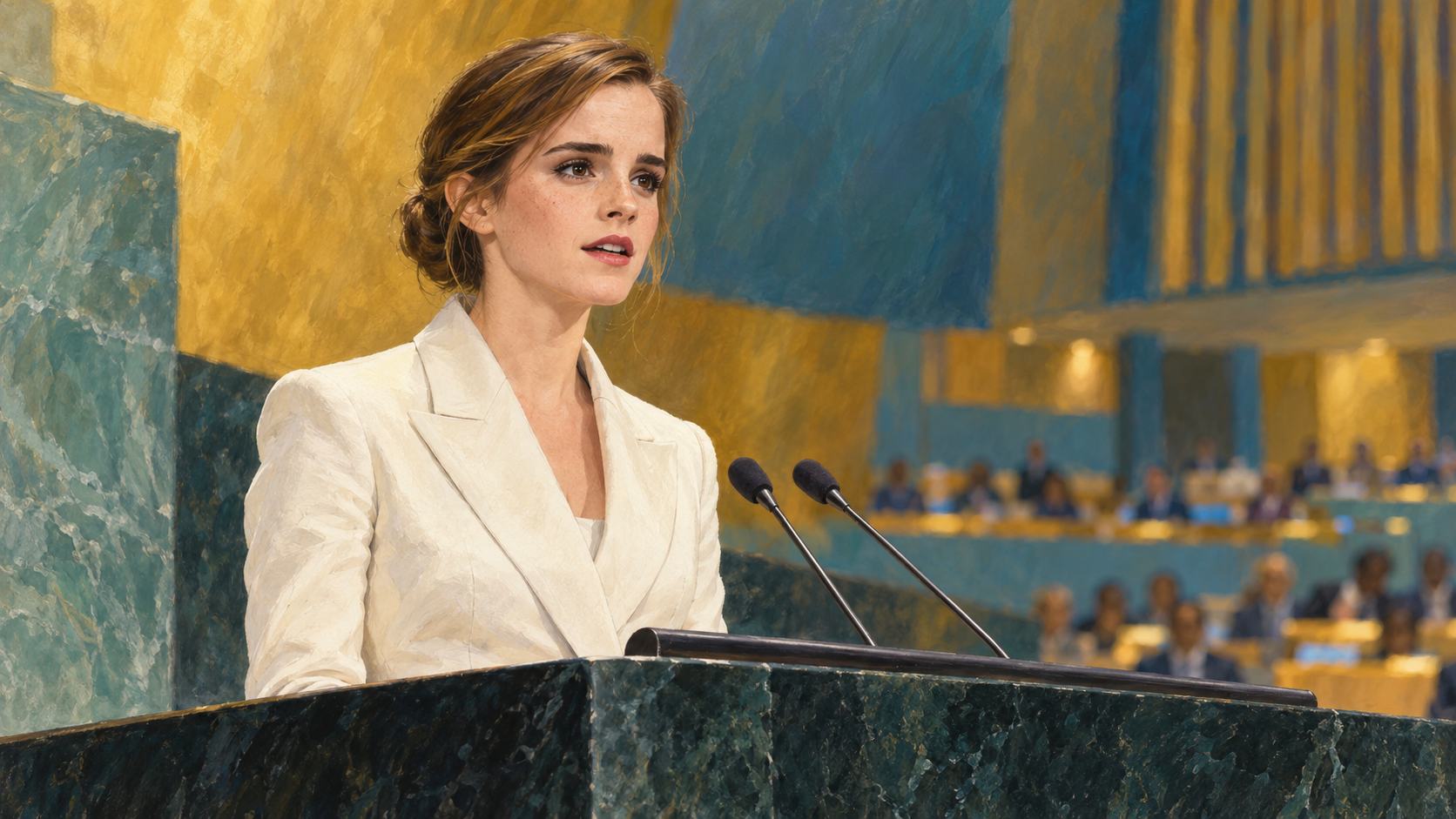
“It is time that we all perceive gender on a spectrum, not as two opposing sets of ideals.”
Emma Watson delivered this line at United Nations headquarters in 2014 while launching the HeForShe campaign. Her address invited men and boys into work for gender equality and described the costs that rigid roles impose across society. She recalled girls being labeled bossy for leadership and boys being discouraged from vulnerability. The spectrum language was part of an argument that liberation is not a zero-sum transfer of freedom from one gender to another; narrow ideals constrain anyone punished for failing to perform the expected role.
Popular culture is one of the places those ideals are repeated most efficiently. Costumes, camera work, jokes, romantic plots, and casting shorthand can turn a social expectation into something that feels natural. A spectrum opens more room for character: strength can coexist with tenderness, ambition with care, and identity with contradiction. Watson’s sentence asks stories to move beyond paired boxes in which one trait automatically belongs to men and its opposite to women. That expansion benefits the audience by making fictional people less predictable and real people less policed.
The speech has also drawn criticism, especially when solidarity campaigns center famous advocates or frame men’s involvement as the route by which women’s equality becomes persuasive. Race, economic position, sexuality, disability, nationality, and law all influence gender; a broad invitation cannot substitute for leadership by people most affected. Spectrum language also requires care not to erase distinct identities or material inequalities. The quote is a starting point for loosening stereotypes, not a complete account of gender justice.
Audit one familiar media role—the hero, caregiver, genius, romantic lead, or comic fool—and list the traits automatically attached to its gender. Reverse or redistribute those traits while keeping the character psychologically coherent, then ask who gains agency in the revised version. Outside fiction, notice when praise or criticism depends on a person conforming to a gendered expectation. Watson’s challenge becomes concrete when the spectrum is not merely named but reflected in who may lead, feel, fail, nurture, and be understood as fully human. Representation behind the camera matters too. Writers, directors, costume designers, and editors determine which departures from convention look plausible or ridiculous. A broader creative team can identify assumptions that a single perspective has mistaken for neutral storytelling grammar. Test the finished story with attention to consequence: does the nonconforming character receive a full arc, or does the narrative eventually punish difference to restore the old order?
Watson spoke at the United Nations in September 2014 as a UN Women goodwill ambassador launching HeForShe, a campaign inviting men and boys to support gender equality.
The statement followed examples of girls and boys constrained by gendered expectations. Watson argued that equality could free people from roles that restrict leadership, emotion, care, and vulnerability.
The quote helped circulate spectrum language in mainstream culture. Its limitations include the need for intersectional analysis and for campaigns to center people directly affected rather than relying on celebrity advocacy alone.
Explore more "Quotes of The Day"
Discover more notable quotes from influential voices across politics, science, business, technology, sports, and culture. Each quote offers insight into how ideas, beliefs, and decisions shape the world around us.