

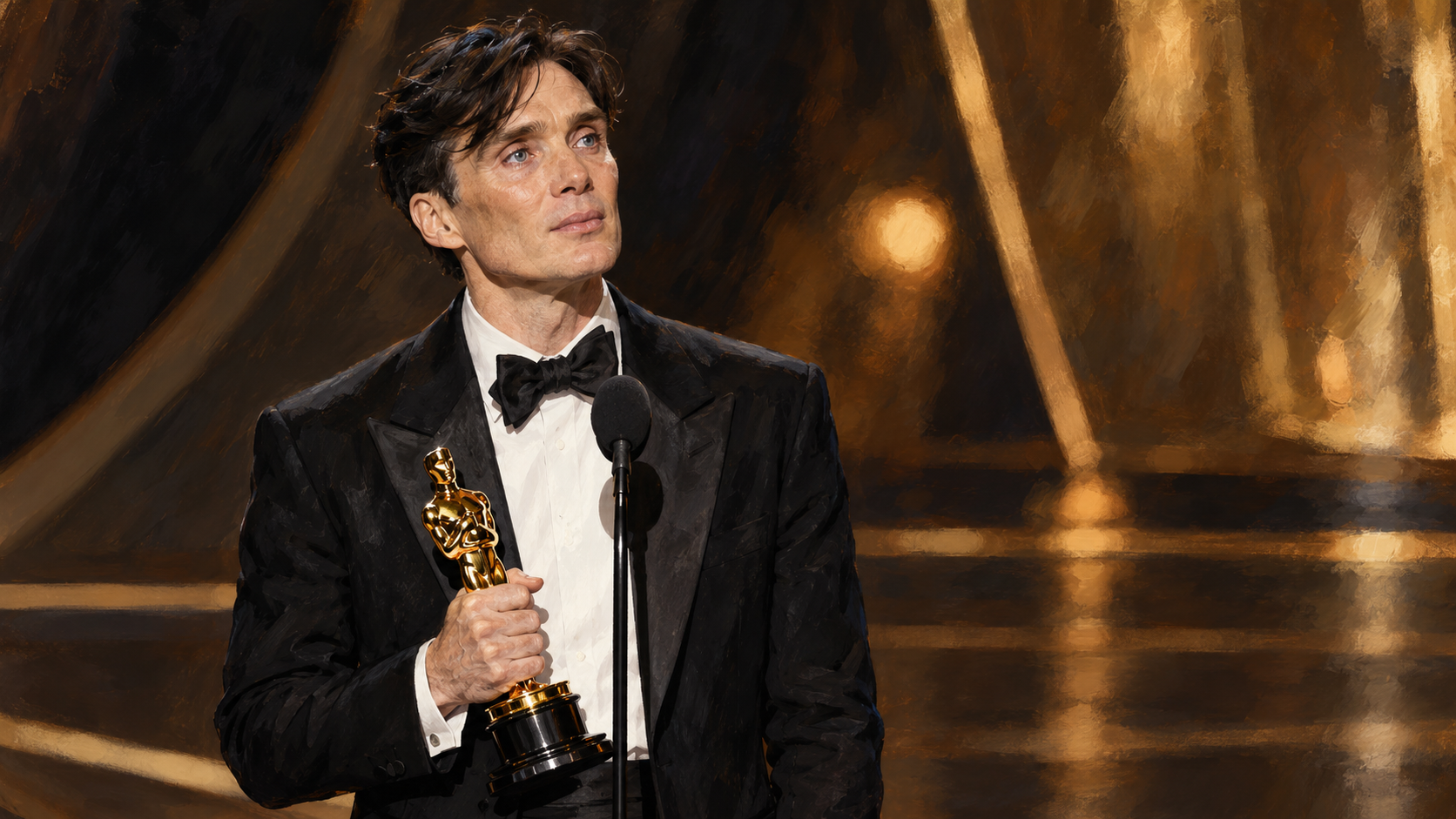
“For better or for worse, we’re all living in Oppenheimer’s world.”
Cillian Murphy delivered this line during his 2024 best-actor Oscar speech for portraying J. Robert Oppenheimer. After thanking the film’s collaborators, he noted that its subject was the person who helped create the atomic bomb and dedicated the award to peacemakers. The sentence refused to let a celebrated performance remain safely inside historical drama. Nuclear weapons, deterrence, proliferation, environmental damage, and the memory of Hiroshima and Nagasaki are not closed chapters; they shape the political world in which the ceremony took place.
Biographical films can make vast systems feel intimate by concentrating them in a face and a set of decisions. Murphy’s performance brought ambition, dread, calculation, and moral conflict into view, giving audiences an emotional route through technical and political history. His quote then widened the frame again. Oppenheimer’s world includes scientists, military planners, government officials, affected communities, activists, and generations born after the original project. A movie may follow one protagonist, but the consequences exceed the protagonist’s consciousness and the boundaries of a three-hour narrative.
The phrase should not turn Oppenheimer into the sole author of the nuclear age or allow spectacle to substitute for history. Thousands of people contributed to the Manhattan Project, while Japanese civilians, Indigenous communities near extraction and testing sites, workers, and military populations experienced different forms of harm. A film’s selective viewpoint can illuminate one moral problem while leaving others peripheral. Responsible engagement means asking whose world is visible, whose evidence is absent, and what the dramatic center makes easier to remember.
After watching a historical film, choose one consequence that continues beyond its ending and consult a source produced outside the protagonist’s perspective. Compare what the story made vivid with what it compressed or omitted. Murphy’s sentence offers a bridge from awards-night admiration to public memory: the performance matters partly because viewers still inhabit the structures the character helped create. The most useful response is neither to dismiss the film nor to treat it as complete, but to let its emotional force open a broader, better-sourced inquiry. That habit also improves criticism. Instead of asking only whether an actor was convincing, examine how the film’s perspective organizes sympathy and responsibility. A powerful portrayal can begin a historical conversation, but the conversation matures by adding archives, witnesses, and communities the central performance cannot contain. Curators can extend that process through paired screenings, reading lists, and discussions that place the celebrated film beside work made from locations it leaves near the edge.
Murphy spoke at the 2024 Academy Awards after winning best actor for Oppenheimer. He connected the film’s success to the continuing nuclear legacy of the historical figure he portrayed.
The line was prompted by a story about scientific achievement inseparable from mass destruction and state power. Murphy used the acceptance speech to dedicate the award to people working for peace.
Its relevance extends beyond one film because nuclear policy and memory remain active. The qualification is that Oppenheimer is only one perspective within a history involving many creators, victims, communities, and institutions.
Explore more "Quotes of The Day"
Discover more notable quotes from influential voices across politics, science, business, technology, sports, and culture. Each quote offers insight into how ideas, beliefs, and decisions shape the world around us.