

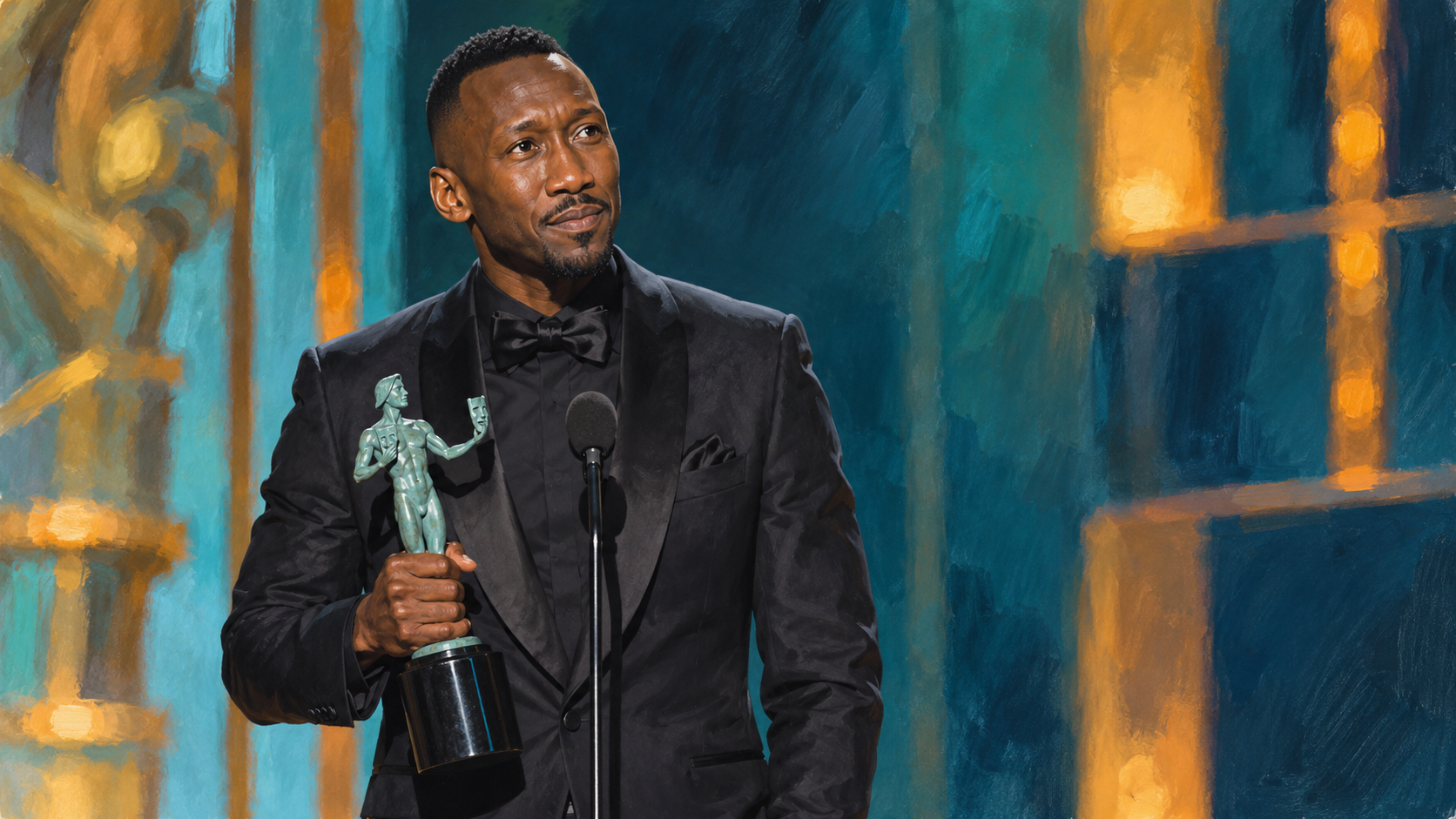
“What I learned from working on Moonlight is we see what happens when you persecute people.”
Mahershala Ali said this while accepting the 2017 Screen Actors Guild Award for his supporting performance in Moonlight. He explained that persecution can make people fold inward and described the value of seeing the details that make a person unique. Ali also spoke about converting to Islam and his mother’s response as an ordained Christian minister, offering their continuing love as a lived example of difference without abandonment. The speech connected the film’s quiet emotional world with a public moment marked by arguments over identity and belonging.
Moonlight follows Chiron across three stages of life as he navigates poverty, masculinity, sexuality, and violence. Ali’s character, Juan, offers care while embodying contradictions the film does not excuse or simplify. That complexity supports the quotation’s central idea: persecution does not merely produce a public disagreement; it can reorganize a person’s inner life, teaching concealment, guardedness, and self-denial. Popular stories can counter that process when they give an audience time to perceive interiority where stereotype once supplied the whole explanation.
Empathy is not the same as absolution. Understanding how persecution harms a person does not remove responsibility for harmful choices, and a compassionate performance cannot substitute for legal protection or material safety. The language of uniqueness can also become too individual if it ignores patterns shared across groups. Ali’s speech is strongest when intimate recognition and structural analysis work together: see the specific human being, then address the conditions that repeatedly place comparable people in danger.
Practice the lesson by noticing where a story uses a label as a conclusion. Seek a first-person account, a carefully reported history, or a work created from within the represented community, and record which details complicate your initial picture. In collaborative settings, make it safer to name difference without demanding disclosure. Ali’s words ask more than passive tolerance. They invite the kind of attention that keeps another person from being reduced to the feature for which society has decided to punish them. The film’s quietness offers another clue: recognition sometimes requires slowing the pace at which judgment is made. Leave space for pauses, guarded answers, and contradictions without filling them immediately with an outsider’s explanation. A person shaped by persecution may reveal trust gradually, and the audience’s patience can become part of the ethics of seeing. That patience must be joined to protection. Stories can cultivate recognition, while workplaces, schools, families, and governments determine whether recognition becomes safety in daily life.
Ali delivered the quotation at the 2017 SAG Awards after winning for Moonlight. His speech connected the film’s portrait of a persecuted young man with his own experience as a Muslim in a Christian family.
The statement was prompted by the film’s depiction of how homophobia, racism, poverty, and rigid masculinity shape Chiron’s ability to reveal himself and accept care.
The quote remains relevant to representation and public life. Its qualification is that empathy must not replace accountability or policy; personal recognition and structural protection are both necessary.
Explore more "Quotes of The Day"
Discover more notable quotes from influential voices across politics, science, business, technology, sports, and culture. Each quote offers insight into how ideas, beliefs, and decisions shape the world around us.