

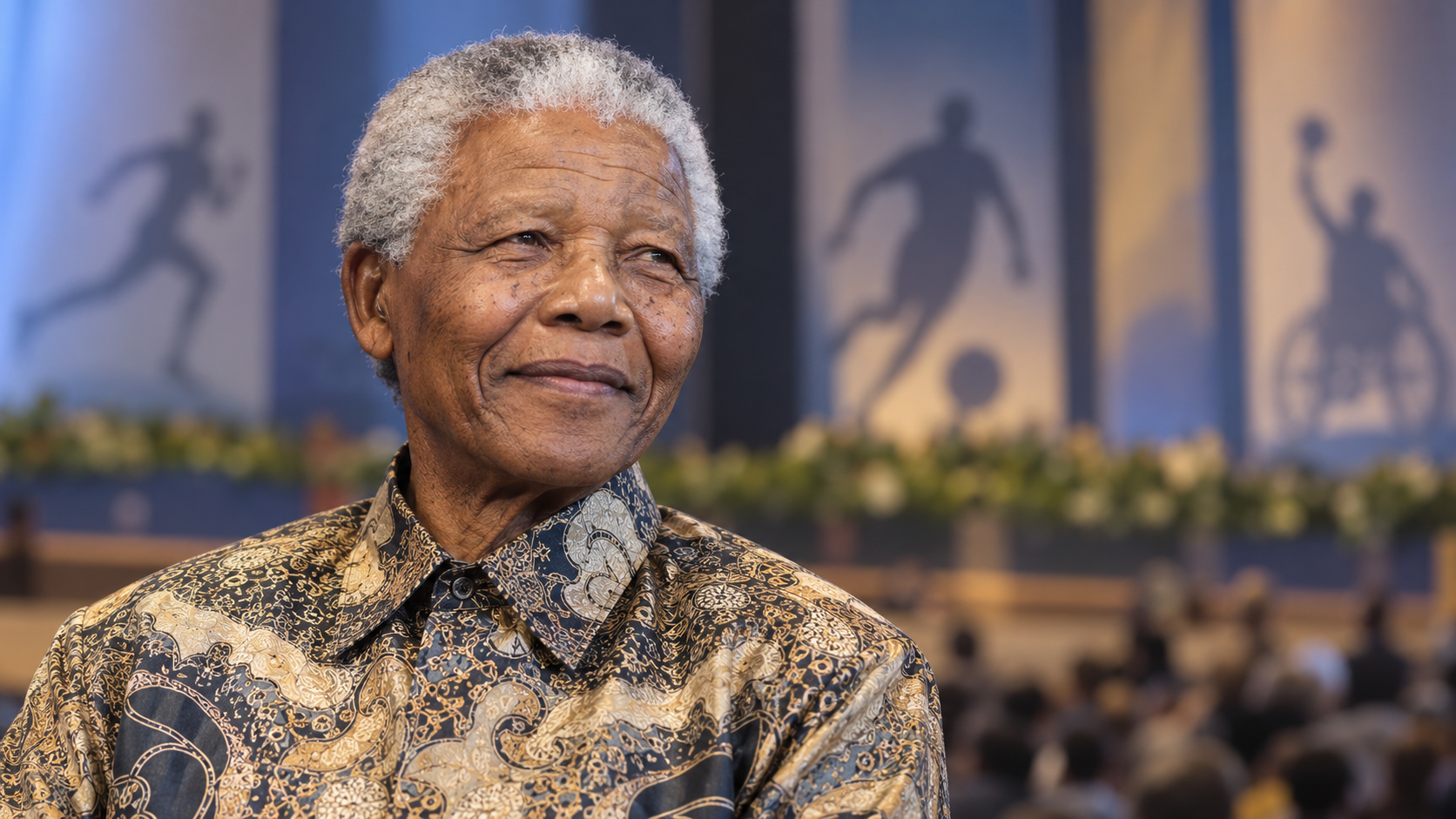
“Sport has the power to change the world.”
Nelson Mandela opened the inaugural Laureus World Sports Awards in Monaco on May 25, 2000, with a claim that soon became the organization’s guiding idea: “Sport has the power to change the world.” Mandela had completed his term as South Africa’s president the previous year and appeared as Laureus’s founding patron. He was not offering a slogan detached from experience. His public life had shown him how shared civic symbols could help people imagine a society beyond apartheid, while also teaching him that symbolism must be joined to organized work.
The sentences that followed defined the kind of power he meant. Sport could inspire, unite people “in a way that little else does,” speak to young people in a language they understood, and create hope where despair had existed. Mandela then pointed to the athletes around him as figures whose responsibilities extended beyond the field into their communities. He envisioned an active hall of fame spreading help and hope, and an international community in which rules were equal and conduct was guided by fair play and good sportsmanship. The setting mattered: Laureus was being launched not only as an awards institution but as a movement that would connect sporting fame to programs intended to improve young people’s lives.
That context keeps the quotation from becoming magical thinking. A match cannot by itself dismantle racism, repair unequal schools, or guarantee safe places to play. Sports institutions can reproduce exclusion when access, funding, leadership, or rules are unfair. Mandela’s speech assigned sport a capacity, not an automatic virtue. Its unifying language becomes credible when leagues, athletes, sponsors, and community programs use attention and resources to widen opportunity and confront discrimination. Without that follow-through, an uplifting ceremony can leave the underlying barriers untouched. Fair play is therefore more than courteous behavior during competition; it is a principle for deciding whose talent is noticed, whose voice is heard, and whose neighborhood receives investment.
The quote still matters because sport remains one of the few cultural spaces where strangers gather around common rules, visible effort, and uncertain outcomes. Teams can create belonging across lines that politics and everyday life often harden, while prominent athletes can bring public attention to neglected communities. Yet the measure of change lies beyond applause: who gets facilities, coaching, safety, representation, and a genuine chance to participate. Mandela’s wording endures because it balances ambition with responsibility. Sport has power, but people and institutions decide whether that power becomes spectacle, exclusion, or durable public good.
Mandela spoke at the first Laureus World Sports Awards in Monaco on May 25, 2000, appearing as the new organization’s founding patron.
The speech connected elite recognition to community duty, asking celebrated athletes to spread help, inspiration, hope, fair play, and good sportsmanship. Primary source; Additional source.
Mandela described sport as a common language that can create connection and challenge racial barriers, especially for young people.
He did not prove that every sporting event produces justice. The power he named depends on equal rules, genuine access, responsible leadership, and sustained community action.
Athletes and leagues still command unusual public attention, giving them opportunities to support education, health, inclusion, and local development.
The quote remains a demanding standard: sport fulfills its promise when the people who organize it turn shared emotion into fairer structures and lasting opportunity.
Explore more "Quotes of The Day"
Discover more notable quotes from influential voices across politics, science, business, technology, sports, and culture. Each quote offers insight into how ideas, beliefs, and decisions shape the world around us.