

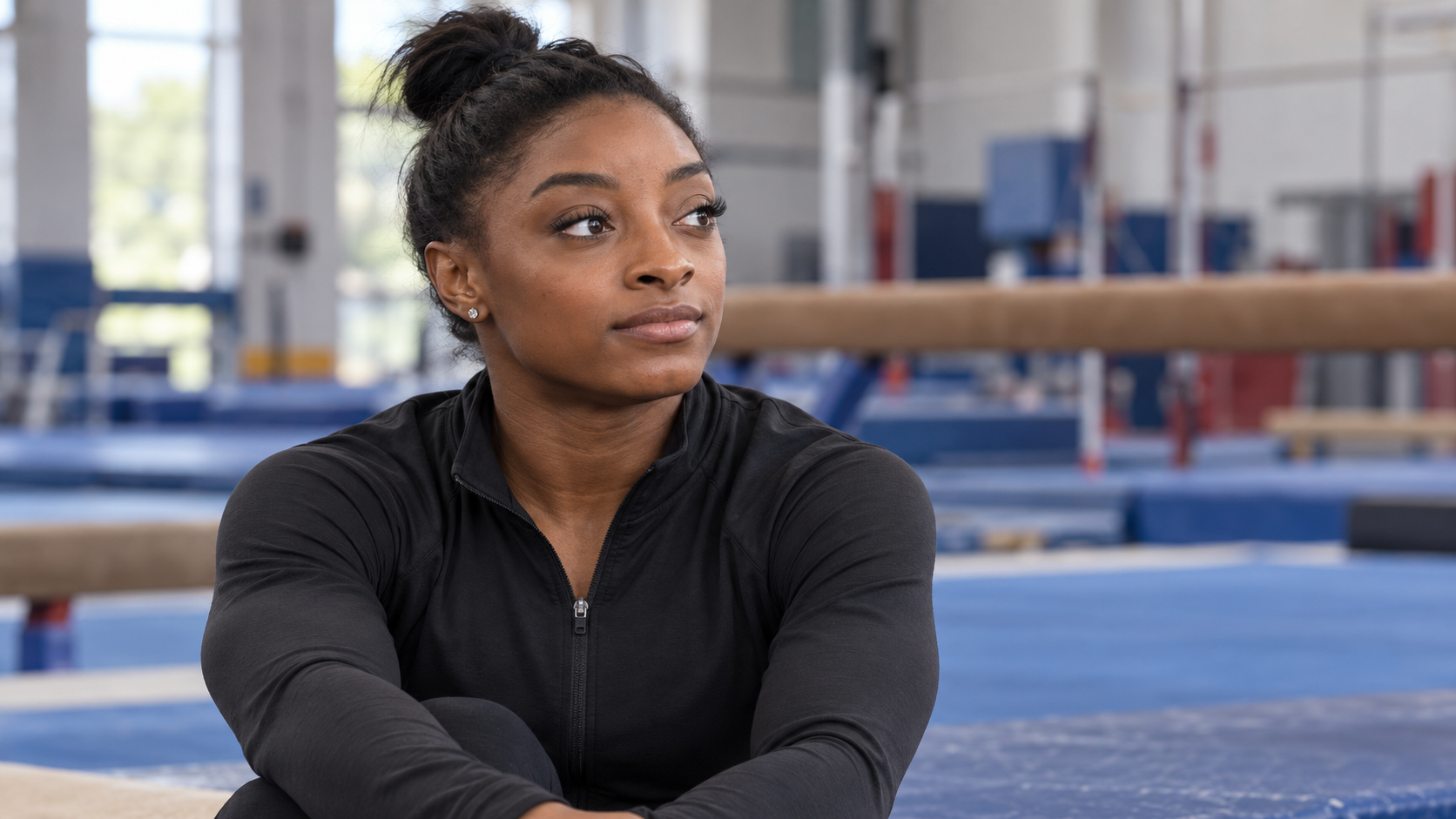
“We have to protect our minds and our bodies and not just go out and do what the world wants us to do.”
Simone Biles spoke these words after withdrawing from the women’s gymnastics team final at the Tokyo Olympics on July 27, 2021: “We have to protect our minds and our bodies and not just go out and do what the world wants us to do.” Biles had completed one vault before deciding she could not safely continue. The United States went on to win the silver medal, while the most decorated gymnast of her generation faced a global audience accustomed to treating her extraordinary difficulty and consistency as guarantees.
At the post-event press conference, Biles said she had chosen to take a back seat, focus on mindfulness, and avoid putting the team’s medal at risk through mistakes. She later described experiencing the “twisties,” a dangerous loss of spatial awareness that can leave a gymnast uncertain of position while rotating in the air. In a sport where a fraction of a second separates a controlled landing from serious injury, the mind and body are not independent systems. Her decision was therefore both a health judgment and a competitive judgment informed by expertise in her own performance. Biles did not present that assessment as a theory about athletes in general. She described the immediate information available to her—how she felt in warmups, what happened on the vault, and the consequences of attempting further routines without reliable orientation.
The quote changed the usual language of toughness. Protecting oneself was not the opposite of responsibility; in this case, it was part of responsibility to teammates who had prepared for their own roles. Biles remained beside the team, supporting the athletes who continued, and later returned to win a bronze medal on balance beam. That return matters, but it should not be treated as proof required to justify the withdrawal. An athlete does not owe spectators a comeback before a safety decision becomes legitimate, and another athlete might need a different response or a longer absence.
Biles’s statement continues to shape conversations about coaching, medical independence, workload, sports psychology, and the expectations placed on elite performers. It does not suggest that every difficult moment calls for withdrawal, or that mental health can be reduced to a slogan. It argues that athletes are people with relevant knowledge about their own condition, not machines activated by public demand. Strong sports cultures still pursue excellence, but they build procedures in which competitors can report danger honestly, receive qualified support, and make decisions without being punished for recognizing when performance is no longer safe. That approach also protects teammates by making contingency planning normal instead of treating every withdrawal as an unimaginable crisis.
Biles made the statement after leaving the Tokyo Olympic team final following one vault on July 27, 2021. The U.S. team completed the event and won silver.
She explained that her mental state was not aligned with the demands of the routine and that continuing could endanger both her safety and the team’s result. Primary source; Additional source.
In aerial gymnastics, spatial awareness is a safety requirement. Protecting mental health and protecting the body can be the same decision rather than competing priorities.
The quote does not prescribe withdrawal for every athlete or challenge. It supports informed, individualized decisions made with appropriate medical and coaching support.
The episode pushed athlete welfare into discussions of selection, workload, medical authority, and the power spectators and sponsors hold over competitors.
Biles’s words remain useful because they place human judgment inside the definition of toughness instead of treating obedience to outside expectations as courage.
Explore more "Quotes of The Day"
Discover more notable quotes from influential voices across politics, science, business, technology, sports, and culture. Each quote offers insight into how ideas, beliefs, and decisions shape the world around us.