

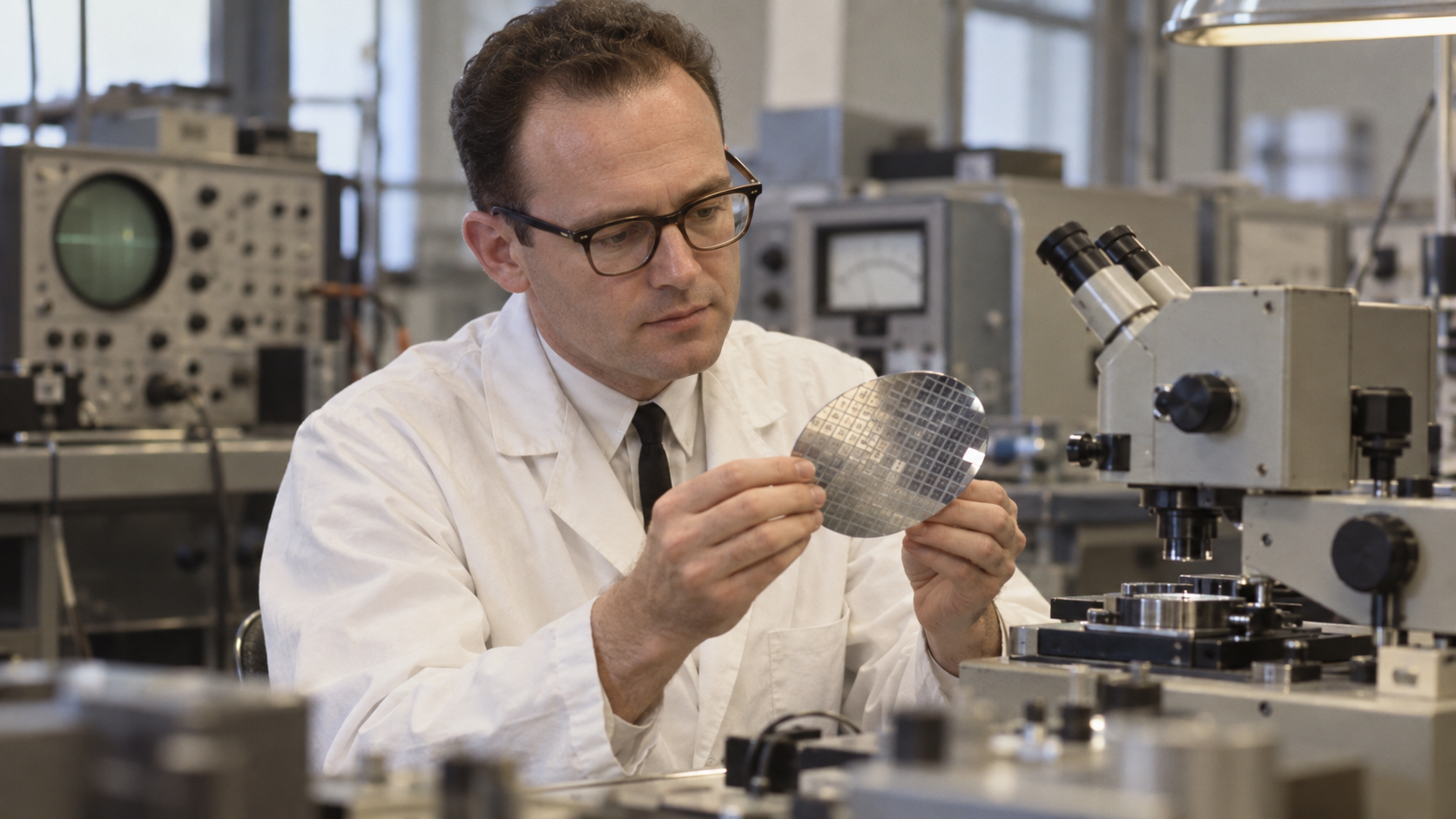
“The complexity for minimum component costs has increased at a rate of roughly a factor of two per year.”
Gordon Moore wrote this line in his 1965 article “Cramming More Components onto Integrated Circuits,” when commercial chips were still modest and their future was uncertain. He examined the number of components that produced the lowest cost per component and observed that this economically useful level of complexity had been increasing at roughly a twofold annual rate. The sentence was not originally presented as a timeless physical law. It was an informed projection drawn from a young industry’s manufacturing progress, and Moore used it to argue that integrated electronics would make sophisticated computing and communications broadly affordable.
The phrase “minimum component costs” is essential. Moore was not counting transistors simply to celebrate bigger numbers. As fabrication improved, manufacturers could place more functions on one chip while reducing the cost of each function—up to a point where defects and production difficulty outweighed the savings. That economic balance encouraged engineers to design more capable devices and gave customers more performance for their money. In 1975, Moore revised the expected cadence to about a doubling every two years. The familiar name “Moore’s Law” came later, as the semiconductor industry turned the observation into a planning benchmark.
For decades, that benchmark coordinated decisions across an enormous supply chain. Chip designers anticipated future transistor budgets; equipment makers developed finer lithography; software companies assumed improving hardware; device manufacturers planned products that would become practical at the next generation of cost and performance. The forecast became partly self-reinforcing because companies invested to stay on its curve. Its effects reached far beyond processor speed. Denser chips helped shrink computers, expand memory, lower the price of electronics, and enable smartphones, cloud computing, digital cameras, medical equipment, and countless embedded systems.
Today, continued improvement requires more than simply making every transistor smaller. Advanced packaging, chiplets, specialized accelerators, new materials, three-dimensional structures, and software optimization all contribute to progress, while fabrication plants and leading-edge designs have become extraordinarily expensive. Energy use and heat also constrain what raw transistor counts can deliver. Consumers experience the result through battery life, responsiveness, reliability, and price rather than through transistor totals alone. Moore’s sentence still matters because it links technical capability to economics and coordinated expectation. It describes how repeated improvement can compound into social change, but it does not promise that any particular rate will continue automatically. The industry’s challenge is to keep finding practical ways to deliver more useful computation, not merely to preserve a famous curve.
Moore published the observation in the April 19, 1965 issue of Electronics while leading research and development at Fairchild Semiconductor.
He was examining the chip complexity that minimized component cost and projecting how integrated circuits could make electronics widely affordable.
The original estimate was roughly annual doubling; Moore revised the cadence in 1975 to about every two years.
“Moore’s Law” is an economic and technological trend that became an industry roadmap, not an immutable law of physics.
The expectation coordinated investment in design, fabrication, equipment, and software, helping compounding improvements reach many products.
Modern progress increasingly combines smaller features with packaging, specialization, architecture, and software under tighter cost and energy limits.
Explore more "Quotes of The Day"
Discover more notable quotes from influential voices across politics, science, business, technology, sports, and culture. Each quote offers insight into how ideas, beliefs, and decisions shape the world around us.