

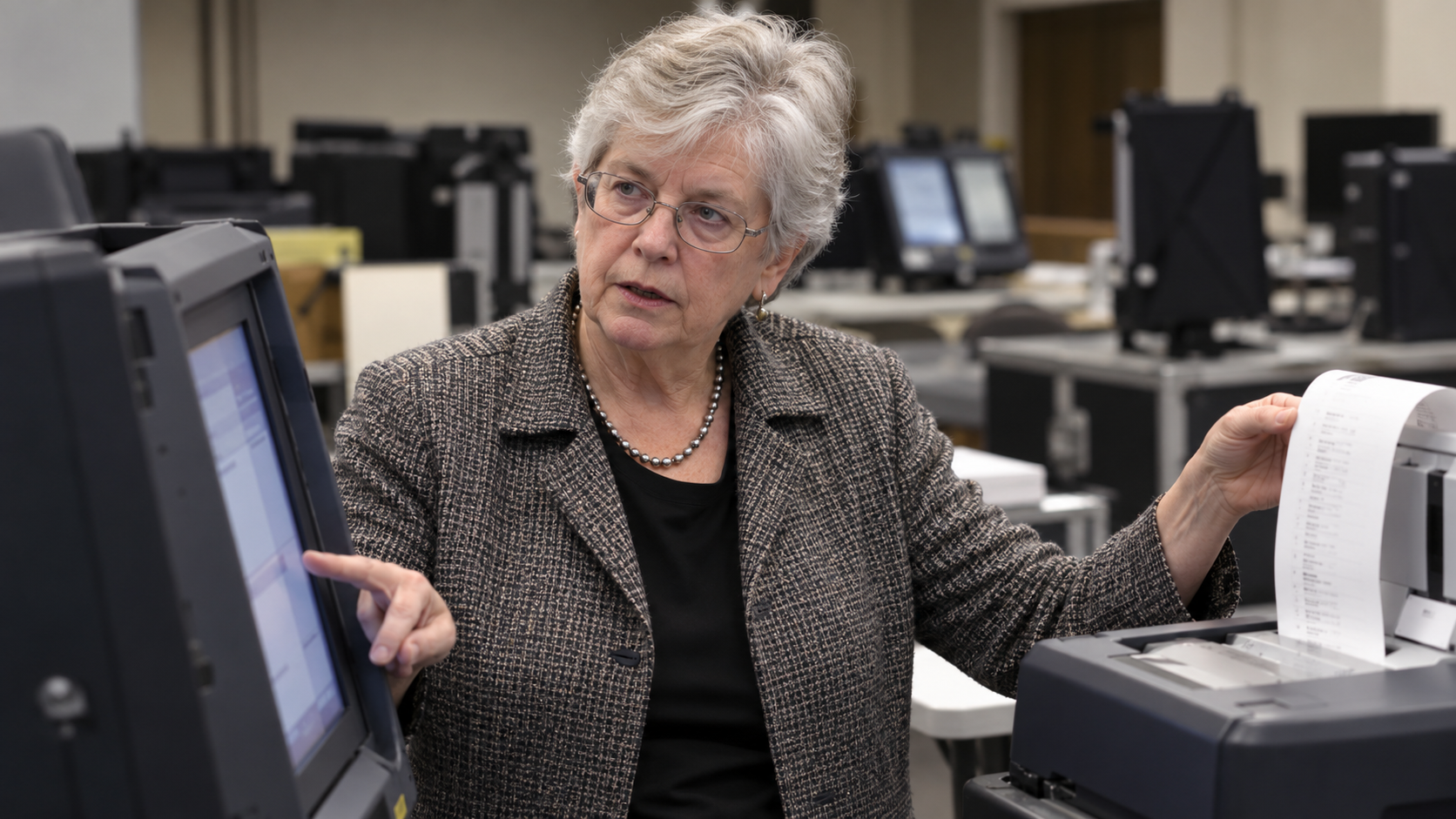
“There are more checks and balances on ATMs than on voting machines, which is pretty appalling.”
Barbara Simons made this comparison during an early national debate over paperless electronic voting. A 2004 Johns Hopkins Magazine report described computer scientists examining voting-machine code, weak security practices, and systems that could record a ballot without producing evidence a voter could verify. Simons’s reference to automated teller machines was effective because ATMs were already familiar examples of high-stakes computing. Banks did not simply trust a screen’s final number; transactions were surrounded by records, reconciliation, access controls, and procedures for investigating disputes. Voting, she argued, deserved at least as serious a system of independent checks.
The quote is not a claim that banking technology is flawless or that elections should copy every financial practice. The crucial word is “checks.” A secure system should not require the public to trust that software behaved correctly just because a vendor or official says it did. Software can contain bugs, administrators can make mistakes, equipment can be misconfigured, and attackers can look for weaknesses. When the outcome matters, designers should create evidence outside the component being checked. In elections, voter-marked paper ballots and rigorous post-election audits can provide a record that does not depend entirely on the same software that counted the votes.
Simons’s warning illustrates a central principle of security engineering: prevention alone is not enough. Teams should also make failures detectable and recovery possible. Logs can document actions, separation of duties can limit unilateral control, independent reviews can expose design errors, and physical records can support reconciliation. These measures are sometimes dismissed as friction, yet carefully chosen friction can protect legitimacy. A fast system that cannot explain or verify its result may be less useful than a slightly slower one whose outcome can be checked. Trust grows from observable processes, not from the absence of visible trouble.
The lesson extends well beyond voting equipment. Medical devices, financial platforms, cloud services, identity systems, and AI-assisted decisions all create results that people may need to challenge. For each one, engineers can ask what independent evidence exists, who can examine it, and what happens when the primary system is wrong. Simons’s comparison endures because it turns a specialized security debate into an everyday standard. If society expects redundancy and records for routine financial transactions, systems that carry greater public consequences should not offer less accountability. The goal is not to distrust technology by default. It is to build technology that does not demand blind trust.
ATMs handle valuable transactions through multiple layers of records, controls, and reconciliation. Simons used that familiar example to show how unusual it was for some voting systems to offer less independent evidence.
Her point was about accountability rather than identical architecture. Both systems are high stakes, but an election must also preserve ballot secrecy while allowing the overall result to be verified.
An independent check does not rely entirely on the same software or device that produced the original result. It gives investigators a separate source of evidence when errors or disputes arise.
For elections, voter-marked paper ballots combined with statistically sound audits can test whether reported electronic totals reflect the ballots. The paper record alone is insufficient if nobody checks it.
Critical systems should be designed not only to resist failure but also to reveal it. Clear logs, divided responsibilities, reviewable evidence, and tested recovery procedures help make outcomes accountable.
This principle applies wherever software makes consequential decisions. Users and institutions need a practical way to question a result without asking the system that may have failed to certify itself.
Explore more "Quotes of The Day"
Discover more notable quotes from influential voices across politics, science, business, technology, sports, and culture. Each quote offers insight into how ideas, beliefs, and decisions shape the world around us.