

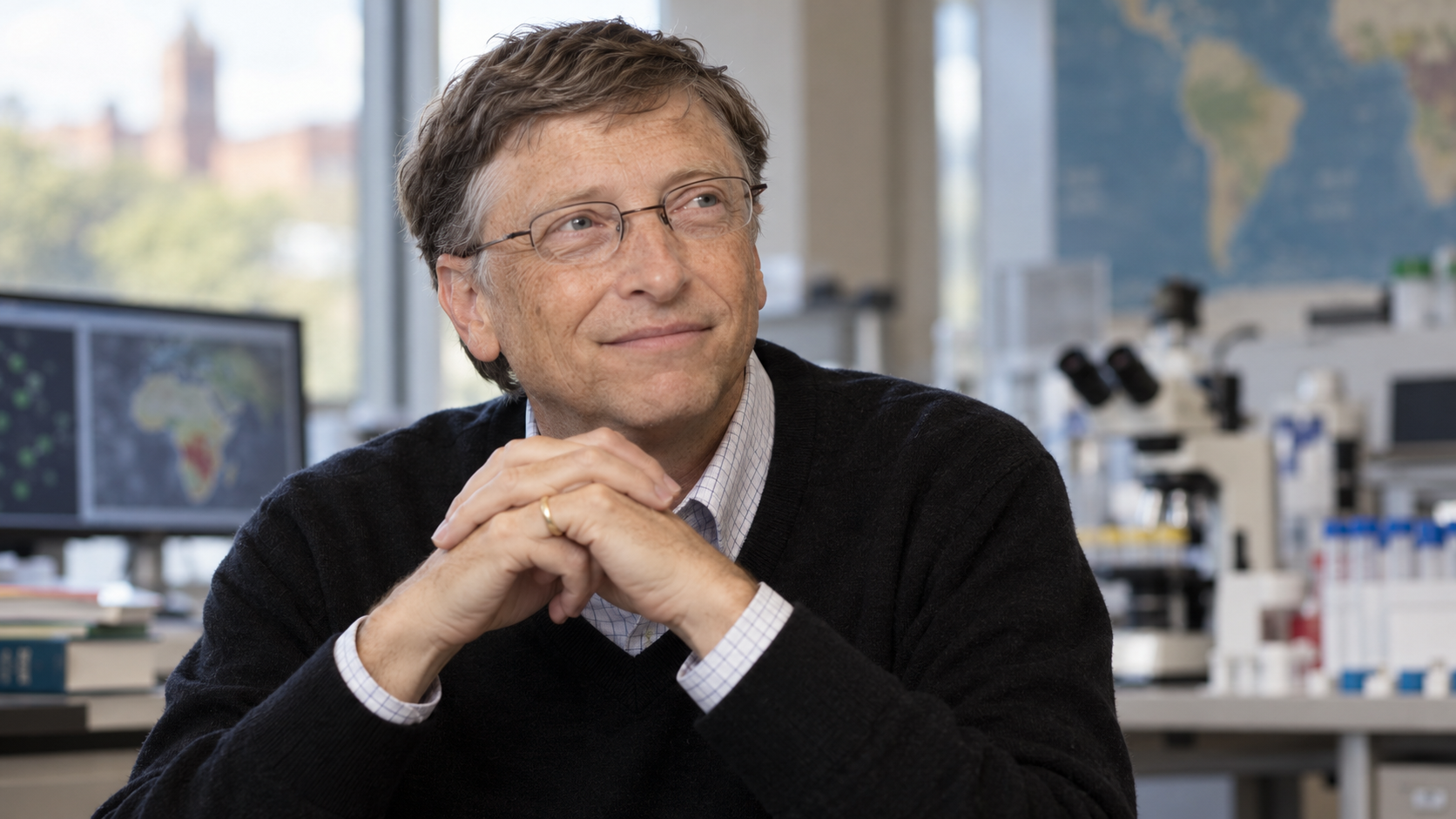
“Humanity’s greatest advances are not in its discoveries—but in how those discoveries are applied to reduce inequity.”
Bill Gates made this argument in his 2007 Harvard commencement address, after describing how little he had understood as a student about severe global inequities in health and opportunity. He praised discovery, but insisted that knowledge alone is not the final measure of progress. His examples concerned preventable deaths, education, and the obstacles that keep useful solutions from reaching people with the least political or purchasing power. The line reframed technical achievement as a delivery problem: a medicine, network, or piece of knowledge changes lives only when institutions can place it in the hands of those who need it.
That emphasis does not diminish science or invention. Application depends on discovery, and complex problems require sustained research. Gates was pointing to the additional work between a successful experiment and a fair outcome: manufacturing, cost reduction, infrastructure, training, distribution, public trust, and accountable policy. Each layer introduces choices about who is served first and whose constraints are treated as central. A technology may be impressive in a laboratory yet inaccessible where electricity is unreliable, maintenance is scarce, language support is missing, or prices exceed local incomes. Effectiveness must therefore be measured in the conditions where people actually live.
The quotation also warns against treating access as a final charitable step added after design. Equity can change the design itself. Low-bandwidth services, inexpensive diagnostics, offline tools, accessible interfaces, and products that work across languages are not watered-down versions of innovation; they are responses to real requirements. At the same time, technology cannot eliminate inequity by itself. Unequal laws, institutions, markets, and power shape who benefits. A platform may expand access while creating new dependencies or privacy risks. Applying discovery responsibly requires listening to affected communities and evaluating consequences, not simply increasing deployment numbers.
The principle remains urgent as artificial intelligence, biotechnology, and digital public services advance rapidly. Headlines often celebrate what a system can do before asking who can use it safely, who supplies the data, and who bears the cost of error. Gates’s standard redirects attention from novelty to outcomes. It asks engineers, funders, governments, and institutions to connect technical capability with implementation capacity and public purpose. The strongest evidence of progress is not that a breakthrough exists somewhere; it is that the breakthrough is adapted, governed, and delivered so that previously excluded people gain a meaningful share of its benefits. That standard also makes maintenance visible, because an intervention that cannot be sustained after a pilot has not yet crossed the gap between demonstration and durable benefit.
Gates spoke at Harvard in 2007 and reflected on global problems he had not seriously encountered during his own years at the university. His address focused particularly on unequal health and educational outcomes.
The sentence followed his appeal to turn awareness into action. Discovery was essential, but the moral test was whether knowledge could be applied where preventable suffering remained greatest.
The quote separates invention from impact. A technical result becomes a social advance through affordable delivery, usable design, dependable infrastructure, and institutions capable of sustaining it.
It does not claim that every inequity has a technical solution. Distribution, law, trust, and political power can determine outcomes even when an effective tool already exists.
Digital services and AI can scale quickly, but their benefits remain uneven when connectivity, language support, disability access, and protection from error are treated as afterthoughts.
Designing for equity from the beginning produces a better test of innovation: not only what the system demonstrates, but who can use it, under what conditions, and with what durable benefit.
Explore more "Quotes of The Day"
Discover more notable quotes from influential voices across politics, science, business, technology, sports, and culture. Each quote offers insight into how ideas, beliefs, and decisions shape the world around us.