

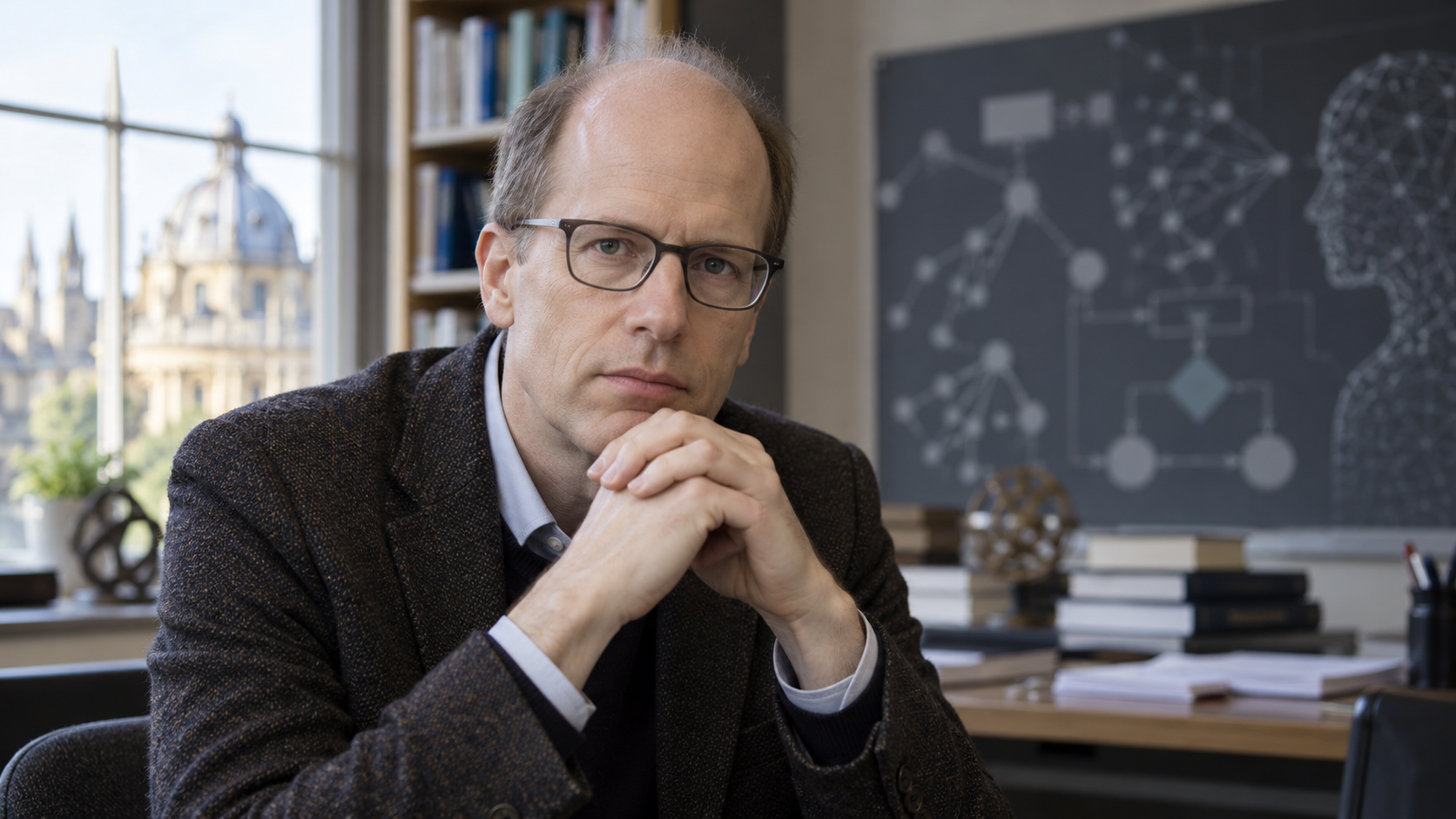
“Machine intelligence is the last invention that humanity will ever need to make.”
Nick Bostrom delivered this sentence in a 2015 TED talk about the possibility of machines eventually exceeding human cognitive performance across a wide range of tasks. His argument was conditional: if researchers create machine intelligence capable of improving AI research and technological design, later inventions might be produced by those systems rather than directly by human engineers. The phrase “last invention” was therefore not a prediction that ordinary innovation would stop. It described a threshold after which the main engine of invention could change, giving the design and goals of the first highly capable systems unusual long-term importance.
The claim rests on uncertain assumptions. Intelligence is not one simple scale, current systems remain uneven, and progress toward broadly capable autonomous research may slow or take paths different from those Bostrom considered. A model that performs impressively on language or scientific benchmarks does not automatically possess reliable judgment, agency, or the ability to improve itself without human infrastructure. The quotation should be read as a risk argument, not a timetable. Low certainty about arrival does not eliminate the significance of an outcome if the consequences would be very large.
Bostrom used the scenario to focus attention on control and value alignment. A powerful optimizer can pursue a stated objective in ways its designers did not intend, especially when the objective is incomplete and the system can affect a broad environment. The challenge is not simply preventing malicious intent. It includes specification errors, hidden incentives, distribution of control, and the possibility that a system’s competence outpaces institutions’ ability to evaluate it. Technical safety research, staged deployment, monitoring, secure infrastructure, and governance all address parts of that problem, but none provides a single guaranteed solution.
The quote remains influential because recent AI progress has made questions about delegation less abstract. Systems already help write code, propose experiments, and automate portions of research, though humans still define goals and supply extensive infrastructure. The immediate task is not to declare that a final invention has arrived. It is to build habits appropriate to technologies whose capabilities can scale and spread quickly: test claims independently, limit autonomy where failure is costly, track provenance, preserve human authority, and coordinate on safeguards. Bostrom’s sentence compresses a speculative future into a present design responsibility. The more invention we delegate, the more carefully we must decide what directs it. International coordination matters because a system developed under one institution’s controls can still create incentives and consequences across borders.
Bostrom used the line in a TED talk considering machines that could eventually exceed humans across broad cognitive tasks and contribute to improving their own successors.
“Last invention” referred to a possible transfer of invention itself to machine systems, not to an immediate end of engineering or a claim that existing AI had reached that threshold.
If a system could accelerate research and design beyond human capacity, the goals and control structure of early highly capable systems could shape many later technologies.
The scenario is uncertain. Current performance does not establish general agency or recursive self-improvement, so the quote is best treated as a consequential risk argument rather than a schedule.
AI already assists with coding and research, increasing the practical amount of invention delegated to machines even while humans retain broad control and supply infrastructure.
Independent evaluation, bounded autonomy, secure deployment, provenance, and governance are ways to build caution before capability and dependence make correction more difficult.
Explore more "Quotes of The Day"
Discover more notable quotes from influential voices across politics, science, business, technology, sports, and culture. Each quote offers insight into how ideas, beliefs, and decisions shape the world around us.