

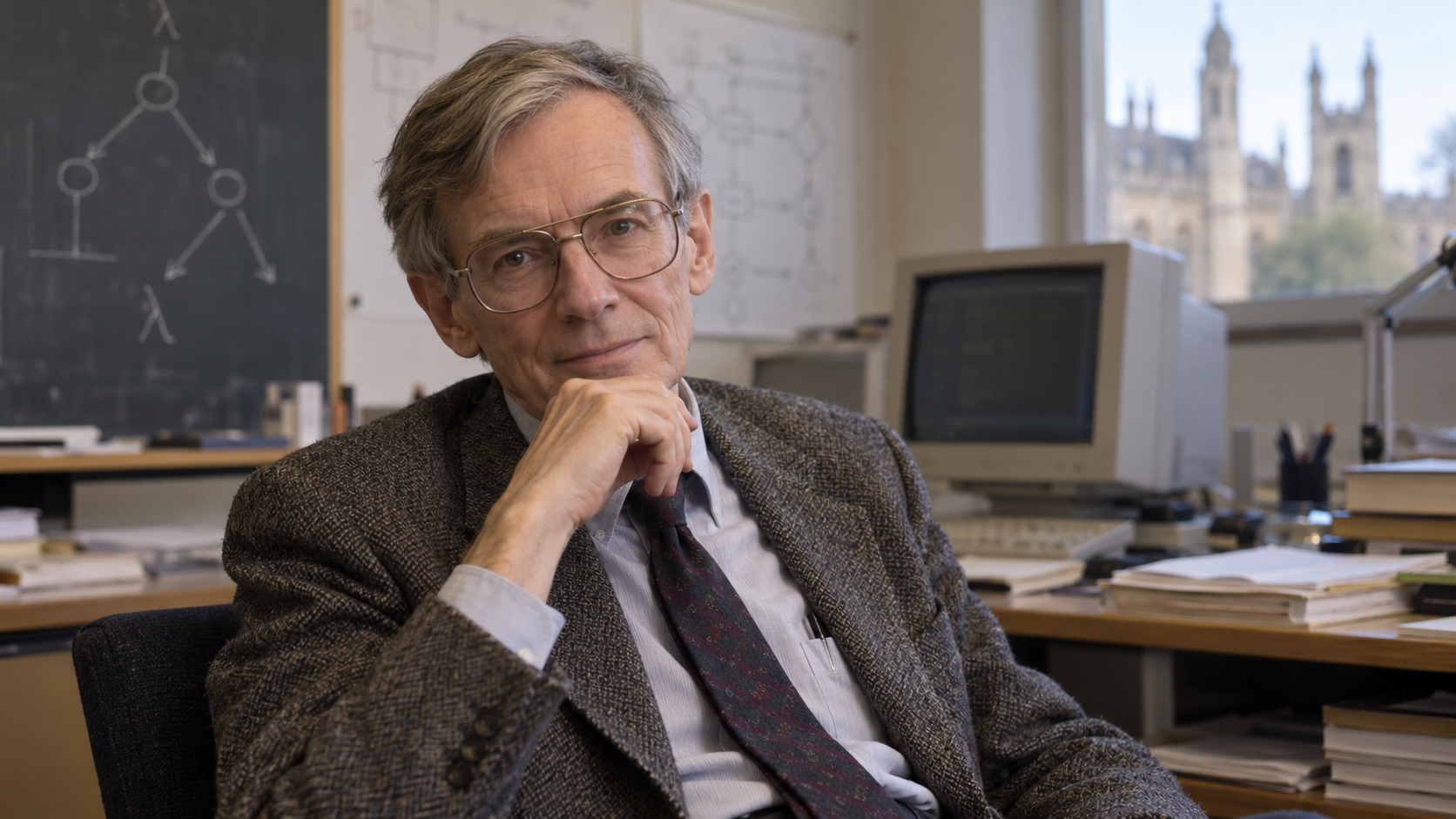
“Types are the leaven of computer programming; they make it digestible.”
Robin Milner supplied this memorable endorsement for Benjamin Pierce’s 2002 book Types and Programming Languages. Milner was well placed to make the comparison: his work on the ML language and type inference helped show how a language could infer useful type information without forcing programmers to annotate every expression. The metaphor of leaven is modest but precise. Leaven does not replace the ingredients of bread; it changes their structure. In programming, types organize values and operations so that a large body of code becomes easier for people and tools to reason about.
A type can describe something simple, such as a number or string, or something richer, such as a function, record, protocol state, or value that may be absent. The type system checks whether operations fit those descriptions and can reject combinations that would be nonsensical or unsafe. This catches some errors before a program runs and documents assumptions at the boundaries between components. Yet types do not prove that software is correct. A well-typed function can implement the wrong requirement, mishandle authorization, or produce a perfectly valid value at the wrong time. The guarantee is always limited to what the type system expresses.
Milner’s word “digestible” also points to human comprehension. A useful type signature summarizes how a piece of code may be used without exposing every implementation detail. Good types make invalid states difficult to represent and guide editors, refactoring tools, and reviewers. Badly designed types can do the opposite: complex abstractions, misleading names, or excessive cleverness may satisfy a compiler while confusing the team. The choice is not simply typed versus untyped. It is how much structure helps a particular domain, how clearly that structure communicates intent, and where runtime checks are still needed.
The lesson remains important as software systems combine generated code, external APIs, and data whose shape changes over time. Types can provide a disciplined boundary between uncertain input and trusted internal assumptions. They help teams notice when an AI-produced function calls an interface incorrectly, when a service response has changed, or when a supposedly optional field is treated as guaranteed. They are most effective alongside tests, validation, code review, and monitoring. Milner’s metaphor endures because it avoids grandiosity. Type systems are not the entire meal of software engineering, but they can transform a mass of instructions into something more structured, navigable, and safe to consume. Thoughtful error messages complete the benefit by showing developers how an assumption failed rather than merely reporting that a type could not be reconciled.
Milner’s sentence appears as an endorsement of Benjamin Pierce’s 2002 textbook Types and Programming Languages. Milner’s own research had made major contributions to type inference and ML.
The book connected diverse language features through type systems, matching Milner’s image of types as an ingredient that gives programming a more coherent structure.
Types describe categories of values and the operations allowed on them. They can expose mismatches early and summarize contracts between parts of a program.
A type checker proves only the properties encoded by its rules. Correct types cannot guarantee correct requirements, security, timing, or every behavior that matters to users.
Modern software crosses many boundaries among services, generated code, and changing data formats. Types help contain uncertainty and make interface changes visible to tools and developers.
The strongest practice combines expressive but understandable types with runtime validation, tests, review, and monitoring, using each method for the failures it can actually detect.
Explore more "Quotes of The Day"
Discover more notable quotes from influential voices across politics, science, business, technology, sports, and culture. Each quote offers insight into how ideas, beliefs, and decisions shape the world around us.