

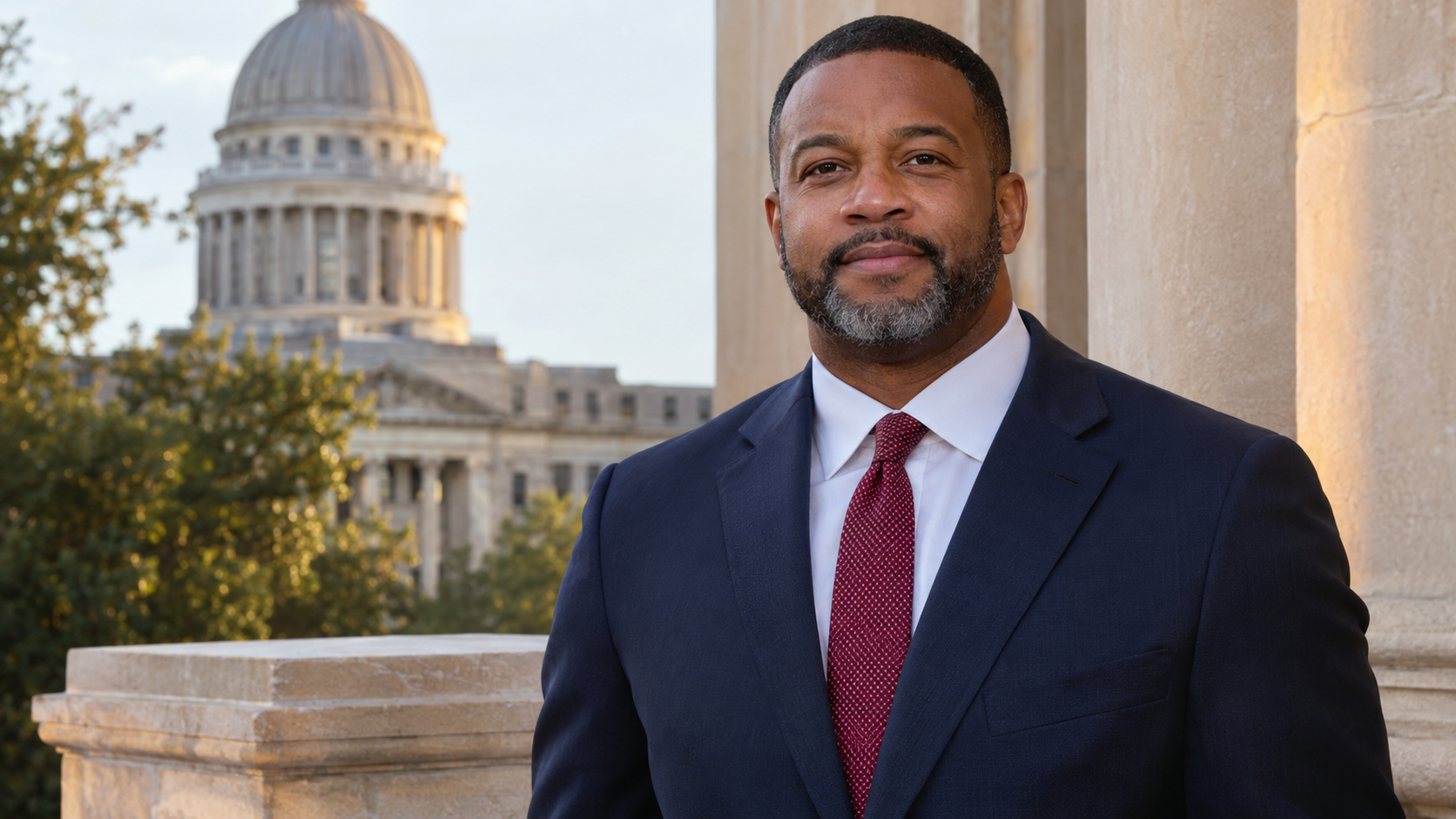
Trump Praises Scott Colom After Mississippi Senate Upset
President Donald Trump praised Mississippi senator-elect Scott Colom’s outreach to Republican voters after the Democrat’s projected victory over incumbent Sen. Cindy Hyde-Smith, a reversal from the attacks Trump directed at Colom during the campaign. The Associated Press called the race on Nov. 11 after counties processed absentee and affidavit ballots for more than a week. Hyde-Smith conceded that evening. Mississippi’s final statewide certification was still pending, so the reported totals remained unofficial.
Trump’s comments, made during a Nov. 12 podcast appearance, focused on Colom’s decision to walk the line outside a Trump rally in Corinth and speak with the president’s supporters. Trump credited the approach even though he had campaigned for Hyde-Smith and described Colom in sharply negative terms before the election. The exchange underscored the crossover strategy that helped Colom compete in a state Trump carried by about 23 percentage points in 2024.
The result is also a major historical milestone. Colom would become Mississippi’s first Black U.S. senator since Reconstruction and the first Democrat elected to the seat from the state since John Stennis in 1982. He is a 43-year-old district attorney from Columbus who has led Mississippi’s 16th Circuit Court District since winning election in 2015.
Why the race took more than a week to call
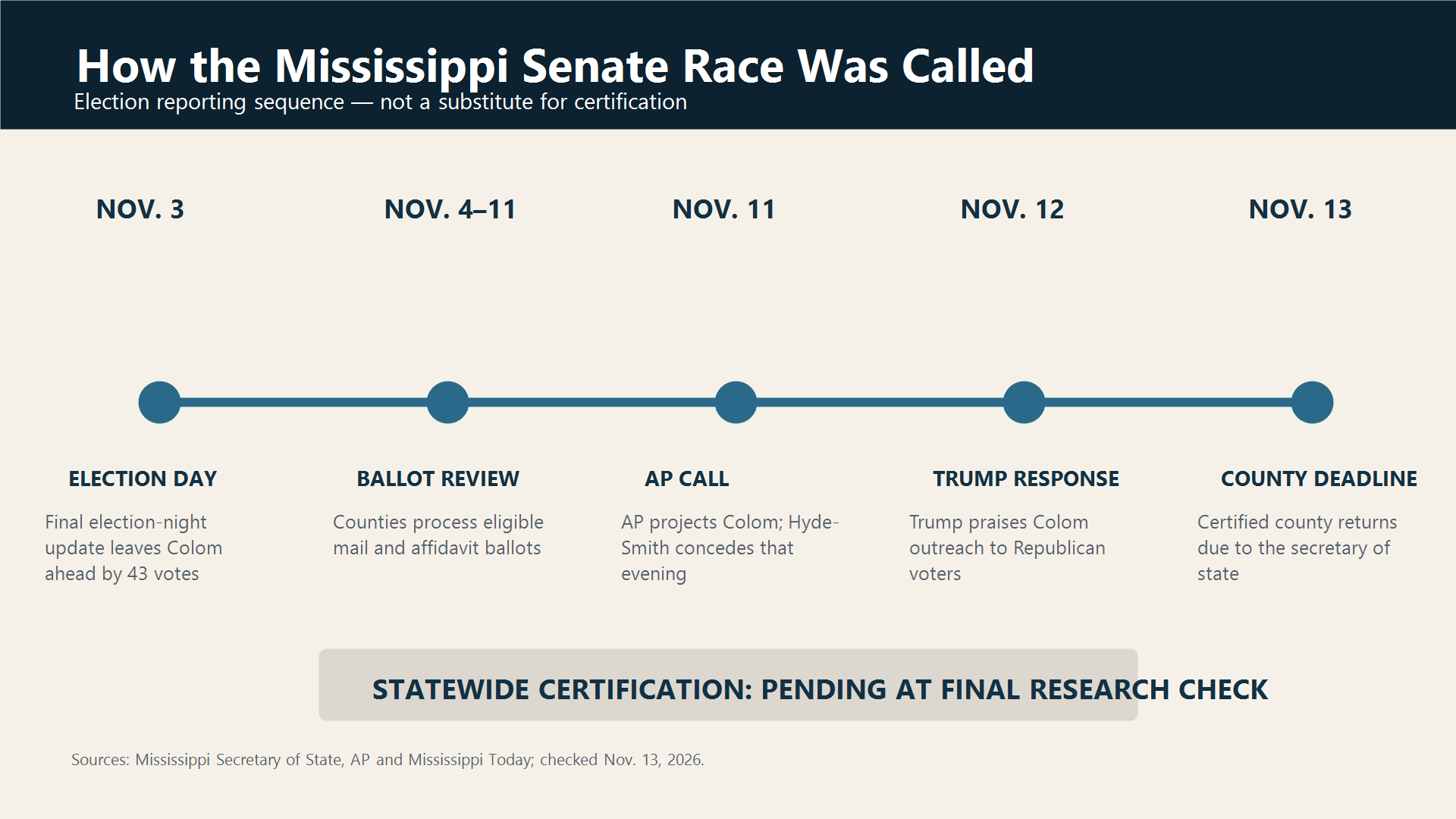
Mississippi does not operate a single centralized election-reporting system that immediately produces a final statewide total. County circuit clerks and election commissioners administer the count, and the secretary of state has described the system as bottom-up. The state said counties had ten days after the Nov. 3 election to submit certified results, making Nov. 13 the county deadline.
Colom led by 43 votes after the final election-night update, according to the AP’s explanation of its decision. Counties then reviewed mail ballots received within the legal deadline and affidavit ballots cast by voters whose eligibility required verification. Those updates generally favored Colom, and his lead expanded as the review continued.
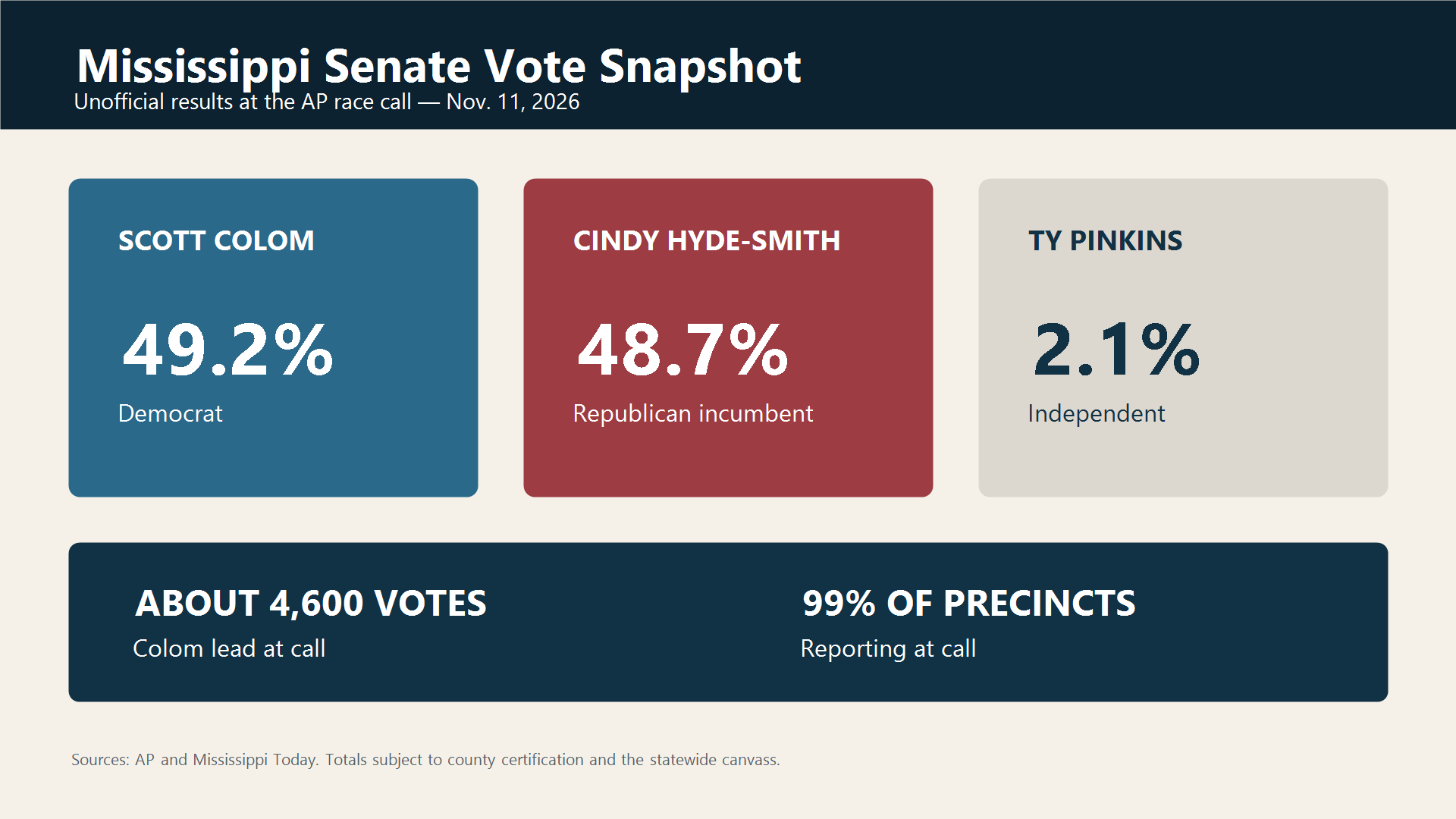
At the time of the AP call, Mississippi Today reported Colom ahead roughly 4,600 votes, 49.2% to 48.7%, with 99% of precincts reporting. Independent candidate Ty Pinkins received a little more than 2% in a separate results compilation. The AP call is a journalistic projection based on the remaining vote and the pattern of completed county updates; it is not the same as a state certification.
Hyde-Smith’s concession made the political outcome clearer. She said she respected the voters’ decision and wished Colom well. Mississippi has no automatic recount law for the Senate race. The AP reported that a candidate seeking a review would need to ask a court to order one. No such challenge had displaced the projected result as of the final research check.
How Colom built a winning coalition
Colom’s campaign tied national policy to household costs. He criticized tariffs, the Iran war and their effects on gasoline, farming and consumer prices, while presenting himself as a prosecutor focused on public safety and practical state concerns. He also argued that Hyde-Smith was not sufficiently visible or effective in Washington. Hyde-Smith’s campaign responded that Colom would empower national Democratic leaders and liberal donors.
The Democrat’s biography helped him resist simple ideological labeling. Colom was elected district attorney for a four-county circuit that includes Clay, Lowndes, Noxubee and Oktibbeha counties. His official biography says he expanded diversion and rehabilitation programs while prosecuting violent crime. President Joe Biden nominated him for a federal judgeship in 2022, but the nomination did not advance after Hyde-Smith withheld support.
During the Senate campaign, Colom worked to maximize Black turnout while seeking voters who normally support Republicans. Mississippi Today reported that he won DeSoto County by seven percentage points, flipped Lafayette and Madison counties and limited losses in Harrison County. The exact certified county margins will be the best record for evaluating that coalition, but the preliminary pattern shows he needed more than the traditional Democratic base.
Trump’s post-election praise highlighted that part of the strategy. Colom had approached people waiting for Trump’s rally, introduced himself and asked about their concerns. AP reporting described a campaign that challenged Trump’s policies without making personal attacks on his voters. Trump said after the election that the tactic deserved credit. The comment does not amount to a policy alliance, but it acknowledges that Colom won support in places where Democrats usually struggle.
Why the result is historically significant
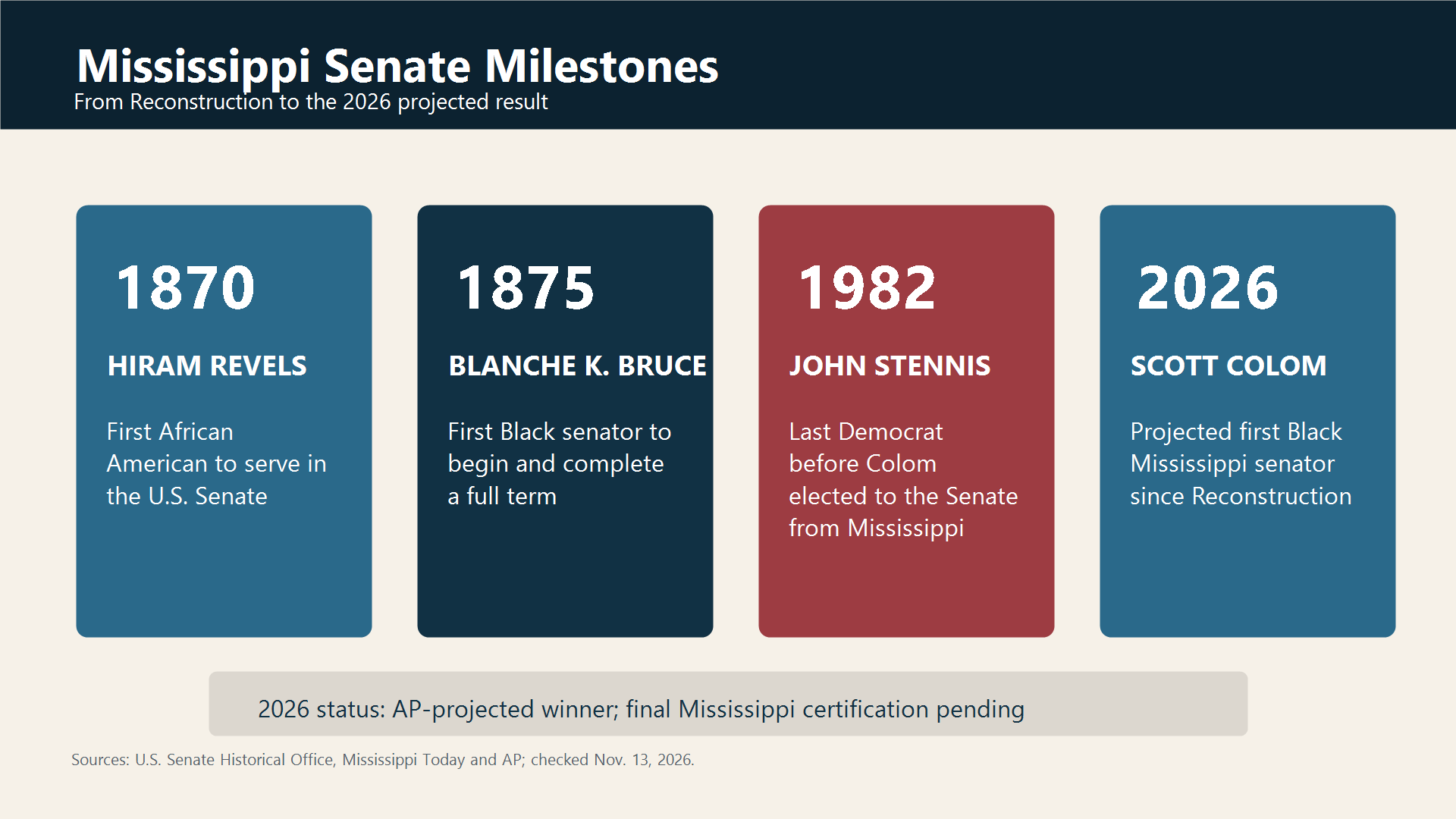
Mississippi has a distinctive place in the history of Black political representation. Hiram Revels of Natchez took the oath on Feb. 25, 1870, becoming the first African American to serve in the U.S. Senate. Blanche K. Bruce began a full term in 1875 and later became the first Black senator to preside over the chamber. Both served during Reconstruction, when the state Legislature selected senators.
Colom would be the first Black Mississippian elected by the state’s voters to the Senate. The long gap matters in a state where Black residents make up 36.8% of the population, according to the Census Bureau, but where Black candidates have not won statewide office in the modern era. His election does not end disparities in representation or political power, but it changes a record that had stood for nearly a century and a half.
The party shift is also notable. Hyde-Smith entered the Senate through an appointment in 2018 and won elections later that year and in 2020. Republicans had won Mississippi’s Senate contests for decades, and most forecasters treated the 2026 race as safely Republican. Colom’s victory contributes to a larger Democratic Senate majority projected after the midterms, although other unresolved races and final certifications determine the exact chamber count.
The comparison with Reconstruction requires care. Revels and Bruce were chosen by the state Legislature under the constitutional system then in effect, while Colom ran in a statewide popular election. Their careers arose from different institutions and political conditions, but the long interval between them shows how rarely Black Mississippians gained access to the state’s highest elected offices.
What the outcome means — and what it does not
The election shows that Mississippi can be competitive under a particular set of conditions: a favorable national environment for Democrats, an incumbent whose campaign struggled to respond, economic dissatisfaction, strong Black turnout and a challenger able to reduce Republican margins. It does not prove that the state has undergone a permanent partisan realignment. Trump’s 2024 margin and the GOP’s strength in state government remain important counterevidence.
It also does not establish one motive for voters who split their tickets. Some may have prioritized prices or health care; others may have responded to Colom’s prosecutorial record, campaign style or local roots. Trump’s praise suggests that outreach to his supporters was visible, but it does not reveal how many of those voters chose Colom or why. The certified returns can show where ticket splitting occurred, not each voter’s reason.
For the Senate, Colom’s arrival will affect the size and composition of the Democratic caucus. His positions on tariffs, rural health care, criminal justice and the Iran conflict will matter when the new Congress organizes. A larger majority can change committee ratios and the difficulty of moving nominations or legislation, but chamber rules and disagreements within a caucus still limit what any majority can do.
What happens next
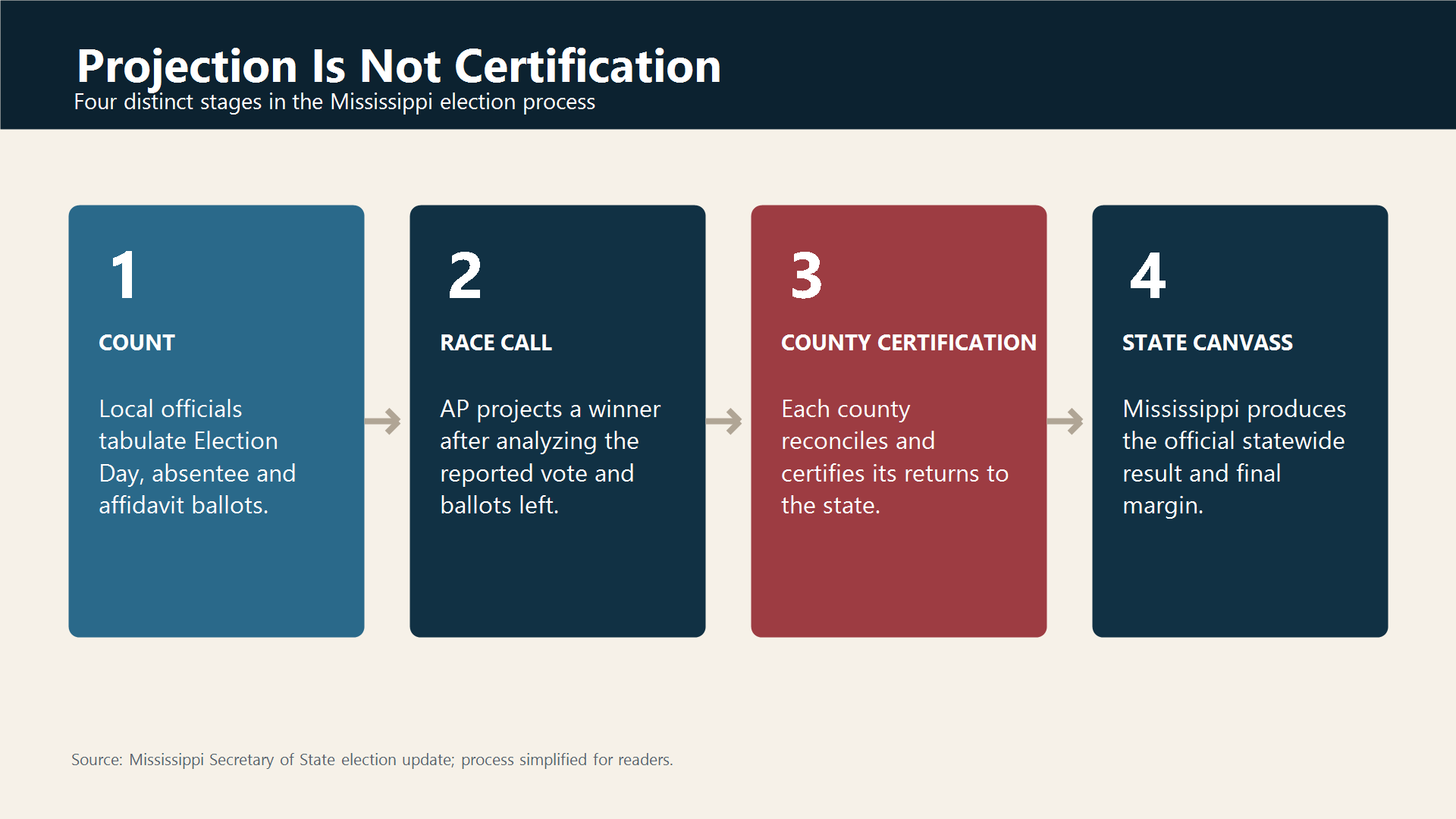
The next official steps are county certification, the statewide canvass and preparation of the final election record. Readers should expect the final totals to differ slightly from the snapshot used when the AP called the race. Certification is the legal confirmation of the result; the AP projection and concession establish the political expectation before that process is complete.
Colom will then prepare to take office when the new Congress convenes in January. His transition will include staffing, committee preferences and constituent services. Hyde-Smith remains the sitting senator until the current term ends. The distinction matters because senator-elect describes the projected winner of the next term, not someone who already holds the office.
Mississippi’s 2027 state elections will provide an early test of whether the coalition behind Colom can be repeated. For now, the verified conclusion is narrower: a Democrat built a lead that the AP judged insurmountable, the Republican incumbent conceded, Trump praised the winner’s crossover outreach, and the state’s formal certification process remained the final administrative step.
Colom’s Mississippi Win Expands Representation and Tests Voting Access
Scott Colom’s projected victory in Mississippi’s U.S. Senate race is a political upset with consequences that extend beyond one seat. The Associated Press called the race for the Democratic district attorney on Nov. 11, eight days after Election Day, after counties processed late-arriving absentee ballots and affidavit ballots. Republican Sen. Cindy Hyde-Smith conceded and congratulated him. The totals were still unofficial pending the state’s certification process, but the remaining ballots were not expected to overcome Colom’s lead.
The result is historic because Mississippi has not sent a Black senator to Washington since Reconstruction. Hiram Revels took office in 1870 as the first African American to serve in the U.S. Senate, and Blanche K. Bruce began a full term in 1875. Colom would follow them more than 145 years later. He also would become the first Democrat elected to the Senate from Mississippi since John Stennis won reelection in 1982 and the first Black candidate elected to statewide office in Mississippi since Reconstruction.
That history gives the outcome special weight in a state where Black residents account for 36.8% of the population, according to the Census Bureau, but where statewide offices have remained overwhelmingly Republican for decades. The result does not erase the state’s racial disparities or prove that every political barrier has fallen. It does demonstrate that a statewide coalition anchored by Black voters can prevail when turnout, persuasion and dissatisfaction with the incumbent converge.
A count decided through local election administration
Mississippi’s election system is unusually decentralized. County circuit clerks and election commissioners administer the count, and the secretary of state described the state as a bottom-up system. Counties had ten days after the Nov. 3 election to certify their returns to the state, setting Nov. 13 as the county deadline. That process included mail ballots received within the legal window and affidavit ballots cast by voters whose eligibility required later review.
Colom led by only 43 votes after the final election-night update, according to the AP’s race-call explanation. His margin grew as counties reviewed ballots that had not been included in the first totals. By the time the AP called the race, reporting compiled by Mississippi Today showed him ahead about 4,600 votes, 49.2% to 48.7%, with 99% of precincts reporting. Independent candidate Ty Pinkins received the remaining share. Those figures were not a certified state canvass and could still change slightly.
The extended count illustrates why voters should distinguish a slow count from a suspect count. Election officials were following state timelines for mailed and affidavit ballots rather than discovering a new category of votes after Election Day. A transparent explanation of those rules is especially important when a close margin changes as legally cast ballots are verified. The public record supports scrutiny of the process, but the existence of late reporting alone is not evidence of misconduct.
Mississippi does not provide an automatic statewide recount mechanism for this contest. The AP reported that a candidate seeking a review would have to persuade a court to order one. Hyde-Smith’s concession reduced the likelihood of an immediate challenge, although the state’s formal certification remains the legal step that converts the county returns into the official statewide result.
Representation and the meaning of the coalition
Colom’s path combined high participation in heavily Black communities with improved performance in places Democrats normally lose. Local reporting credited him with winning DeSoto County, a populous Republican-leaning suburban county, and flipping Lafayette and Madison counties while limiting losses along the Gulf Coast. The coalition was not simply a larger version of the traditional Democratic base. It included voters who had supported President Donald Trump and who were open to splitting their tickets.
Trump acknowledged that crossover effort after the election. During a Nov. 12 podcast appearance, he praised Colom for walking the line outside a Trump rally in Corinth and speaking with the president’s supporters. The comment was striking because Trump had attacked Colom while campaigning for Hyde-Smith. Colom’s strategy was to criticize administration policies that he said increased household costs while avoiding broad attacks on people who had voted for Trump.
From a progressive perspective, the strongest lesson is that representation and persuasion can reinforce each other. Colom emphasized the cost of living, rural hospitals, wages and the effects of tariffs and war on household expenses. Those issues connected racial and geographic communities without requiring voters to agree on every national Democratic position. His experience as district attorney in a four-county circuit also gave him a public-safety résumé that complicated Republican attempts to portray him as outside Mississippi’s political mainstream.
The result also highlights the importance of local organizing and durable civic institutions. Colom celebrated at Tougaloo College, a historically Black institution connected to Mississippi’s civil-rights history. His campaign drew on relationships with elected officials and community leaders built over years rather than appearing only during the final weeks. National attention and outside spending arrived late, but the candidate had already established a record as a prosecutor and a statewide message centered on economic pressure.
What the result does not establish
One victory is not proof that Mississippi has become a reliably Democratic state. Trump carried the state by roughly 23 percentage points in 2024, Republicans retain substantial strength in state government, and the circumstances of the 2026 midterm were unusually difficult for the president’s party. Colom also faced an incumbent whose understated campaign became a liability as the race tightened. Future Democratic candidates will not necessarily reproduce the same coalition.
The vote also should not be treated as evidence that every Black voter, rural voter or crossover Republican had the same motive. Some may have responded to economic conditions, some to Colom’s biography and prosecutorial record, some to dissatisfaction with Hyde-Smith and others to the national balance of power. Reporting can identify patterns, but it cannot assign a single explanation to nearly a million individual ballots.
Nor does symbolic representation substitute for policy. Colom will enter a Senate with a Democratic majority if the projected national results hold, but the effectiveness of that majority will depend on leadership, committee assignments, chamber rules and negotiations with a Republican president. Voters who supported him will judge whether his office improves access to federal services, protects voting rights and addresses the economic and health-care issues emphasized during the campaign.
The next accountability test
The immediate next step is administrative rather than ideological: counties must submit certified results, the state must complete its canvass and Colom must take the oath when the new Congress convenes. The certified totals will provide the authoritative margin and county-level record. Until then, descriptions of the vote should identify the AP call and Hyde-Smith’s concession without presenting preliminary numbers as final.
After certification, the larger test will be whether this election widens participation in a durable way. Mississippi will hold statewide and legislative elections in 2027. Campaigns in both parties will study which communities turned out, where ticket splitting occurred and whether voters who supported Colom remain engaged. Progressives will see an opening for a broader multiracial coalition; skeptics will see a singular midterm upset. The evidence needed to decide between those interpretations will come from future elections and from Colom’s performance in office.
Colom’s Upset Tests GOP Strategy and Cross-Party Voter Outreach
Scott Colom’s projected victory over Republican Sen. Cindy Hyde-Smith gives conservatives a difficult but useful case study. Mississippi remains a strongly Republican state, yet a Democratic challenger appears to have won a U.S. Senate seat by combining high turnout in Democratic communities with an appeal to voters who normally back the GOP. The Associated Press called the race on Nov. 11, Hyde-Smith conceded, and President Donald Trump later praised Colom’s willingness to campaign directly among Trump supporters.
The reported result was not yet the state’s certified total. Mississippi counties had until Nov. 13 to submit certified returns, and the statewide canvass remained pending. That distinction should matter to anyone concerned with election integrity. A media call can establish that a news organization believes the outcome is mathematically secure, but the legal authority rests with election officials and the certification process.
At the same time, there was no public evidence that the extended count represented an irregular process. Mississippi is a bottom-up election state in which county officials process absentee and affidavit ballots under state deadlines. Colom’s lead grew as those ballots were reviewed. Hyde-Smith accepted the outcome, and Mississippi does not provide an automatic recount in this contest. A candidate seeking further review would have to obtain a court order.
A warning about candidate quality and retail politics
Republicans entered the race with major structural advantages. Trump carried Mississippi by about 23 percentage points in 2024, Republicans controlled every statewide office, and most forecasters viewed Hyde-Smith as safe. A loss under those conditions cannot be explained only by national headwinds. It suggests the party misjudged the contest and relied too heavily on partisan loyalty.
Colom had a profile that made standard attacks less effective. He was a three-term district attorney in a four-county circuit and could point to experience prosecuting violent crime as well as operating diversion programs. That record allowed him to speak about public safety without sounding like a national activist. He emphasized cost-of-living concerns, rural hospitals, wages and the effects of tariffs and the Iran war on Mississippi households.
Hyde-Smith’s campaign argued that Colom would strengthen national Democratic leaders and interests outside the state. That message did not prevent him from winning crossover support. Local reporting found that he carried DeSoto County and flipped Lafayette and Madison counties while limiting losses elsewhere. The final certified returns will provide the authoritative county record, but the preliminary pattern indicates a candidate problem as well as a party problem.
Trump’s reaction reinforces that lesson. During the campaign, he attacked Colom while rallying for Hyde-Smith. After the election, he credited the Democrat for walking the line outside the Corinth rally and speaking to people waiting to hear the president. Colom did not hide his disagreements with Trump, but he treated Trump voters as people worth persuading. That approach earned attention and appears to have helped him separate his opponent from the president’s full support.
For Republicans, the danger is assuming that presidential voting patterns automatically transfer to every Senate candidate. Voters can support Trump and reject a Republican senator whom they view as distant or ineffective. A durable majority requires candidates who maintain local visibility, explain what they have delivered and respond to economic conditions rather than relying on party labels alone.
What conservatives should ask about the count
The close margin makes careful procedure essential. Colom led by only 43 votes after the final election-night update. His lead expanded when counties processed mail and affidavit ballots. The AP waited more than a week to call the race and said the remaining vote could not reasonably erase the advantage. Mississippi Today reported a lead of about 4,600 votes, 49.2% to 48.7%, at the time of the call.
Those numbers should be described as an unofficial snapshot, not a permanent total. Counties are the primary election administrators, and each must reconcile ballots before transmitting certified returns. The state then produces the official statewide record. The proper conservative response is to demand transparent reconciliation and compliance with law while avoiding claims that a changing count is inherently illegitimate.
The distinction protects both sides. If late-reporting ballots favor one candidate, officials should document why they were eligible and how they were processed. If a candidate wants judicial review, the claim should identify a specific legal or factual basis. A general suspicion based only on the timing of reported results is not enough to establish an error, much less misconduct.
Institutional consequences in Washington
Colom’s projected win contributes to a larger Democratic Senate majority. The precise national balance depends on remaining races and certifications, but a larger majority can affect committee ratios, scheduling and the ability to move nominations. Conservatives should prepare for stronger congressional oversight of the Trump administration and for legislation that reflects the priorities of a Democratic-led chamber.
That does not mean Democrats will be able to enact their entire agenda. The Senate still operates through rules that require coalition building, the House will have its own priorities, and Trump retains the presidency. Colom’s campaign presented him as a pragmatic Mississippian, but his actual votes will determine whether that promise translates into independence from party leadership.
His background suggests that criminal justice and rural policy may become areas of emphasis. As district attorney, he combined prosecution with diversion and rehabilitation programs. During the campaign, he focused on rural hospitals and household costs. Republicans can work with him where state interests align while holding him accountable for votes that expand federal power, spending or regulation beyond what Mississippi voters expected.
History without a partisan verdict
Colom would be Mississippi’s first Black senator since Hiram Revels and Blanche Bruce served during Reconstruction. He would also be the first Democrat elected to the Senate from the state since 1982. Those are genuine historical milestones. Recognizing them does not require treating the result as an endorsement of every Democratic policy or a rejection of conservative government.
Mississippi’s political history also cautions against easy realignment claims. Black residents make up 36.8% of the state population, but statewide coalitions depend on turnout and significant support beyond the Democratic base. The 2026 midterm occurred amid economic dissatisfaction and unusual national conditions. Republicans may recover if they nominate stronger candidates and address the concerns that moved crossover voters.
Colom now faces the burden that comes with an upset. He campaigned as someone willing to listen across party lines. In office, voters will measure that claim through constituent service, committee work and votes on the economy, war powers, judges and federal spending. Trump’s praise is best understood as recognition of effective campaigning, not an endorsement of Colom’s agenda.
The next test for both parties
The first next step is certification. The final county returns and statewide canvass will establish the official margin and give analysts a reliable basis for studying turnout and ticket splitting. Colom is senator-elect, not yet the sitting senator, and Hyde-Smith remains in office until the term ends.
After that, Republicans must decide whether to treat the loss as a one-time anomaly or a warning about state-level political discipline. Democrats must decide whether Colom’s approach can travel to other conservative states without losing credibility with their own base. Mississippi voters will get the clearest answer from performance rather than campaign interpretation.
The narrowest verified conclusion is also the most useful: a Republican incumbent lost a race her party expected to win, a Democrat built an unusual coalition, the incumbent conceded, and the Republican president acknowledged the winner’s outreach. Conservatives who want to prevent a repeat should study the candidate and the campaign instead of assuming that Mississippi’s partisan history will correct the problem on its own.
FACT CHECK
- Claim: Colom’s vote total is already final. Evidence: False. The AP projected the result, but Mississippi’s statewide certification remained pending.
- Claim: Late-counted ballots appeared outside the legal process. Evidence: Unsupported. Counties were processing mailed and affidavit ballots under published state deadlines.
- Claim: Trump endorsed Colom. Evidence: False. Trump campaigned for Hyde-Smith; after the election he praised one element of Colom’s voter outreach.
- Claim: One result proves Mississippi permanently realigned. Evidence: Not established. The state remains strongly Republican in recent presidential and statewide voting.

Explore Related Streets
Discover interconnected perspectives across the Knowledge Streets —each Street brings its own lens to the political landscape.

Politics Street
Politics Street covers campaigns, elections, legislation, and the shifting dynamics shaping power in America and beyond.

Government Streets
Policy, budgets, agencies, and oversight across federal, state, and local government—plain-English explainers and timely analysis.

Defense Street
Daily defense posture, procurement, readiness, strategy, and technology—curated updates for leaders and curious citizens.

Left Streets
Progressive politics, policy ideas, movement priorities, and media framing—news and analysis from the left lane.

Right Streets
Conservative politics, policy priorities, movement debates, and media framing—news and analysis from the right lane.

Citizen Streets
How government affects everyday life—services, rights, civic tools, and practical guides to participate with confidence.
More in Politics

Explore our other Politics related sites:
Politics Street
Government Streets
Constitution Street
Defense Street
Left Streets
Right Streets
Citizen Streets
News Street Network

