

On This Day in Science: January 5, 2005
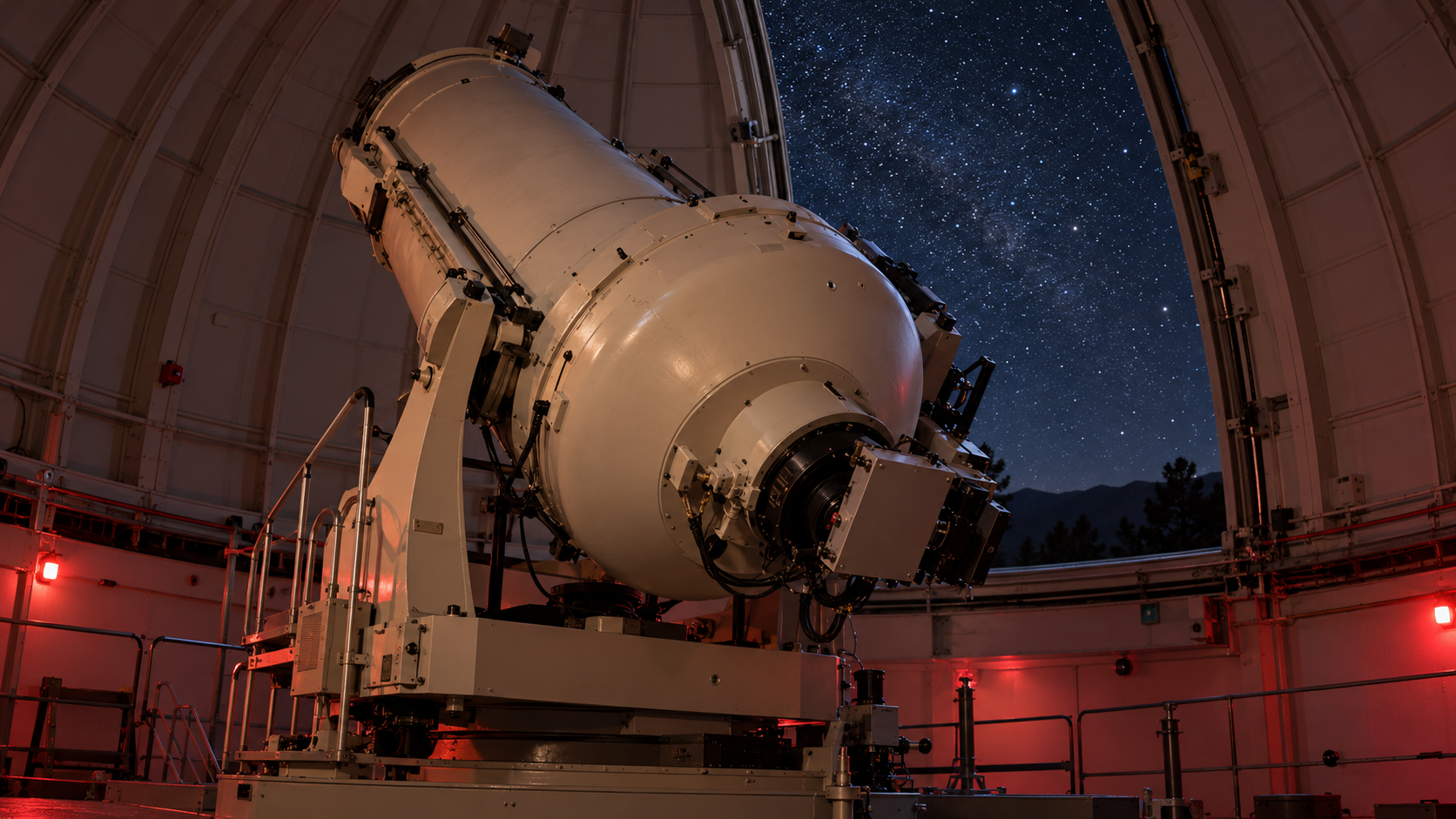
On January 5, 2005, astronomers Mike Brown of the California Institute of Technology, Chad Trujillo of Gemini Observatory, and David Rabinowitz of Yale University identified a distant moving object that would become known as Eris. The team found it while reexamining digital images taken on October 21, 2003, with the 48-inch Samuel Oschin Telescope at Palomar Observatory in California. The survey repeatedly photographed large areas of sky so software and researchers could look for faint points that shifted against the background stars. Eris moved so slowly because of its immense distance that it had escaped the team’s initial screening, but the January review revealed a body orbiting far beyond Neptune.
The object first carried the provisional designation 2003 UB313 and the informal nickname Xena. Follow-up observations showed that it was comparable in size to Pluto and more massive, creating an immediate classification problem. If Pluto was a planet, a world like Eris appeared to have a strong claim to the same status, and surveys were beginning to reveal other sizable objects in the region beyond Neptune. Eris also has a small moon, later named Dysnomia, whose orbit allowed astronomers to calculate the dwarf planet’s mass. Because Eris is so remote, direct images show little more than a point of light; most knowledge of its surface and composition comes from measurements of reflected light, heat, and occultations.
Eris follows a highly elongated and tilted orbit and is, on average, about 68 times farther from the Sun than Earth. A trip around the Sun takes roughly 557 Earth years. Its surface is extremely cold and is thought to contain frozen methane, while its diameter is about 2,400 kilometers, close to Pluto’s. Those figures were refined after the discovery, and early size estimates carried substantial uncertainty. The science was therefore not a single dramatic photograph but a chain of careful comparisons: detecting motion, confirming the orbit, measuring brightness, finding the moon, and improving estimates of size and mass.
The discovery forced astronomers to decide whether the solar system contained a growing number of planets or whether its categories needed revision. In 2006, the International Astronomical Union adopted a definition that requires a planet to clear the neighborhood around its orbit. Pluto and Eris did not meet that criterion and were classified as dwarf planets. The decision remains culturally controversial, but it gave researchers a framework for describing a newly recognized population of distant worlds. Eris made that debate unavoidable, showing how one faint point in archived survey images could change the vocabulary used to describe the solar system.
The discovery came from comparing survey images taken more than a year earlier, not from seeing a resolved planet-like disk through the telescope.
Eris moved unusually slowly across the images because of its distance, so the team had to broaden its search for subtle motion.
Eris appeared comparable to Pluto in size and proved more massive, challenging any definition that treated Pluto as a planet but excluded similar distant bodies.
Measurements improved over time, illustrating why classification could not rest on an early brightness estimate alone.
The 2006 IAU definition placed both Eris and Pluto among dwarf planets because neither had cleared other objects from its orbital neighborhood.
That decision organized a rapidly expanding inventory of outer-solar-system worlds while keeping debate about planetary categories alive.
Explore more of "On This Day ..."
Discover more events from the same date across news, politics, technology, sports, and other fields. Each link highlights significant moments that shaped history on different fronts.