

On This Day in Science: January 7, 1610
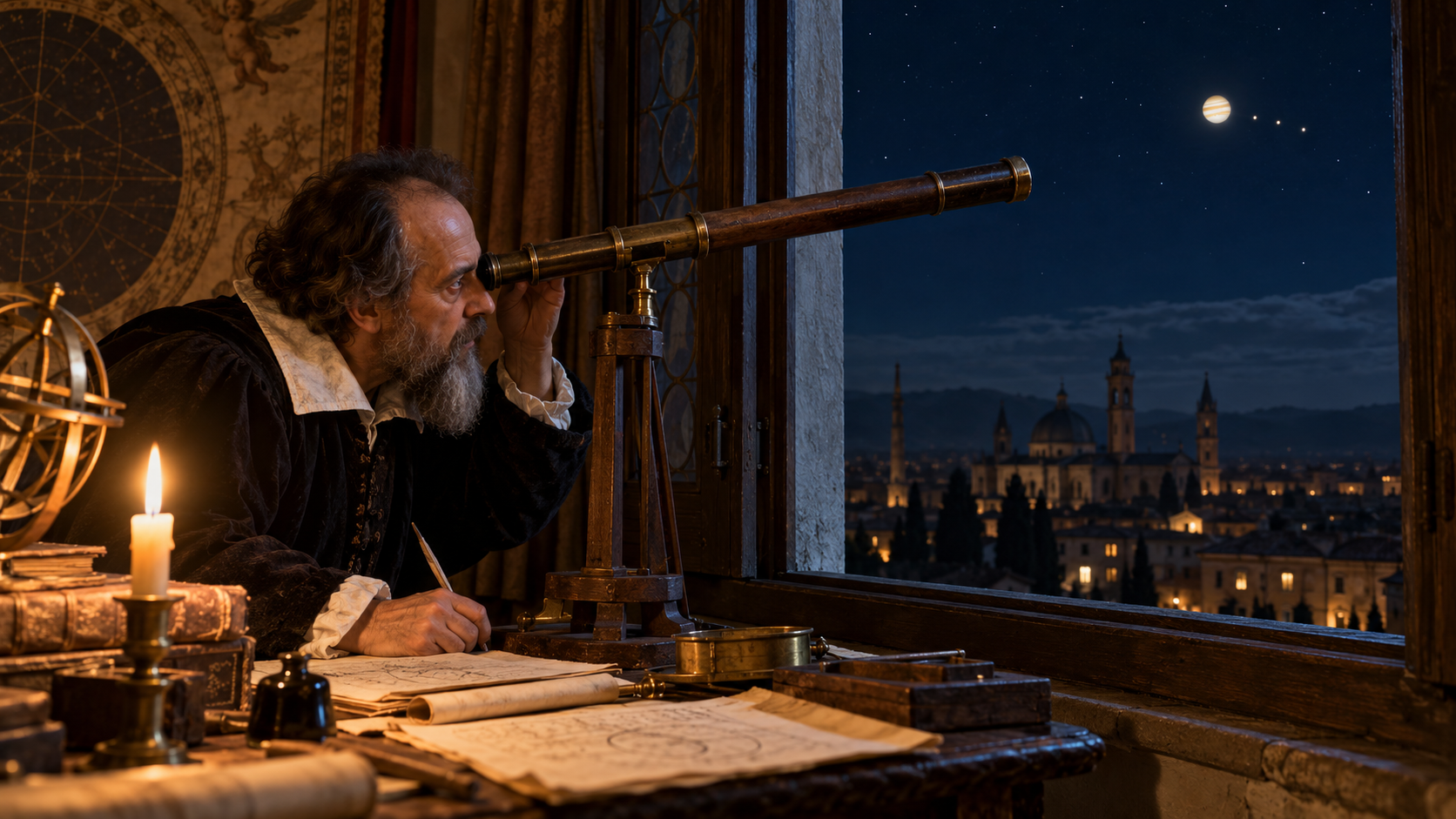
On January 7, 1610, Galileo Galilei aimed an improved telescope at Jupiter from Padua and noticed three small points of light arranged near the planet. They were too faint to see with the unaided eye, and at first he described them as fixed stars. His instrument was modest by modern standards, magnifying roughly twenty times, but it gathered enough light and resolved enough detail to expose a pattern no observer had recorded clearly before. Galileo drew the points in his notebook and returned to Jupiter on later nights, turning a single surprising view into a sequence of measurements.
The pattern refused to behave like distant background stars. The lights changed position from night to night yet remained close to Jupiter, sometimes appearing on one side and sometimes on the other. On January 10 Galileo saw one point disappear, likely hidden by the planet, and on January 13 he recorded four objects. By January 15 he concluded that the bodies moved around Jupiter. They are now known as Io, Europa, Ganymede, and Callisto, collectively the Galilean moons, although the names were proposed later by Simon Marius. Galileo published his observations in Sidereus Nuncius, or The Starry Messenger, in March 1610.
The finding mattered because it provided a visible example of motion around a center other than Earth. It did not by itself prove that Earth circles the Sun, and early telescopic observations could be difficult to reproduce with uneven instruments. Still, the moons weakened a common objection to the Copernican system: if Earth moved, critics asked, how could it keep its Moon? Jupiter showed that a moving world could carry satellites with it. Continued observations also gave astronomers a natural clock; predicted eclipses of the moons later helped improve longitude measurements and studies of the speed of light.
Galileo’s January 7 observation became a model for telescopic science. The important act was not merely seeing unfamiliar lights but recording their relative positions, repeating the observation, and accepting the explanation that best fit the changing geometry. Modern spacecraft have since revealed volcanic Io, ice-covered Europa, giant Ganymede, and cratered Callisto as distinct worlds. Their scientific richness extends far beyond the argument that first made them famous, yet every close view traces back to the patient series of sketches begun that winter night beside Jupiter. The discovery also showed how a new instrument can change the questions scientists are able to ask, provided that surprising views are checked across time rather than trusted as isolated impressions.
Three faint points appeared in a straight line near Jupiter on January 7, while later observations revealed a fourth.
Their changing positions, combined with their continuing closeness to Jupiter, showed that they were orbiting the planet rather than fixed stars.
The system demonstrated that not every celestial body revolved around Earth and answered an important objection to a moving Earth.
It supported, but did not alone prove, the Sun-centered model that Galileo defended.
Io, Europa, Ganymede, and Callisto later became major subjects of planetary science, each with a different surface and interior.
Their eclipses also served astronomy as predictable events for timing, navigation research, and measurements of light's travel time.
Explore more of "On This Day ..."
Discover more events from the same date across news, politics, technology, sports, and other fields. Each link highlights significant moments that shaped history on different fronts.