

On This Day in Science: January 10, 1946
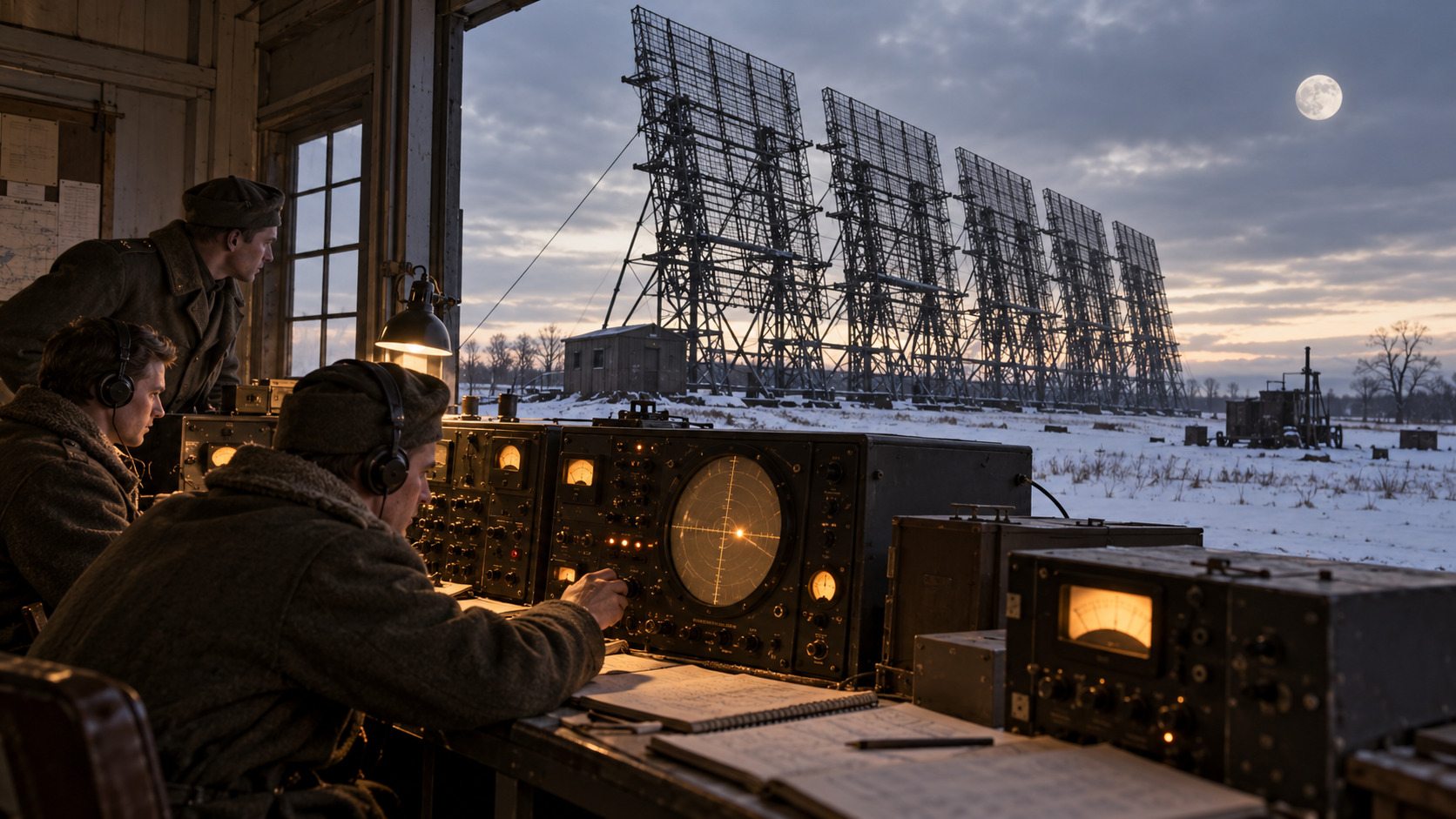
On January 10, 1946, engineers with the U.S. Army Signal Corps transmitted radar pulses from the Evans Signal Laboratory in New Jersey and detected echoes from the Moon. The experiment, called Project Diana, used equipment adapted from wartime radar under the direction of Lieutenant Colonel John H. DeWitt Jr. Its antenna array was built from a group of dipoles mounted on a large frame, and its transmitter operated near 111.5 megahertz. About two and a half seconds after a pulse left Earth, a faint return appeared, matching the round-trip travel time to the Moon.
Reaching the Moon required more than simply increasing transmitter power. The team had to account for the Doppler shift caused by Earth’s rotation, predict when the Moon would pass through the antenna’s limited steering range, and separate an extremely weak echo from noise. Earlier efforts, including DeWitt’s own prewar attempt, had not produced a dependable result. On the morning of January 10 the operators repeated the measurement as the Moon rose, and the delay of the echoes changed in the expected way. The repeatability distinguished a lunar reflection from interference or a local signal.
Project Diana demonstrated that very-high-frequency radio waves could pass through the ionosphere, travel through space, strike another world, and return information to Earth. That result helped establish radar astronomy, in which reflected signals reveal the distance, motion, rotation, and surface properties of solar-system bodies. The equipment could not make a detailed lunar map, and the first echoes were fragile traces on instruments, not pictures. Its importance was physical and practical: the path through the upper atmosphere was open, and celestial targets could be studied actively rather than only by collecting light they emitted or reflected naturally.
The experiment also influenced communications and tracking. Techniques developed for Moon-bounce research contributed to thinking about radio links beyond Earth, while later radar systems measured planets, asteroids, and the Moon with far greater precision. Project Diana did not itself create satellite communication, but it showed that radio engineers could calculate and manage a signal path on a planetary scale. Conducted only months after World War II, the January 10 test redirected radar technology toward astronomy and spaceflight. The returning pulse was tiny, yet it marked the first deliberate radar contact between Earth and another celestial body. It also joined laboratory planning with celestial mechanics, since the Moon’s motion and Earth’s rotation had to be treated as parts of the instrument.
A radar pulse needed about two and a half seconds to travel to the Moon and back, producing a predictable delay.
Repeated returns as the Moon crossed the antenna beam showed that the signal was a reflection rather than local interference.
The team adapted wartime radar, predicted the Moon's path, and compensated for Doppler shift from Earth's rotation.
The returning energy was extraordinarily weak, so timing and careful noise control mattered as much as transmitter power.
Project Diana proved radio waves could cross the ionosphere and made active study of celestial bodies practical.
Later radar astronomy and space communications refined the same principles for mapping, ranging, tracking, and data links.
Explore more of "On This Day ..."
Discover more events from the same date across news, politics, technology, sports, and other fields. Each link highlights significant moments that shaped history on different fronts.