

On This Day in Science: January 14, 2005
On January 14, 2005, the European Space Agency’s Huygens probe entered the atmosphere of Titan, Saturn’s largest moon, and made the first landing on a world in the outer solar system. Huygens had traveled for more than seven years attached to NASA’s Cassini orbiter. After separating on December 25, 2004, it coasted toward Titan in silence. At atmospheric entry, a heat shield protected the probe at about 5.4 kilometers per second. A sequence of parachutes then slowed the descent so six instruments could sample the moon’s thick nitrogen-rich air.
During two hours and twenty-seven minutes beneath the parachutes, Huygens measured temperature, pressure, winds, aerosols, atmospheric gases, and light. Its camera system photographed branching channels, bright uplands, and darker plains through the orange haze. Cassini received the probe’s data and relayed it to Earth. One communications channel was lost because a receiver command had not been activated, reducing the number of images, but overlapping observations and direct radio tracking from Earth preserved much of the mission. The landing occurred at about 11:38 UTC, only a few kilometers from the planned point.
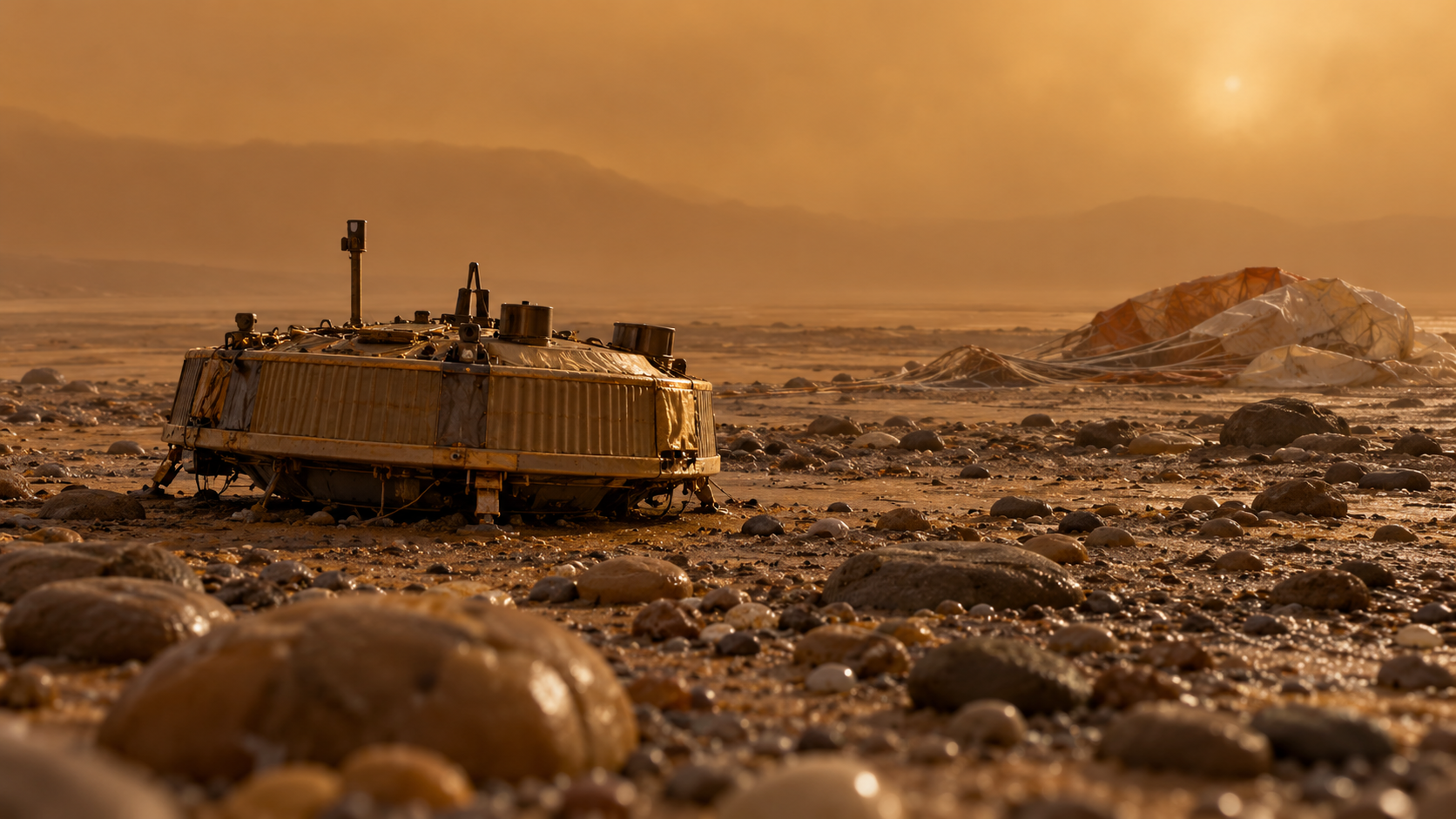
Huygens struck the surface at roughly 4.5 meters per second and survived. The ground was neither an open sea nor hard rock; measurements and images suggested a damp, sandlike mixture covered with rounded chunks of water ice. The probe transmitted from the surface for more than an hour while Cassini remained above the horizon. Chemical data revealed methane cycling through Titan’s atmosphere, while the landscape showed features shaped by flowing liquid. At Titan’s cold temperatures, methane can play roles that water performs on Earth, evaporating, forming clouds, raining, and carving channels.
The landing turned Titan from a hazy orange disk into a place with weather, drainage networks, sediments, and a recognizable horizon. Huygens operated for only a few hours, and it sampled one location, so broad conclusions required Cassini’s later radar and infrared mapping. Together, the missions revealed lakes and seas of hydrocarbons near Titan’s poles and a complex organic atmosphere. The January 14 descent remains the most distant landing ever achieved. It demonstrated the scientific power of international cooperation and showed that even under unfamiliar chemistry and extreme cold, another world can display landscapes built by active cycles. Its brief surface record now anchors interpretations of observations collected across an entire moon. Future rotorcraft exploration can test how representative that single landing site really was. Until then, every new Titan model remains tied to this compact ground truth.
Huygens used a heat shield and three parachutes to slow down while instruments sampled Titan's air from high altitude to the surface.
Cassini served as the relay because the small probe could not send its full science return directly to Earth.
Images showed rounded water-ice cobbles and terrain shaped by channels, while impact measurements suggested a soft, damp surface.
The scene resembled familiar river processes even though methane, not liquid water, drives much of Titan's weather.
No spacecraft has landed farther from Earth, and the probe continued transmitting well beyond its required surface lifetime.
Huygens and Cassini together revealed Titan as an active world with weather, organic chemistry, dunes, and hydrocarbon seas.
Explore more of "On This Day ..."
Discover more events from the same date across news, politics, technology, sports, and other fields. Each link highlights significant moments that shaped history on different fronts.