

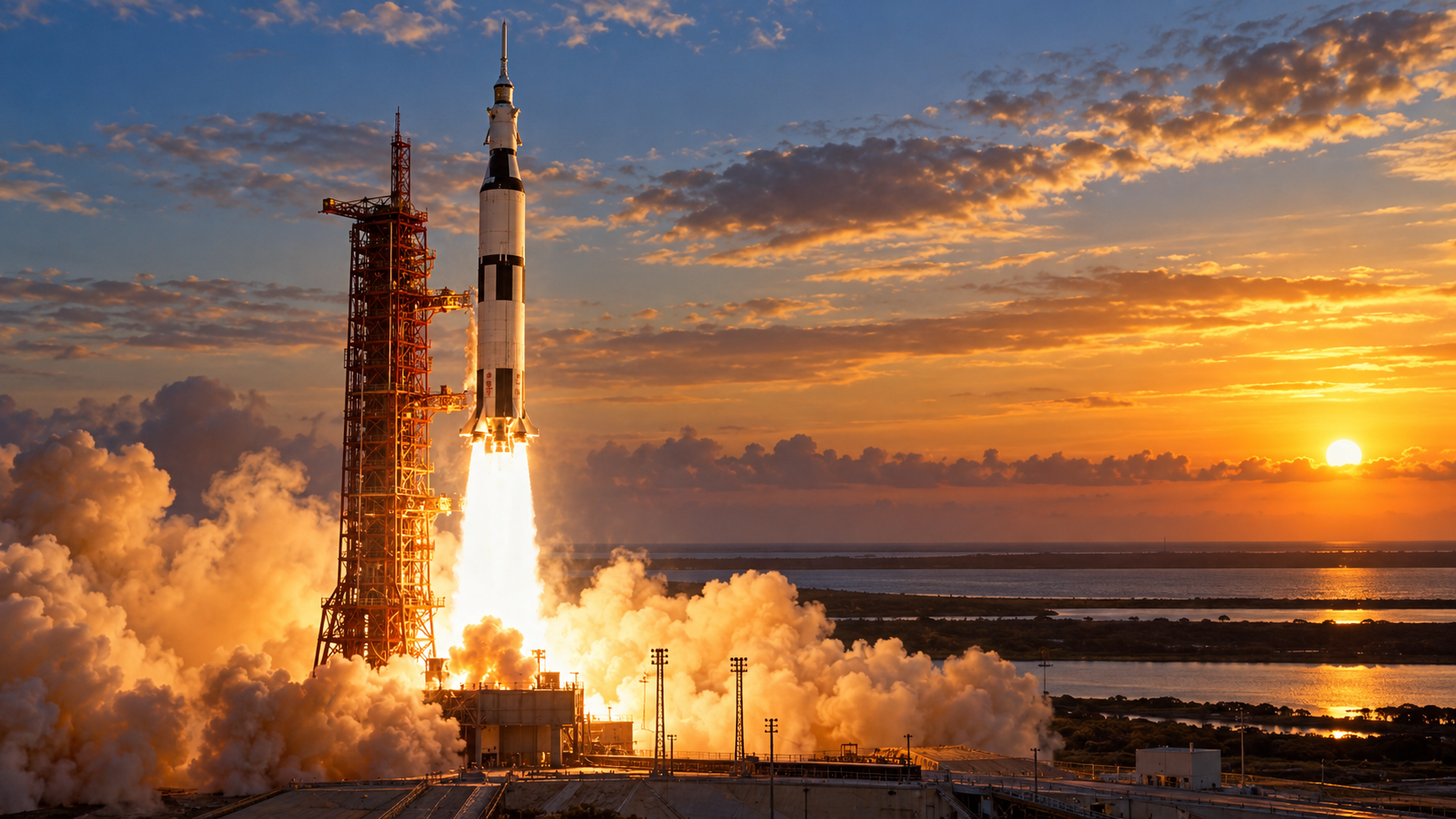
On This Day in Science: January 22, 1968
On January 22, 1968, Apollo 5 lifted off from Cape Kennedy’s Launch Complex 37B on the first flight of a Lunar Module. The mission carried no crew and no command module. A Saturn IB placed Lunar Module 1 into Earth orbit so engineers could test the separate descent and ascent stages that would later carry astronauts down to the Moon and back to lunar orbit. Because LM-1 was not intended to land, it lacked legs, windows, seats, and other hardware unnecessary for an automated test, while a mission programmer performed functions a crew would normally command.
The flight plan called for firings of the descent engine, including a restart, followed by staging and operation of the ascent engine. The first descent burn ended after only four seconds instead of the planned thirty-nine. The guidance computer had been programmed with conservative limits and stopped the engine when thrust built more slowly than its test expected. Flight controllers switched to an alternate sequence already stored aboard the vehicle. Two later descent burns succeeded, including throttling, and the ascent engine fired while the descent stage was still operating to simulate an emergency abort from a lunar landing.
Apollo 5 completed its essential objectives in about eleven hours. The tests verified the propulsion systems, stage separation, structural behavior, and the Lunar Module’s ability to restart an engine in space. Both stages remained in orbit and later reentered. The early shutdown was a real anomaly, but analysis showed that hardware had performed correctly; the problem lay in how software interpreted a brief difference between expected and actual thrust buildup. NASA therefore did not repeat the uncrewed mission. The next Lunar Module flight, Apollo 9 in 1969, carried astronauts and tested rendezvous and docking.
The January 22 mission demonstrated the value of testing a new spacecraft in an environment close enough for rapid tracking and control but realistic enough to expose interactions among engines, guidance, and operations. A flawless script would have taught less about the system’s margins. Instead, the interruption exercised contingency planning and showed that controllers could recover the mission without hiding the original fault. Apollo 5 rarely receives the attention given to lunar voyages, yet every crewed landing depended on the compact two-stage machine it tested. Its short Earth-orbit flight converted the Lunar Module from ground hardware into a proven spacecraft. Just as important, postflight analysis distinguished a software threshold problem from an engine defect, avoiding an unnecessary repeat while preserving accountability.
The first space test focused on engines, staging, guidance, and structure before astronauts depended on the Lunar Module.
Removing landing gear and crew equipment reduced complexity for a vehicle that would remain in Earth orbit.
Conservative software limits ended the first descent-engine firing when thrust did not build exactly as the program expected.
Controllers used a prepared alternate sequence, and later burns showed that the propulsion hardware was sound.
The mission proved both stages and the abort sequence needed to separate the ascent stage during a failed descent.
Its results cleared the way for the crewed Apollo 9 test and, ultimately, Lunar Module operations at the Moon.
Explore more of "On This Day ..."
Discover more events from the same date across news, politics, technology, sports, and other fields. Each link highlights significant moments that shaped history on different fronts.