

On This Day in Science: January 24, 1986
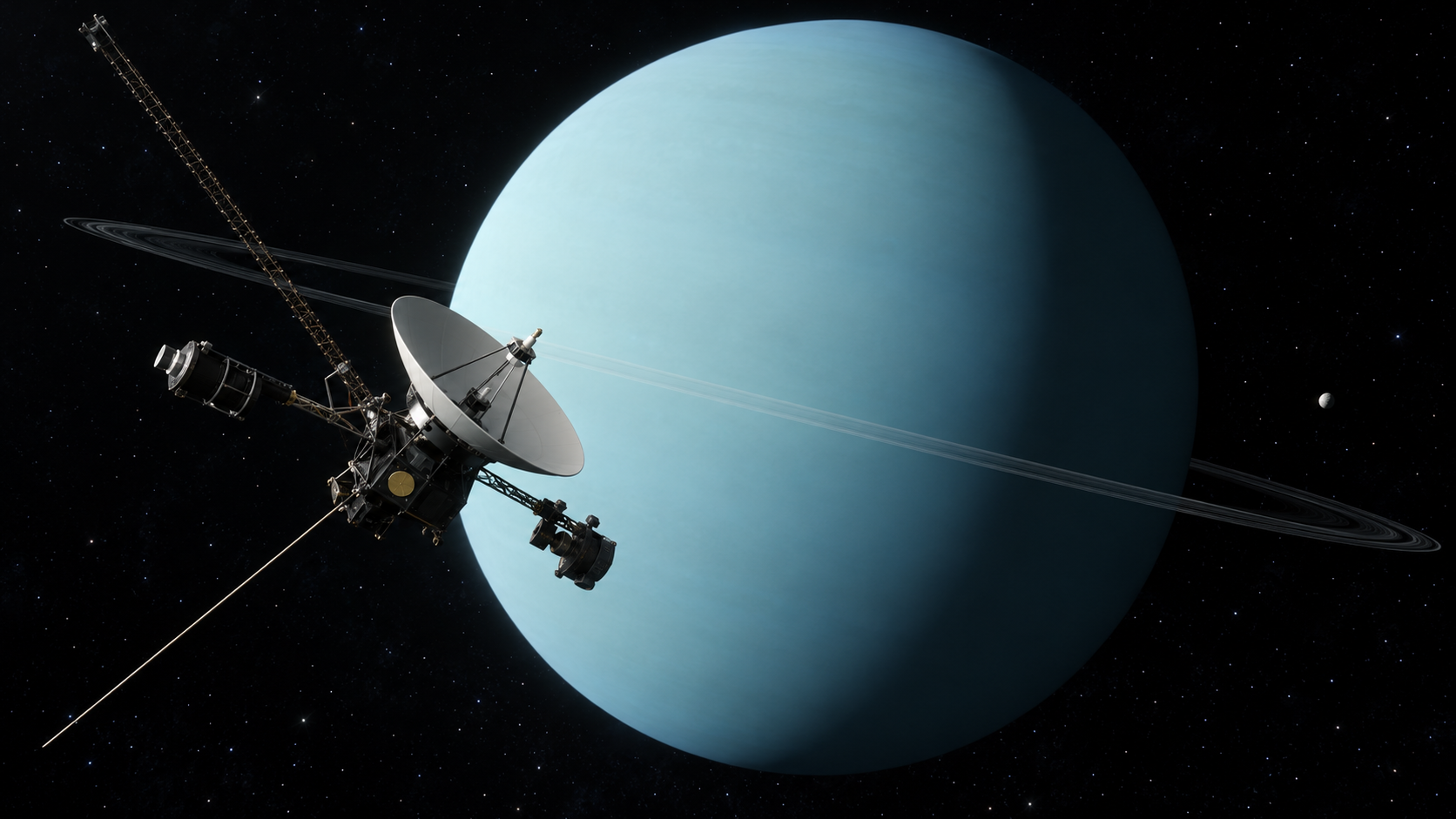
On January 24, 1986, Voyager 2 made humanity’s first and still only close visit to Uranus. After traveling for more than eight years, the spacecraft passed about 81,500 kilometers above the planet’s cloud tops at 17:59 UTC. Light at Uranus is hundreds of times dimmer than at Earth, and radio signals required roughly two and a half hours to cross the distance. Engineers upgraded tracking networks, refined navigation, and programmed a rapid sequence of observations because the spacecraft had only about five and a half hours for its closest study.
Uranus appeared as a nearly featureless blue-green world in ordinary images, but Voyager’s instruments found fast winds, a cold upper atmosphere, rings, moons, and an extraordinary magnetic field. The magnetic axis was tilted about 59 degrees from the rotation axis and displaced from the planet’s center, producing a complex magnetosphere. The spacecraft detected two additional rings and ten previously unknown moons. Its trajectory also had to bend onward toward Neptune, so the Uranus encounter balanced immediate observations against the geometry required for a future planetary flyby.
The closest moon encounter was with Miranda, whose surface displayed giant fault canyons, ridges, and patchwork terrains unlike anything then known. Voyager also photographed Ariel, Umbriel, Titania, and Oberon, revealing varied geological histories across the satellite system. Uranus itself rotates on its side, likely because of major events early in its formation, and the 1986 flyby occurred near southern solstice. That seasonal geometry left much of the northern hemisphere in darkness and limited what one fast passage could reveal.
Voyager 2 continued to Neptune in 1989 and eventually entered interstellar space, but no successor has returned to Uranus. Earth- and space-based telescopes have improved measurements of its atmosphere and rings, yet they cannot replace close inspection of the planet’s gravity, magnetic field, particles, and moons. The January 24 encounter supplied most of the detailed foundation still used to plan a future orbiter. It is both a triumph and a reminder of unfinished exploration: one durable spacecraft transformed Uranus in a day, while four decades later a single flyby remains the limit of direct human knowledge there. Seasonal changes across the planet’s 84-year orbit make that missing long-term perspective especially important. An orbiter could separate momentary conditions from permanent features in ways one rapid passage never could. It could revisit moons and rings under changing illumination and test whether any large icy satellites conceal oceans.
Voyager 2 executed a tightly timed sequence as it crossed the Uranian system at high speed.
The trajectory also preserved the gravitational path to Neptune, constraining how close and where the spacecraft could pass.
Uranus rotates nearly on its side, and its magnetic field is both sharply tilted and offset from the planet's center.
That unusual geometry creates a magnetosphere unlike those Voyager had measured at Jupiter and Saturn.
Images revealed Miranda's fractured patchwork and complex terrains on the other large Uranian moons.
Ten new moons and two rings expanded the known system during an encounter that has never been repeated.
Explore more of "On This Day ..."
Discover more events from the same date across news, politics, technology, sports, and other fields. Each link highlights significant moments that shaped history on different fronts.