

On This Day in Science: January 31, 1958
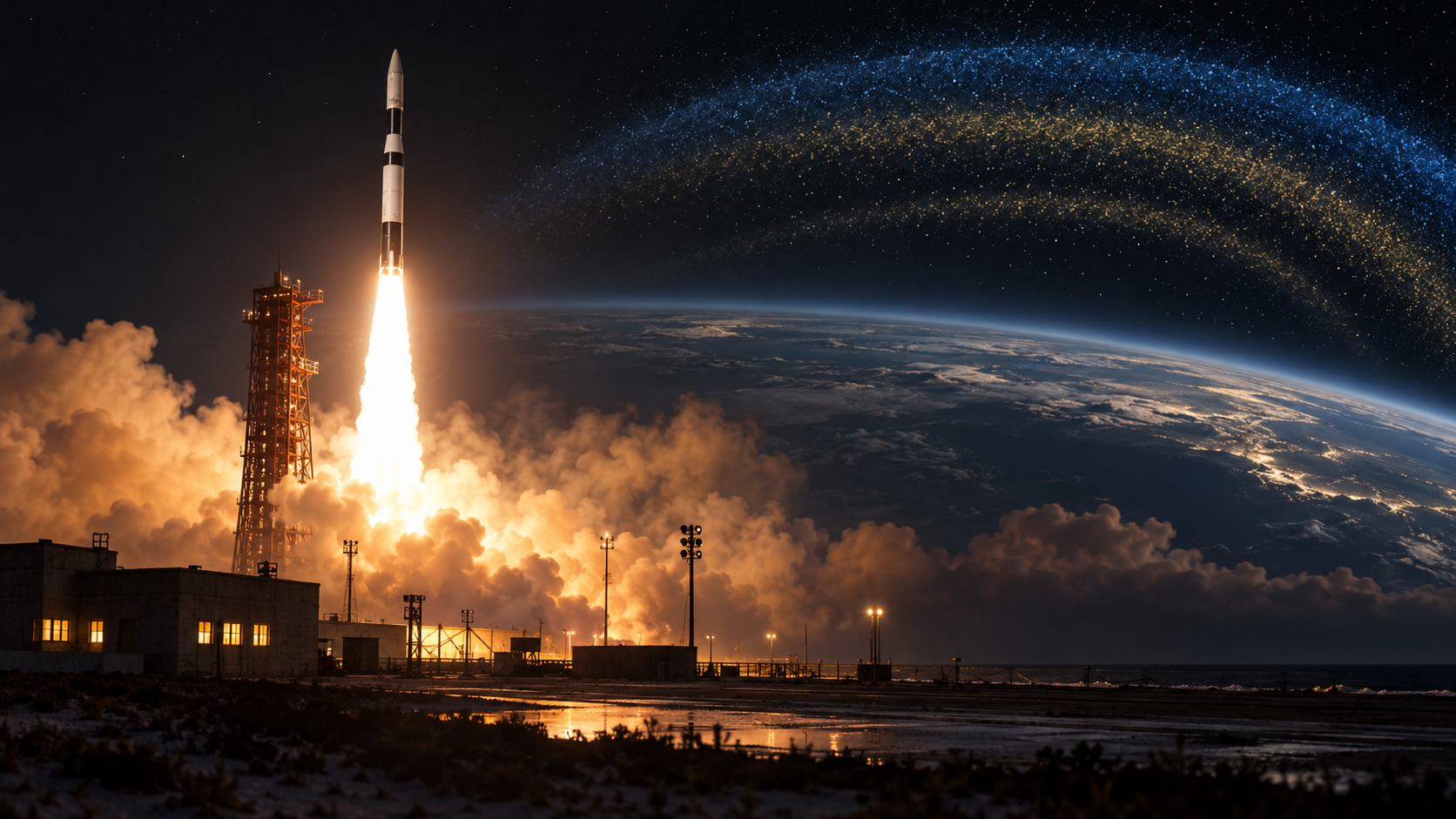
On January 31, 1958, Explorer 1 lifted off from Cape Canaveral at 10:48 p.m. Eastern time and became the first United States satellite to reach orbit. The slender spacecraft rode a Juno I rocket developed from the Army’s Jupiter-C research vehicle. The Jet Propulsion Laboratory designed and built the satellite, while University of Iowa physicist James Van Allen supplied its principal science package. Orbit confirmation came after an anxious delay because the rocket had placed Explorer higher than predicted, lengthening the time before tracking stations could receive its signal.
Explorer 1 weighed about fourteen kilograms and carried a Geiger counter for cosmic rays, temperature sensors, a micrometeorite microphone, and erosion gauges. The cosmic-ray instrument sometimes reported unexpectedly low counts or none at all. Rather than indicating an empty region, the readings suggested the detector was being overwhelmed and saturated by intense radiation. Data from Explorer 3, launched two months later with a recorder, helped confirm zones of energetic charged particles trapped by Earth’s magnetic field. They became known as the Van Allen radiation belts.
The discovery was the first major scientific result of the space age. Radiation belts affect spacecraft electronics, instruments, and human exposure, so mapping them became essential for mission design. They also revealed Earth as part of a dynamic space environment shaped by magnetic fields and particles from the Sun. Explorer 1 transmitted until May 1958 and remained in orbit until 1970. Its small payload could not map the belts completely, but it asked the right question in the new location that rockets had made accessible.
The launch followed the Soviet Union’s Sputnik satellites and the spectacular failure of the U.S. Vanguard TV-3 attempt. Political competition drove urgency, yet Explorer 1 was more than a symbolic reply because it carried a purposeful experiment. Its success joined the Army Ballistic Missile Agency, JPL, universities, tracking stations, and teams of human computers who calculated the trajectory. Months later the United States created NASA, consolidating civilian space work. January 31 marks both a national first and a deeper transition: satellites were not merely objects to place overhead but laboratories capable of discovering invisible structures around the planet. The mission’s scientific result outlasted the political contest and helped define space physics as a field. Later satellites mapped how the belts respond to solar storms and change over time. Explorer 1 thus began a continuing investigation of the space weather surrounding Earth.
A Juno I rocket placed the JPL-built spacecraft into a higher orbit than expected, delaying the first confirmation signal.
The successful flight followed Sputnik and a failed Vanguard launch but carried a focused scientific payload of its own.
Very low counts puzzled researchers until they realized intense radiation could saturate the Geiger counter.
Explorer 3's recorded data later helped confirm belts of charged particles held by Earth's magnetic field.
The radiation belts showed that near-Earth space is a structured environment, not an empty gap between atmosphere and cosmos.
Understanding that environment became essential for satellites, astronauts, communications, and studies of the Sun-Earth system.
Explore more of "On This Day ..."
Discover more events from the same date across news, politics, technology, sports, and other fields. Each link highlights significant moments that shaped history on different fronts.