

On This Day in Pop: October 21, 1959
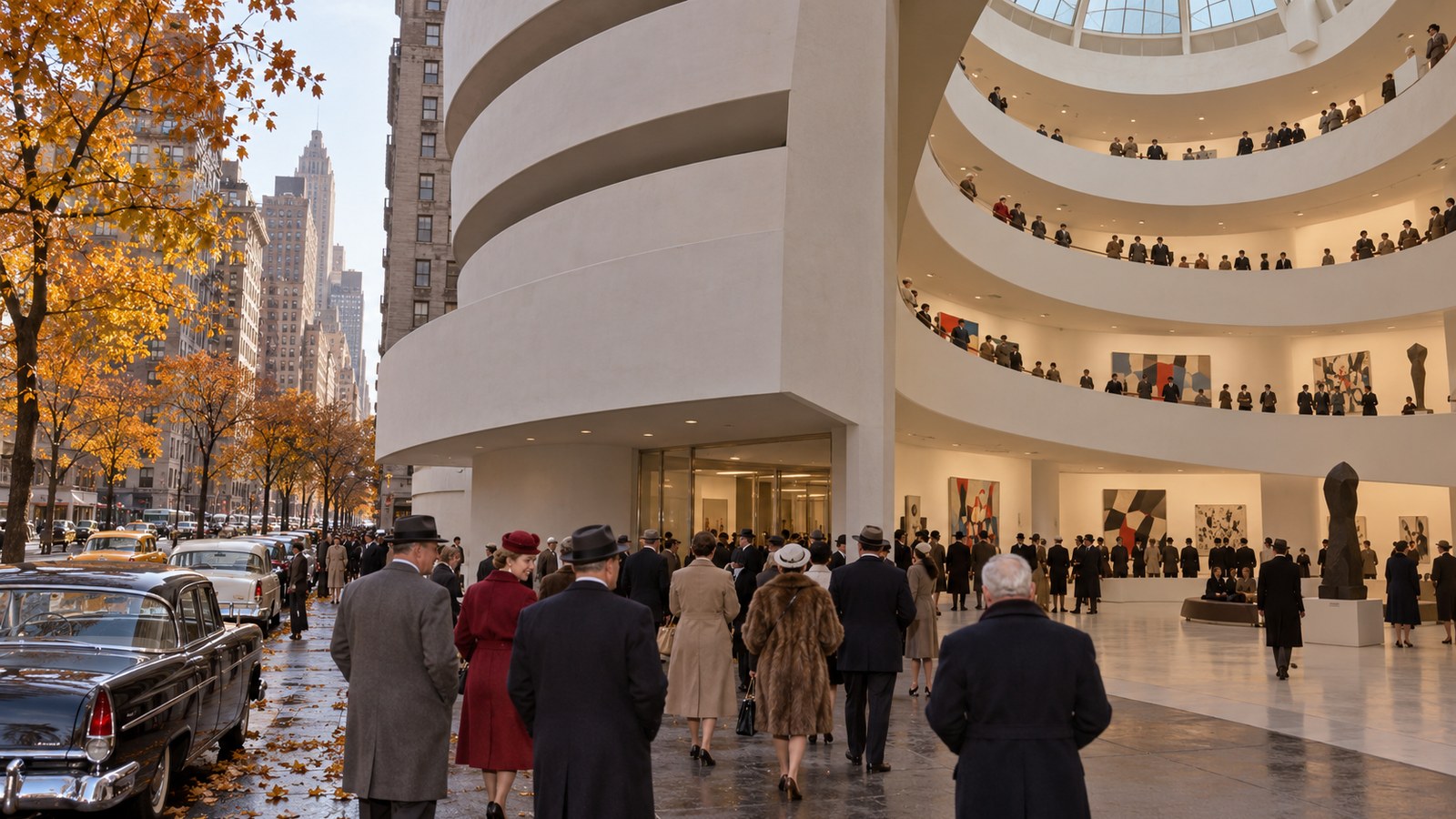
On October 21, 1959, the Solomon R. Guggenheim Museum opened to the public in New York City. Visitors entered Frank Lloyd Wright’s white spiral on Fifth Avenue and followed a continuous ramp around a central rotunda. The building’s curving walls and rising interior made movement through the museum inseparable from viewing art. Wright had worked on the commission for years with curator Hilla Rebay and the Guggenheim Foundation, revising the design through site, funding and code challenges. Both Wright and Solomon Guggenheim died before the building opened. The date captures the event before later reputation made its consequences look inevitable, when audiences encountered a new release, performance or institution with only the expectations available at the time.
Critics questioned whether the architecture competed with the artworks and whether sloping floors and curved walls served exhibitions. The controversy made the museum itself a public work of art rather than a neutral container. Popular culture is never made by a famous name alone. Writers, performers, producers, technicians, broadcasters, retailers, venues and audiences shape what becomes visible and what survives. Their collaboration also determines which experiments reach the public and which disappear before they can build momentum. Looking at those conditions turns an anniversary from a list entry into a record of choices, limits and competing interests.
The building became a New York landmark and a defining project in Wright’s career. Renovations and an expansion addressed practical needs while preserving the central rotunda and ramp. That afterlife matters because influence does not move in a straight line. Reruns, reissues, new technology, criticism and community memory can change the meaning of a work long after its first appearance. Durable pop history therefore holds creative achievement beside questions of labor, access, power and representation.
Opening day established a museum visit as choreography through space. The Guggenheim endures because disagreement about the relationship between building and art remains active every time a new exhibition occupies the spiral. Returning to this October date means separating what participants knew then from what later audiences added. Recordings, photographs, broadcasts and recollections keep the moment active, but they also select and reshape it. That distinction protects against hindsight: a chart position, premiere, publication, concert or opening may become a neat milestone later, but the people present still faced uncertainty. Reading the moment in both directions—through its original conditions and its accumulated meanings—keeps celebration from replacing history. The distance between the immediate event and its continuing interpretation is what makes this episode worth revisiting.
The Guggenheim Museum opened on October 21, 1959.
On October 21, 1959, the Solomon R. Guggenheim Museum opened to the public in New York City.
Frank Lloyd Wright designed the Fifth Avenue building.
Critics questioned whether the architecture competed with the artworks and whether sloping floors and curved walls served exhibitions. The controversy made the museum itself a public work of art rather than a neutral container.
A continuous spiral ramp organizes its central exhibition space.
The building became a New York landmark and a defining project in Wright's career. Renovations and an expansion addressed practical needs while preserving the central rotunda and ramp.
Explore more of "On This Day ..."
Discover more events from the same date across news, politics, technology, sports, and other fields. Each link highlights significant moments that shaped history on different fronts.