

On This Day in Science: February 8, 1865
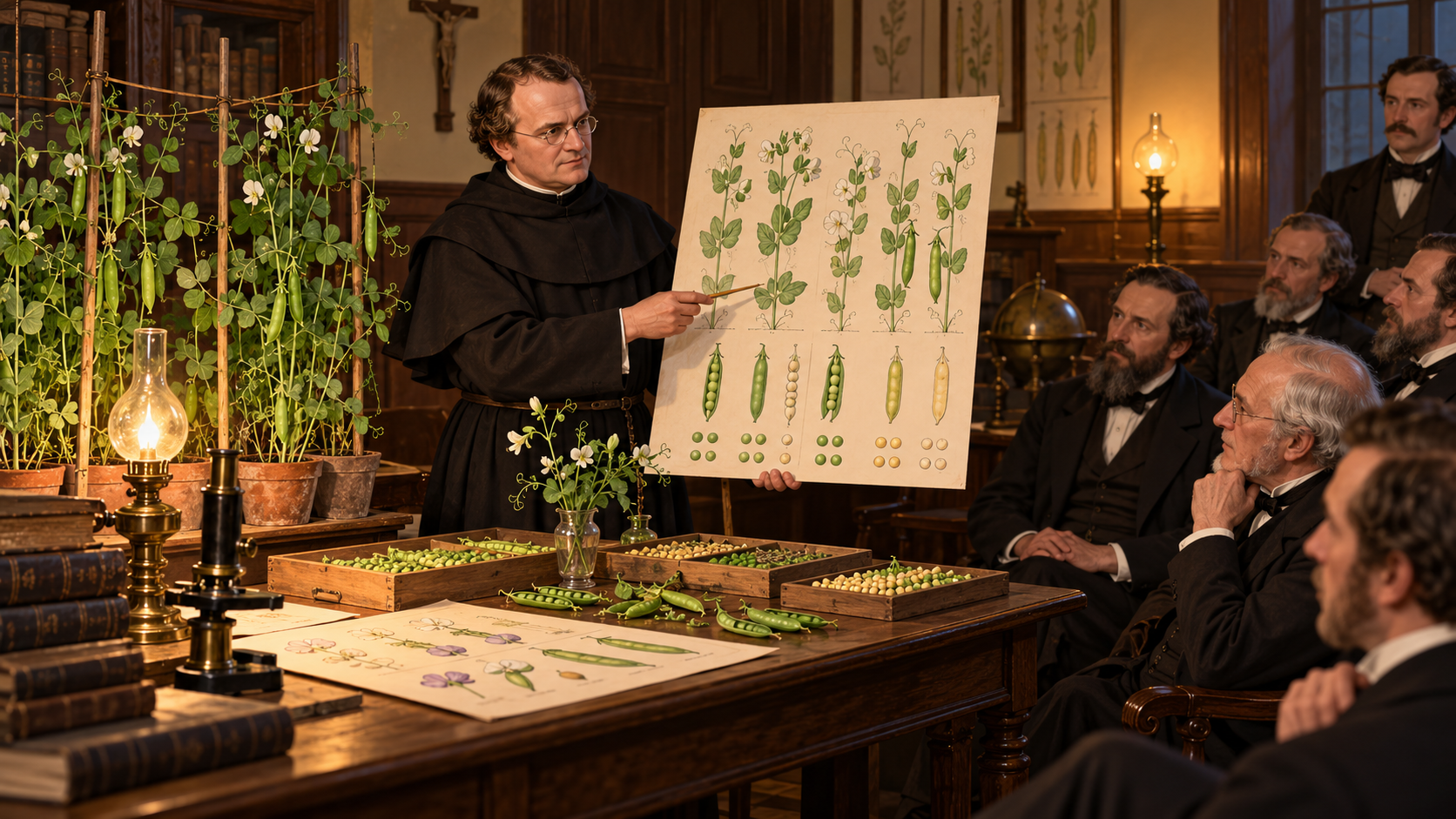
On February 8, 1865, Gregor Mendel presented the first part of his experiments on plant hybrids to the Natural Science Society in Brno. Working in the garden of the Augustinian monastery where he was a friar, Mendel had crossed varieties of garden peas with clearly contrasting traits. He counted how characteristics such as seed shape, flower color, and plant height appeared across successive generations. The meeting was followed by a second presentation on March 8, allowing him to explain a body of work that joined controlled breeding with unusually careful numerical analysis.
Peas gave Mendel useful experimental control. Their flowers normally self-pollinate, but pollen could also be transferred by hand, making parentage traceable. He began with lines that reliably produced the same trait, crossed them, and then observed the hybrids and their descendants. Some traits seemed to vanish in the first hybrid generation and reappear in the next at roughly predictable ratios. Mendel described these as dominant and recessive forms and proposed that hereditary factors remained distinct rather than blending permanently in offspring.
His published paper, issued in 1866, also described how pairs of factors separated when reproductive cells formed and how different trait pairs could assort independently under the conditions he studied. Modern genetics has refined those ideas: genes reside on chromosomes, linked genes do not assort independently, and many traits involve multiple genes, environmental effects, or molecular mechanisms far more complex than the pea examples. Even so, Mendel’s method was revolutionary. Large sample sizes, predefined categories, repeated crosses, and mathematical expectations made inheritance testable rather than anecdotal.
The presentations did not immediately transform biology. Mendel’s paper circulated narrowly, and its importance was widely recognized only around 1900, when several botanists revisited similar patterns. Later scientists connected Mendelian factors to chromosomes and then to DNA. The February meeting is remembered not because every conclusion was complete, but because it revealed a durable way to study biological continuity. By designing crosses, counting outcomes, and comparing results with a model, Mendel showed that living inheritance could yield regularities without becoming simple. His pea plants opened a path from breeding observations to experimental genetics. Its place on the calendar is therefore useful as an entry point, not an endpoint. The people involved worked with the instruments, assumptions, and social conditions of their time, and later research has both extended and corrected their conclusions. Reconstructing the event carefully means separating what was known that day from what became clear afterward. That distinction protects the history from myth while showing how cumulative evidence turns a memorable episode into lasting scientific knowledge.
Pea plants offered visible contrasting traits and allowed both self-pollination and controlled crosses.
Mendel started with stable lines so that the parent plants' characteristics could be followed across generations.
Traits that disappeared in the first hybrid generation could reappear in later offspring at regular ratios.
Mendel proposed distinct hereditary factors that separated and recombined rather than blending away.
The 1865 talks and 1866 paper attracted limited attention during Mendel's lifetime.
Around 1900, renewed experiments brought his work into the foundation of chromosome and molecular genetics.
Explore more of "On This Day ..."
Discover more events from the same date across news, politics, technology, sports, and other fields. Each link highlights significant moments that shaped history on different fronts.