

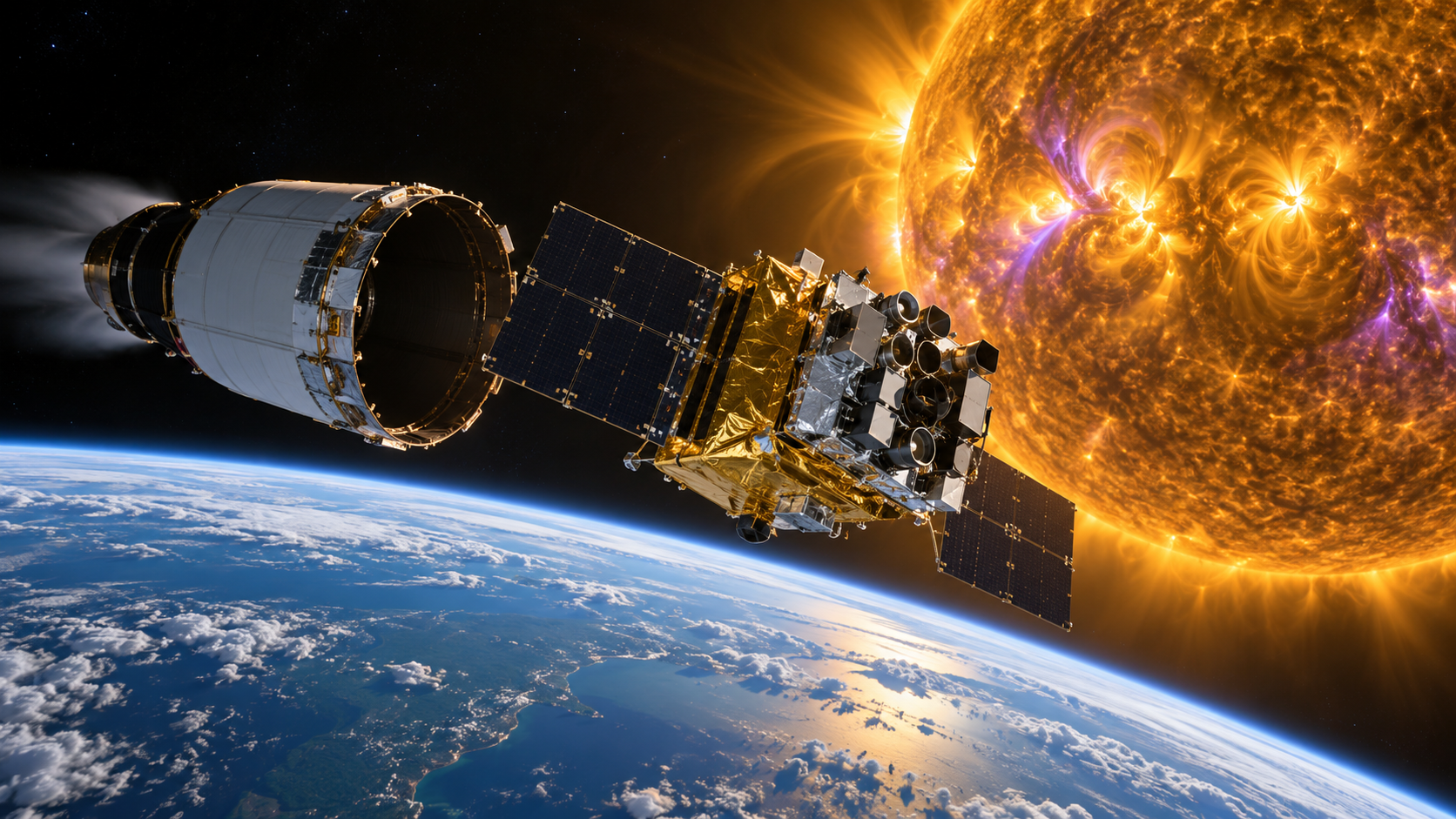
On This Day in Science: February 11, 2010
On February 11, 2010, NASA launched the Solar Dynamics Observatory, or SDO, from Cape Canaveral aboard an Atlas V rocket. The observatory was built to watch the Sun continuously and in far greater detail than intermittent snapshots could provide. From a geosynchronous orbit, it would record the full solar disk at multiple ultraviolet wavelengths, measure magnetic fields across the visible surface, and study vibrations that reveal motion inside the star. Its mission joined fundamental solar physics with the practical need to understand eruptions that can affect technology near Earth.
SDO carries three instrument suites. The Atmospheric Imaging Assembly produces high-resolution images in several wavelength bands every few seconds, allowing scientists to follow rapid changes through layers of the solar atmosphere. The Helioseismic and Magnetic Imager maps surface magnetism and uses oscillations to probe flows beneath the photosphere. The Extreme Ultraviolet Variability Experiment measures changes in the Sun’s ultraviolet output, energy that strongly influences Earth’s upper atmosphere. Together, the instruments create a synchronized record linking internal motion, magnetic structure, and radiation.
The spacecraft generates an immense stream of data because solar activity can evolve without warning. Active regions twist and reorganize, flares release intense bursts of radiation, and coronal mass ejections can throw magnetized plasma into interplanetary space. When that material reaches Earth, it may produce auroras but can also disturb satellites, radio links, navigation signals, and power systems. Continuous observations let researchers examine the conditions before an eruption and test models of how stored magnetic energy becomes motion, heat, and high-energy particles.
SDO was planned as a multiyear mission but has continued far beyond its initial design life, observing much of a full solar cycle and the start of another. Its images have become familiar to the public, yet their scientific value lies in calibrated repetition: the same star, measured with stable instruments, day after day. The February launch created a long baseline for comparing quiet periods with solar maximum. It also demonstrated how an observatory can serve both discovery and preparedness, improving understanding of a nearby star while supplying evidence for the developing science of space-weather prediction. The anniversary also highlights the difference between a first result and a finished understanding. A successful observation can settle one question while opening several harder ones, and even a failed objective can return measurements that reshape later designs. Preserved data, specimens, photographs, and hardware allow new generations to revisit the work with better tools. Science advances through that continuity, where a specific date marks progress without pretending that inquiry stopped there.
SDO operates from geosynchronous orbit and sends back a continuous stream of full-disk solar observations.
Its rapid cadence captures changes that could be missed by instruments taking occasional snapshots.
Cameras image the atmosphere, a magnetic instrument maps the surface and solar interior, and a radiometer tracks ultraviolet output.
Synchronized measurements connect the Sun's hidden motions to visible eruptions and changing radiation.
Solar flares and coronal mass ejections can affect spacecraft, communications, navigation, and electrical systems.
SDO's long record helps researchers test eruption models and recognize conditions that precede disruptive activity.
Explore more of "On This Day ..."
Discover more events from the same date across news, politics, technology, sports, and other fields. Each link highlights significant moments that shaped history on different fronts.