

On This Day in Science: February 14, 1990
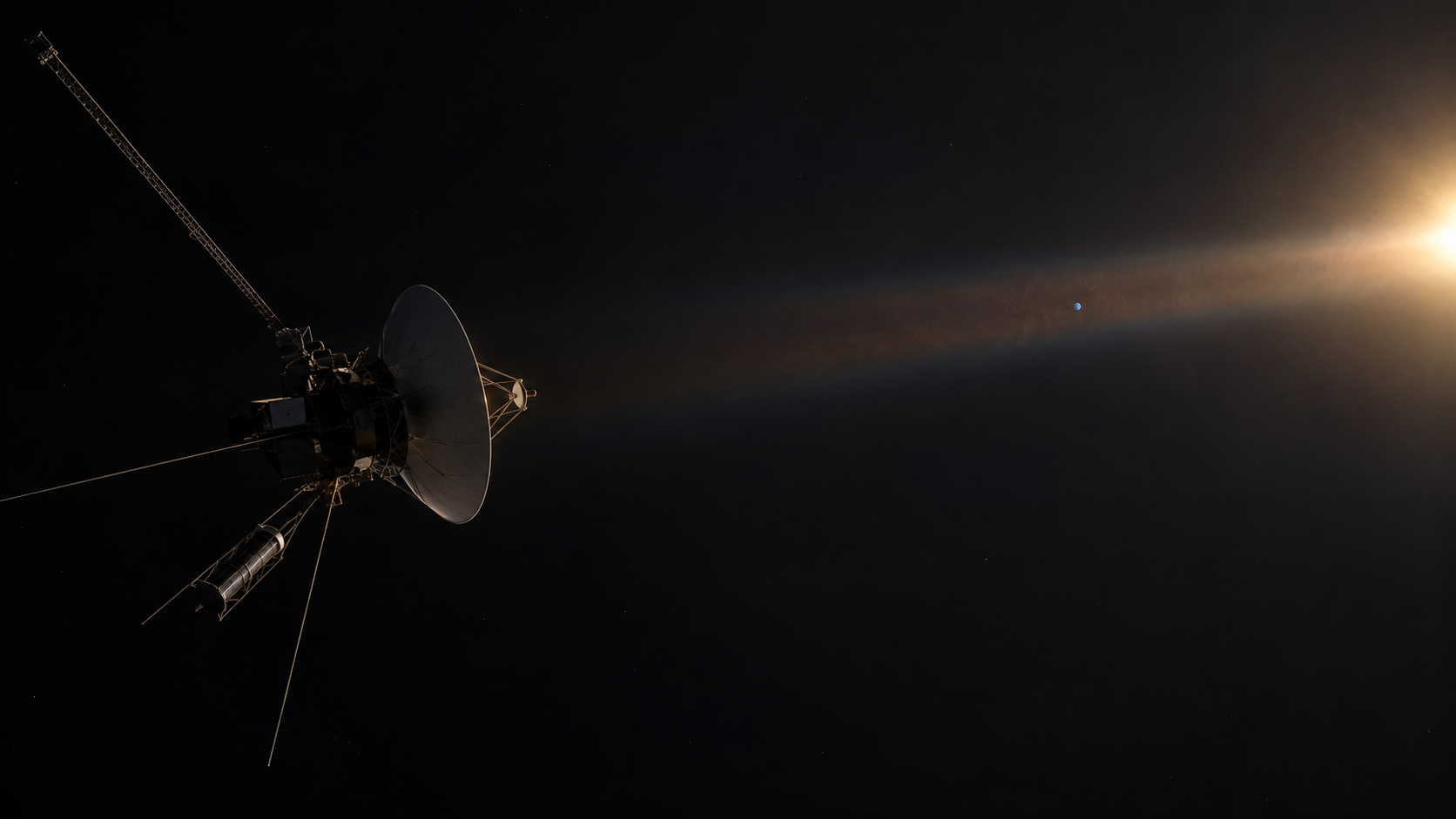
On February 14, 1990, Voyager 1 turned its cameras back toward the solar system and photographed Earth from roughly six billion kilometers away. In the resulting frame, the planet occupied less than a single pixel, caught within a scattered ray of sunlight. The image became known as the Pale Blue Dot. It was part of a larger Family Portrait sequence in which Voyager recorded several planets from beyond Neptune’s orbit, not a navigation requirement or a new discovery target. The cameras were looking home at the end of their active imaging mission.
The observation required careful planning. Pointing the spacecraft close to the Sun risked damaging the cameras, and from Voyager’s position the inner planets were faint points near that glare. Engineers timed a mosaic of exposures using different filters and angles. Earth appeared in a band of stray light produced inside the camera optics, an artifact that gave the picture its famous sunbeam. The dot’s apparent color came from combining filtered images; its tiny size reflected the scale of the view, where an entire world was smaller than the detector could resolve.
Voyager 1 had launched in 1977 and used flybys of Jupiter and Saturn to transform knowledge of the outer planets and their moons. By 1990 it was on a trajectory out of the planetary region, so controllers planned the portrait as a final use of the imaging system. The cameras were then shut down to conserve power and computing resources for fields-and-particles instruments. Decades later, the spacecraft continued measuring the environment beyond the heliosphere, while the backward glance became its best-known photograph.
Carl Sagan, who had advocated for the image, later used it to reflect on Earth’s fragility and shared human history. The photograph contains no visible borders, cities, ecosystems, or people, yet every life known to science was located within that faint point. Its power comes from measurement rather than symbolism alone: distance reduced Earth to its actual angular size in the camera. Pale Blue Dot joined planetary science with perspective, showing that exploration can change how the observer understands the starting point. A technically modest pixel became a durable argument for humility, cooperation, and care for the only inhabited world yet known. Seen across a longer timeline, the event also shows that scientific milestones are junctions rather than isolated beginnings. Earlier experiments, tools, and institutions made the work possible, while later teams tested its limits and carried the result into new settings. What survives is more than an anniversary fact: it is a traceable chain of evidence, correction, and application that allows one moment to remain relevant as knowledge and technology continue to change.
Voyager 1 photographed Earth after completing its close encounters with Jupiter and Saturn.
From that distance the entire planet covered less than one pixel in the camera's field.
Engineers planned filtered exposures while protecting the cameras from the nearby glare of the Sun.
A ray of scattered light inside the optics crossed the frame and happened to contain Earth's tiny image.
The Family Portrait was Voyager 1's final planned imaging project before its cameras were turned off.
The spacecraft continued operating other instruments as it traveled into interstellar space.
Explore more of "On This Day ..."
Discover more events from the same date across news, politics, technology, sports, and other fields. Each link highlights significant moments that shaped history on different fronts.