

On This Day in Science: February 22, 1997
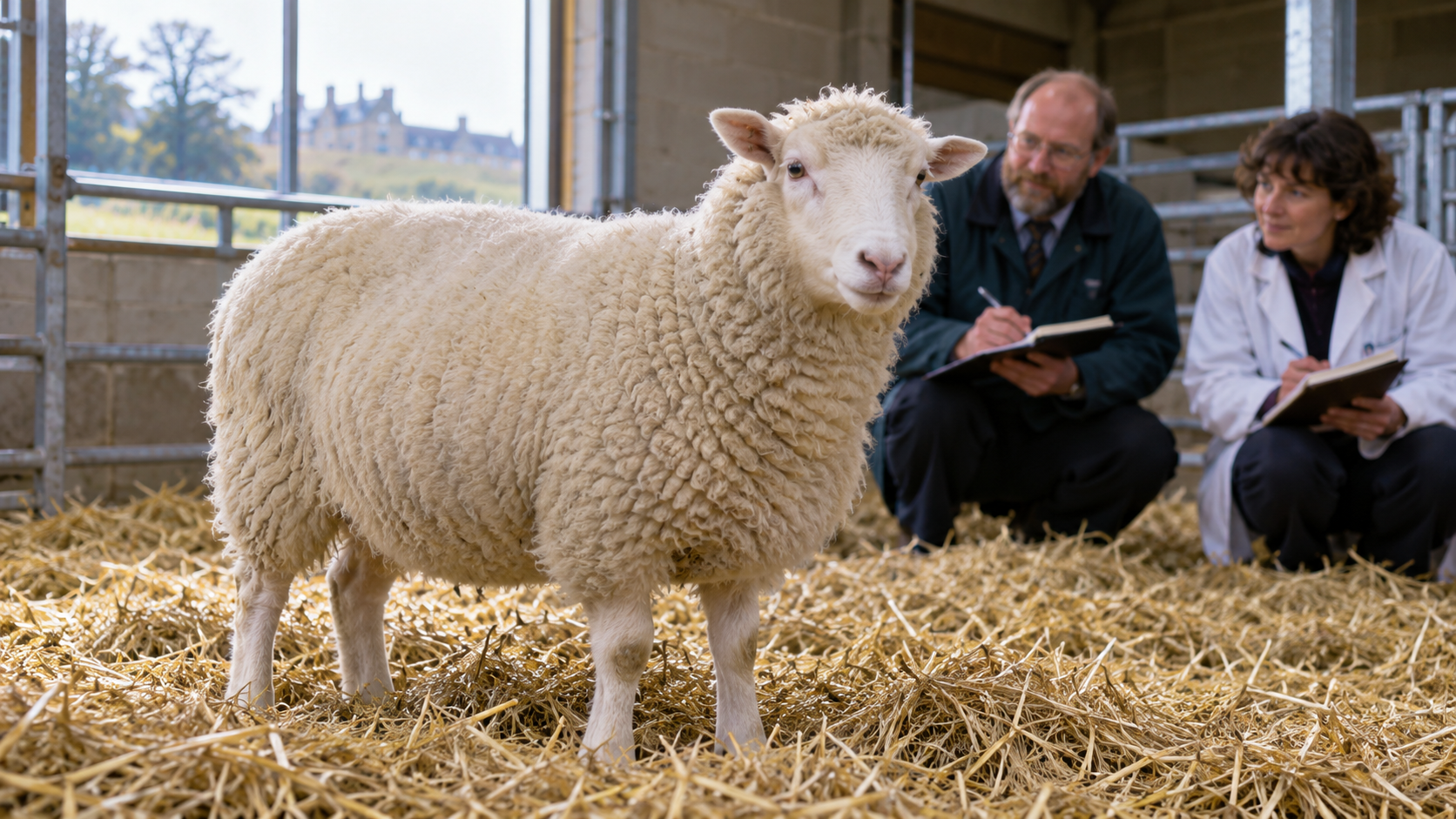
On February 22, 1997, the Roslin Institute in Scotland announced that a sheep named Dolly had been cloned from an adult body cell. Dolly had actually been born on July 5, 1996, and the scientific paper describing the work appeared days after the public announcement. Her significance lay in the source of her nuclear DNA: a cell taken from the mammary gland of an adult Finn Dorset ewe. Earlier cloning experiments had used embryonic cells, which were already developmentally flexible. Dolly showed that genetic material from a specialized adult cell could be reprogrammed to direct the development of an entire mammal.
The method was somatic cell nuclear transfer. Researchers removed the nucleus from an unfertilized egg cell and fused that egg with an adult donor cell using an electrical pulse. Another pulse encouraged the reconstructed cell to divide, and resulting embryos were placed into surrogate ewes. The process was extremely inefficient. Hundreds of reconstructed embryos were attempted, but Dolly was the single live lamb produced from the adult mammary-cell experiment. Her white face helped distinguish her genetically from the black-faced surrogate that gave birth to her.
Dolly’s birth reshaped research on cell identity. If an adult nucleus retained the information needed to make every tissue, then differentiation involved reversible patterns of gene activity rather than permanent loss of genetic instructions. The result stimulated studies of reprogramming, stem cells, livestock breeding, disease models, and conservation. It also prompted immediate ethical debate about animal welfare and possible human reproductive cloning. Those questions were not separate from the science, because low success rates, abnormal development, and the health of donors and surrogates all mattered to evaluating the technique.
Dolly lived at Roslin, produced six lambs, and was euthanized in 2003 after developing progressive lung disease; she also had arthritis. Debate over whether cloning caused premature aging became more nuanced as researchers compared her condition with other sheep. Her preserved body is displayed at the National Museum of Scotland. The February announcement endures because it altered the boundary of what biologists thought a mature cell nucleus could do. Dolly was not a perfect copy in every biological sense—development also depended on the egg, womb, environment, and experience—but she was compelling evidence that adult cellular identity could be reset. Seen across a longer timeline, the event also shows that scientific milestones are junctions rather than isolated beginnings. Earlier experiments, tools, and institutions made the work possible, while later teams tested its limits and carried the result into new settings. What survives is more than an anniversary fact: it is a traceable chain of evidence, correction, and application that allows one moment to remain relevant as knowledge and technology continue to change.
Dolly was the first mammal cloned using a nucleus from a specialized adult body cell.
Her nuclear DNA came from a mammary-gland cell, while an egg cell and a surrogate supported development.
Researchers removed an egg nucleus, fused the egg with a donor cell, and used electrical pulses to start division.
Hundreds of attempts produced only one live lamb from the adult-cell experiment.
Dolly proved that an adult nucleus could be reprogrammed, influencing stem-cell and developmental research.
The low efficiency and animal-welfare concerns also drove debate about the responsible limits of cloning.
Explore more of "On This Day ..."
Discover more events from the same date across news, politics, technology, sports, and other fields. Each link highlights significant moments that shaped history on different fronts.