

On This Day in Science: February 24, 1987
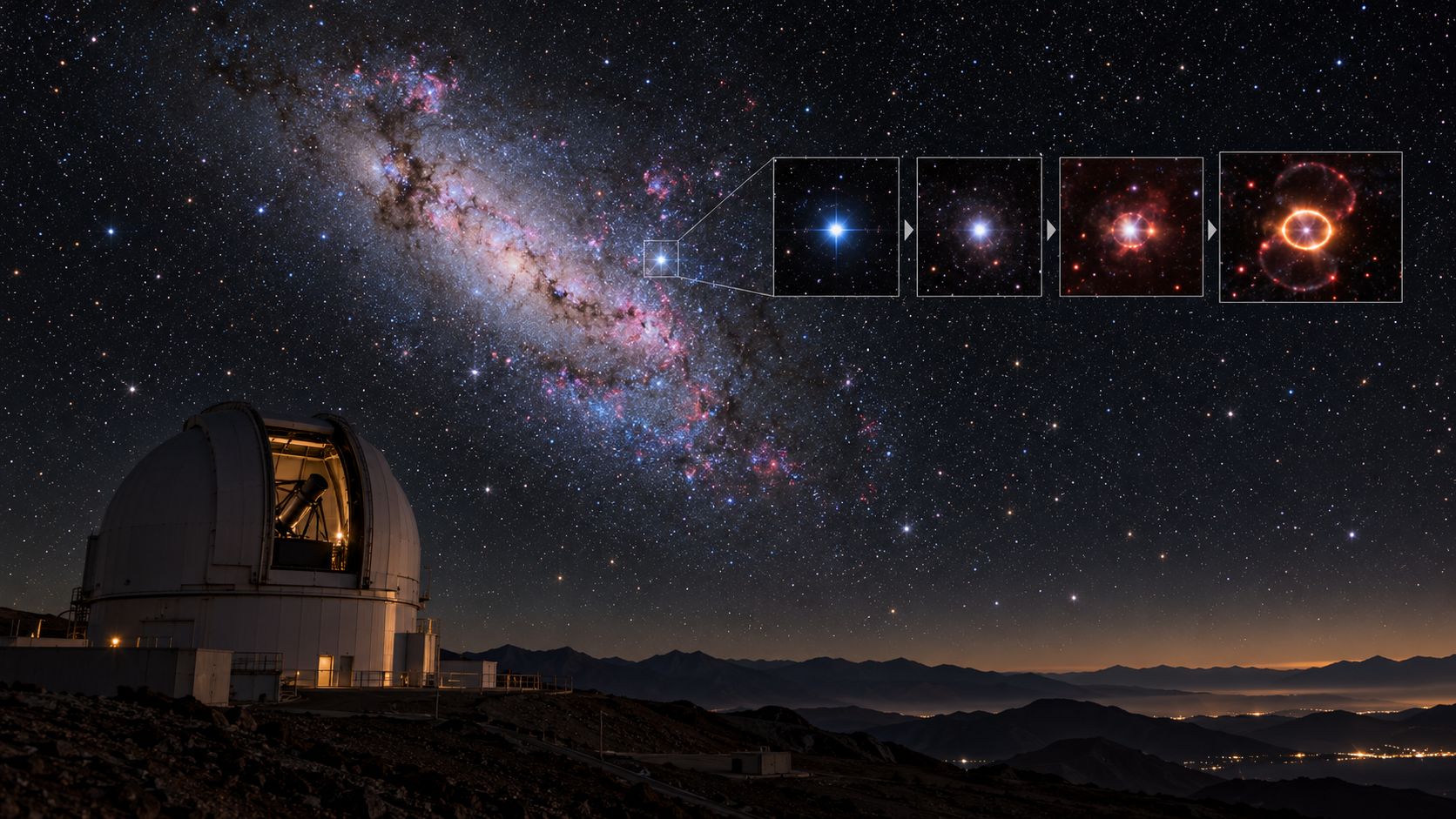
On February 24, 1987, observers in the Southern Hemisphere noticed a new point of light in the Large Magellanic Cloud, a satellite galaxy of the Milky Way. The object was Supernova 1987A, the explosion of a massive star about 168,000 light-years away. It was the closest supernova seen since the early telescope era and the first visible to the unaided eye in nearly four centuries. Photographs taken the previous night helped establish when it brightened, while astronomers quickly turned instruments across the electromagnetic spectrum toward the changing source.
The progenitor was identified as Sanduleak −69 202, a blue supergiant. That was surprising because many models expected this type of core-collapse supernova to arise from a red supergiant. The star’s core had exhausted its nuclear fuel and collapsed, while the outer layers were driven into space at enormous speed. As radioactive elements formed in the blast decayed, they powered the evolving light. Spectra and brightness measurements allowed researchers to track temperature, composition, expansion, and the mixing of material newly forged in the explosion.
Hours before visible light reached Earth, underground detectors in Japan, the United States, and the Soviet Union recorded a brief burst of neutrinos. Only a few dozen events were detected, but their timing and energy provided the first direct evidence that a supernova core collapse releases most of its energy through neutrinos. The observation opened neutrino astronomy beyond the Sun and constrained models of dense stellar cores. It also demonstrated the value of comparing instruments that detect fundamentally different messengers from the same cosmic event.
Long-term observations revealed glowing rings of gas around the supernova, material shed by the star before it died. As the expanding shock wave reached the inner ring, bright hotspots appeared and then changed over years, letting telescopes watch an explosion interact with its surroundings in real time. Researchers continue searching for the compact neutron star expected to remain in the debris. Supernova 1987A became a laboratory measured across decades, not a momentary flash. Its discovery connected stellar evolution, nuclear physics, neutrinos, dust, and shock waves in one observable event, making a distant death unusually close to experimental science. Its place on the calendar is therefore useful as an entry point, not an endpoint. The people involved worked with the instruments, assumptions, and social conditions of their time, and later research has both extended and corrected their conclusions. Reconstructing the event carefully means separating what was known that day from what became clear afterward. That distinction protects the history from myth while showing how cumulative evidence turns a memorable episode into lasting scientific knowledge.
Supernova 1987A appeared in the Large Magellanic Cloud and became visible without a telescope.
Its identified progenitor was a blue supergiant, challenging common expectations for core-collapse explosions.
Underground detectors recorded a short neutrino burst hours before the visible supernova was reported.
Those events confirmed that collapsing stellar cores release enormous energy through nearly massless particles.
Telescopes have followed the expanding debris as it strikes rings of gas expelled by the original star.
The changing remnant continues to test models of shocks, dust formation, nucleosynthesis, and compact objects.
Explore more of "On This Day ..."
Discover more events from the same date across news, politics, technology, sports, and other fields. Each link highlights significant moments that shaped history on different fronts.