

On This Day in Science: February 25, 1995
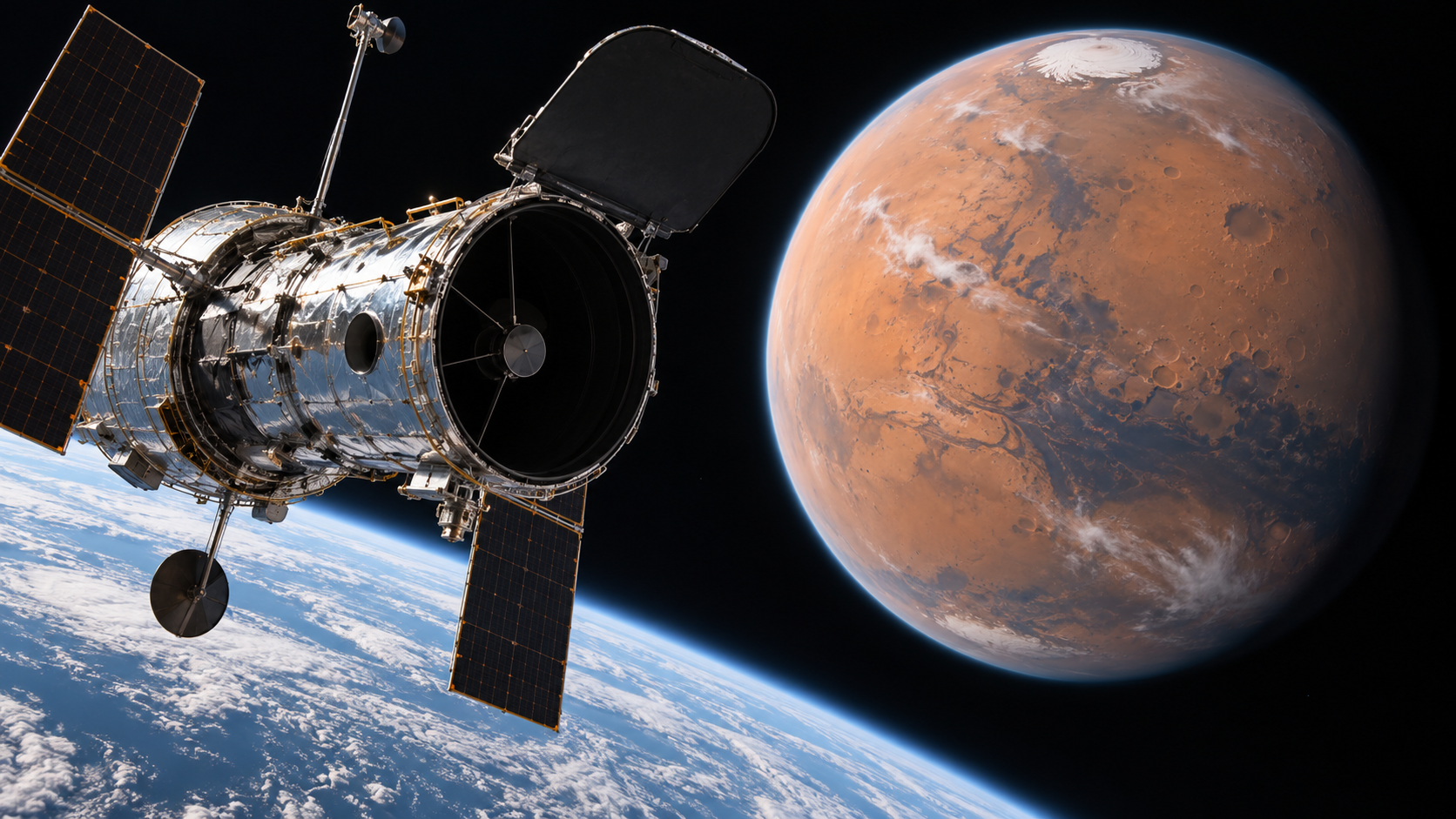
On February 25, 1995, the Hubble Space Telescope photographed Mars near opposition, when Earth and the planet were favorably aligned. The images provided the most detailed complete global coverage of Mars then obtained from Earth orbit. Hubble resolved surface regions, the shrinking northern polar cap, morning clouds, and atmospheric haze while the planet was about 103 million kilometers away. With no active spacecraft orbiting Mars at the time, the telescope acted as an interplanetary weather satellite, filling part of the observational gap between the Viking missions and a new generation of robotic explorers.
The Wide Field and Planetary Camera 2 recorded Mars through multiple filters, allowing researchers to distinguish surface color from clouds and airborne dust. Comparing the views with Viking-era observations suggested that the atmosphere was clearer, cooler, and drier than it had appeared roughly two decades earlier. Wispy clouds gathered near volcanoes and along the morning limb, while the seasonal carbon-dioxide frost had retreated from the polar region. A global perspective helped scientists connect local features with circulation patterns across the planet.
Planetary weather is not merely scenery. Dust can heat the atmosphere, alter temperatures, obscure the surface, and influence spacecraft that rely on solar power or atmospheric braking. Clouds and frost trace the movement of water and carbon dioxide through the Martian climate system. Repeated Hubble observations offered a consistent way to watch those processes over seasons and years, complementing the close but intermittent measurements of orbiters and landers. Mars also became a comparative laboratory for testing atmospheric models under conditions very different from Earth’s.
The February images demonstrated Hubble’s flexibility after its first servicing mission had corrected the telescope’s vision. Although built primarily for distant astronomy, it could turn toward a nearby moving world and monitor large-scale change. Later Mars missions provided far sharper local measurements, while Hubble continued supplying whole-planet context during favorable oppositions. That combination remains valuable: close spacecraft reveal detail, and remote observatories show how the pieces fit together. The 1995 survey transformed Mars from a static globe into a world with weather that could be followed, compared, and eventually forecast for exploration. For science history, the episode is also a case study in how evidence moves from an observation or engineered test into a durable body of knowledge. Instruments supplied measurements, specialists debated interpretation, and later work refined what the first result could mean. Archives preserve the early record while new methods let researchers ask different questions of it. That continuing revision is not a weakness in the original achievement; it is the process through which a dated milestone remains scientifically useful.
Hubble observed Mars during a period when no active spacecraft was circling the planet.
Its images supplied whole-world context for clouds, haze, frost, and major surface regions.
Multiple wavelengths helped researchers separate atmospheric features from the colored surface below.
Comparisons with Viking-era data suggested a cooler, clearer, and drier Martian atmosphere.
Dust and clouds influence temperature, visibility, solar power, and the performance of arriving spacecraft.
Long-term remote monitoring complements the detailed local measurements returned by orbiters and landers.
Explore more of "On This Day ..."
Discover more events from the same date across news, politics, technology, sports, and other fields. Each link highlights significant moments that shaped history on different fronts.