

On This Day in Science: February 29, 1504
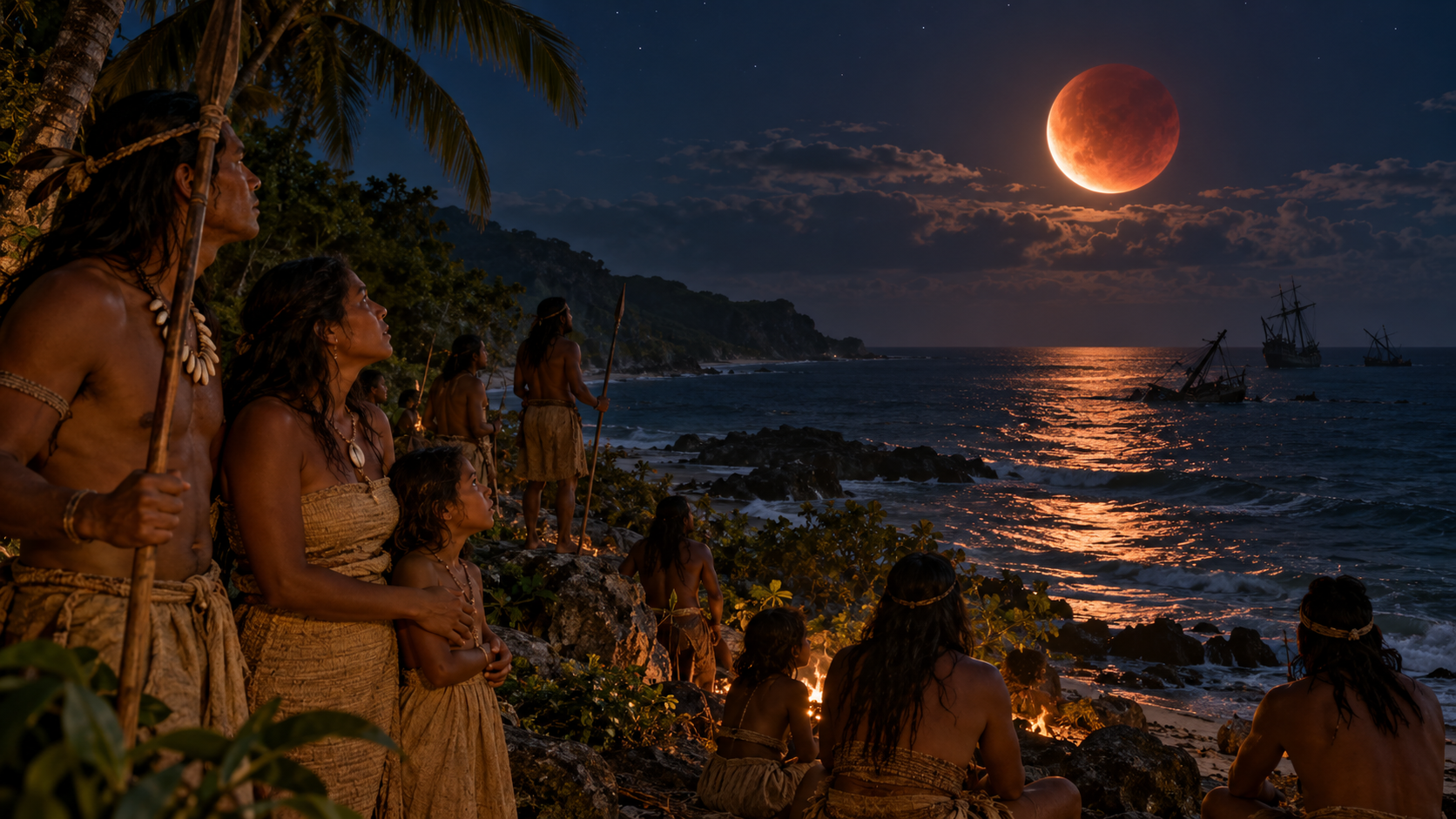
On the evening of February 29, 1504, a total lunar eclipse was visible from Jamaica. Christopher Columbus, stranded there during his fourth voyage, knew of the event from astronomical tables associated with Johannes Müller of Königsberg, known as Regiomontanus. Columbus and his crews had depended on food supplied by Indigenous Taíno communities, but relations deteriorated after months of demands and abuses. Facing resistance and dwindling provisions, he used advance knowledge of the eclipse to claim that his God would darken the Moon as punishment unless supplies resumed.
A lunar eclipse occurs when the full Moon passes through Earth’s shadow. The geometry is predictable because the motions of Earth and Moon repeat in measurable cycles, although accurate local timing was difficult with early-sixteenth-century instruments. Regiomontanus’s printed ephemerides collected calculated positions and eclipse forecasts for navigators and astronomers. From Jamaica, the eclipse began near moonrise on February 29 local time, even though astronomical catalogs may date the event March 1 in Universal Time. The rising Moon darkened and took on the coppery color produced by sunlight filtered through Earth’s atmosphere.
Historical accounts say Columbus withdrew during totality, timed part of the event, and then announced that the Moon would return after he had interceded. The tactic succeeded in renewing provisions. It is sometimes retold as clever scientific problem-solving, but that framing can hide the coercive colonial setting. Columbus possessed a specialized prediction unavailable to the people he threatened and used it to exploit fear after his own expedition had strained the community. The episode is therefore both a demonstration of astronomical calculation and a warning about how unequal access to knowledge can become power.
The eclipse itself was a natural event, indifferent to the human conflict beneath it. Its prediction reflected centuries of observations, mathematical tables, manuscript traditions, printing, and navigation. Modern eclipse catalogs can reconstruct its path and timing with far greater precision, while historians place the episode within the violence and extraction of European colonization. February 29 offers an unusually layered science anniversary. It shows that reliable knowledge can forecast the sky, but the ethical meaning of that knowledge depends on how it is used. Scientific accuracy does not make manipulation benign; it makes responsibility more important. For science history, the episode is also a case study in how evidence moves from an observation or engineered test into a durable body of knowledge. Instruments supplied measurements, specialists debated interpretation, and later work refined what the first result could mean. Archives preserve the early record while new methods let researchers ask different questions of it. That continuing revision is not a weakness in the original achievement; it is the process through which a dated milestone remains scientifically useful.
A total lunar eclipse occurs when Earth moves between the Sun and full Moon, casting its shadow across the lunar surface.
Sunlight refracted through Earth's atmosphere can leave the eclipsed Moon glowing copper or red.
Regiomontanus's ephemerides compiled calculated celestial positions and eclipse forecasts used by navigators.
Local calendar dates can differ from modern Universal Time, placing the Jamaican evening on February 29.
Columbus used the forecast to threaten Taíno communities and pressure them to resume supplying his stranded expedition.
The episode belongs to the history of astronomy and to the coercive colonial conditions in which that knowledge was used.
Explore more of "On This Day ..."
Discover more events from the same date across news, politics, technology, sports, and other fields. Each link highlights significant moments that shaped history on different fronts.