

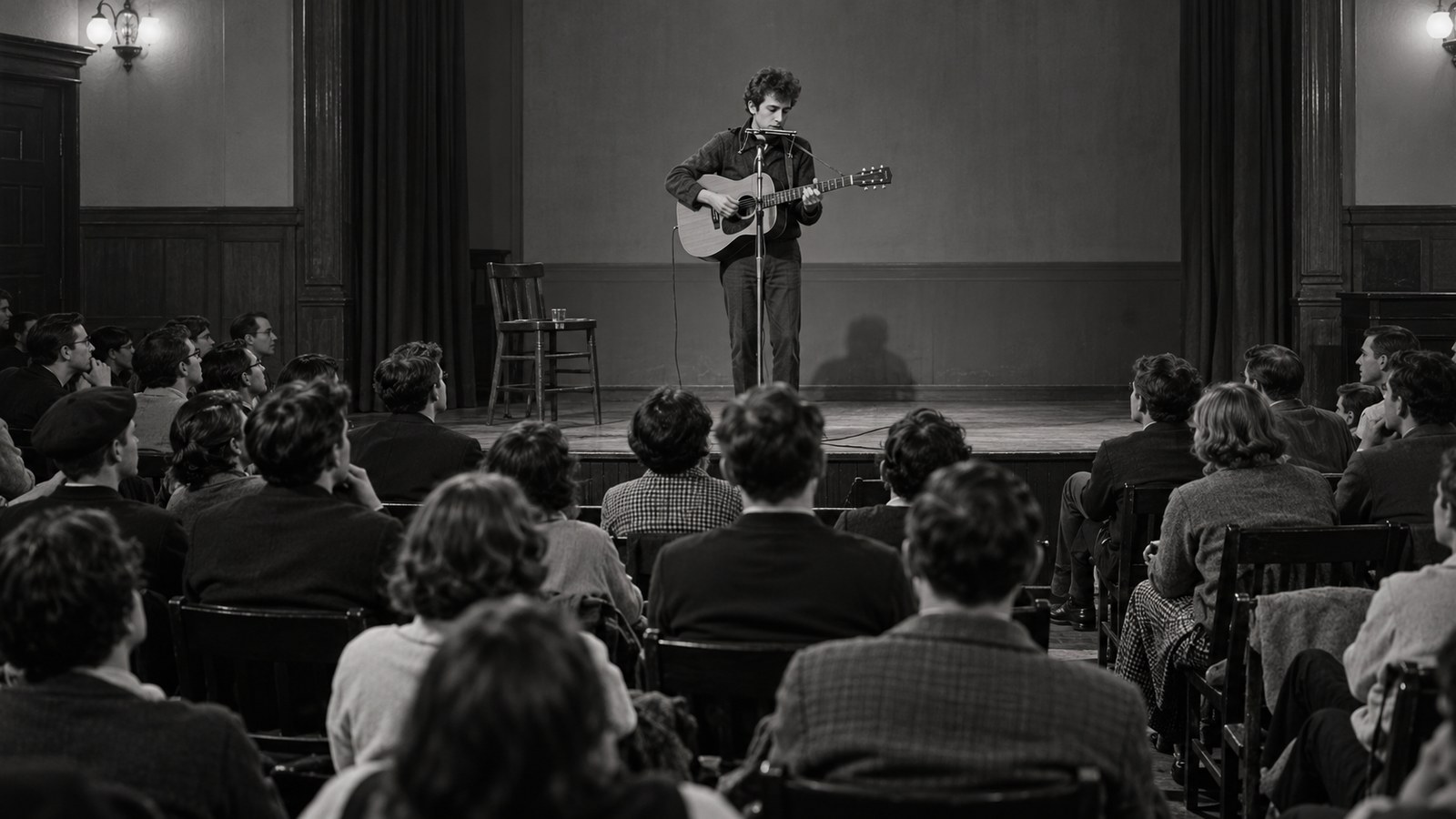
On This Day in Pop: November 4, 1961
On November 4, 1961, Bob Dylan gave his first formal New York concert at Carnegie Chapter Hall. The twenty-year-old singer performed traditional ballads, blues, topical material and early originals with acoustic guitar and harmonica. Promoter Izzy Young organized the recital in the two-hundred-seat room, but only about fifty people attended. Dylan had arrived in New York earlier that year and built a reputation in Greenwich Village clubs while seeking out Woody Guthrie and absorbing folk repertory. A favorable New York Times review had recently increased professional interest. The date captures the event before later reputation made its consequences look inevitable, when audiences encountered a new release, performance or institution with only the expectations available at the time.
The small audience makes the concert valuable as a record of ambition before fame. Dylan was testing how borrowed songs, invented autobiography, humor and a distinctive voice could become a coherent public identity. Popular culture is never made by a famous name alone. Writers, performers, producers, technicians, broadcasters, retailers, venues and audiences shape what becomes visible and what survives. Their collaboration also determines which experiments reach the public and which disappear before they can build momentum. Looking at those conditions turns an anniversary from a list entry into a record of choices, limits and competing interests.
Columbia Records released his debut album the following year, and his songwriting soon transformed the folk revival. Recordings from the Chapter Hall performance later circulated, allowing listeners to hear work still in formation. That afterlife matters because influence does not move in a straight line. Reruns, reissues, new technology, criticism and community memory can change the meaning of a work long after its first appearance. Durable pop history therefore holds creative achievement beside questions of labor, access, power and representation.
The recital demonstrates that cultural turning points can look minor when they occur. Its importance lies not in a triumphant crowd but in an artist learning to command a room with material gathered from many traditions. Returning to this November date means separating what participants knew then from what later audiences added. Recordings, photographs, broadcasts and recollections keep the moment active, but they also select and reshape it. That distinction protects against hindsight: a chart position, premiere, publication, concert or opening may become a neat milestone later, but the people present still faced uncertainty. Reading the moment in both directions—through its original conditions and its accumulated meanings—keeps celebration from replacing history. The distance between the immediate event and its continuing interpretation is what makes this episode worth revisiting.
The concert took place on November 4, 1961.
On November 4, 1961, Bob Dylan gave his first formal New York concert at Carnegie Chapter Hall. The twenty-year-old singer performed traditional ballads, blues, topical material and early originals with acoustic guitar and harmonica.
Carnegie Chapter Hall was a smaller room within the Carnegie complex.
The small audience makes the concert valuable as a record of ambition before fame. Dylan was testing how borrowed songs, invented autobiography, humor and a distinctive voice could become a coherent public identity.
Izzy Young organized the recital.
Columbia Records released his debut album the following year, and his songwriting soon transformed the folk revival. Recordings from the Chapter Hall performance later circulated, allowing listeners to hear work still in formation.
Explore more of "On This Day ..."
Discover more events from the same date across news, politics, technology, sports, and other fields. Each link highlights significant moments that shaped history on different fronts.