

How Fungi Build Mycorrhizal Networks Explainer
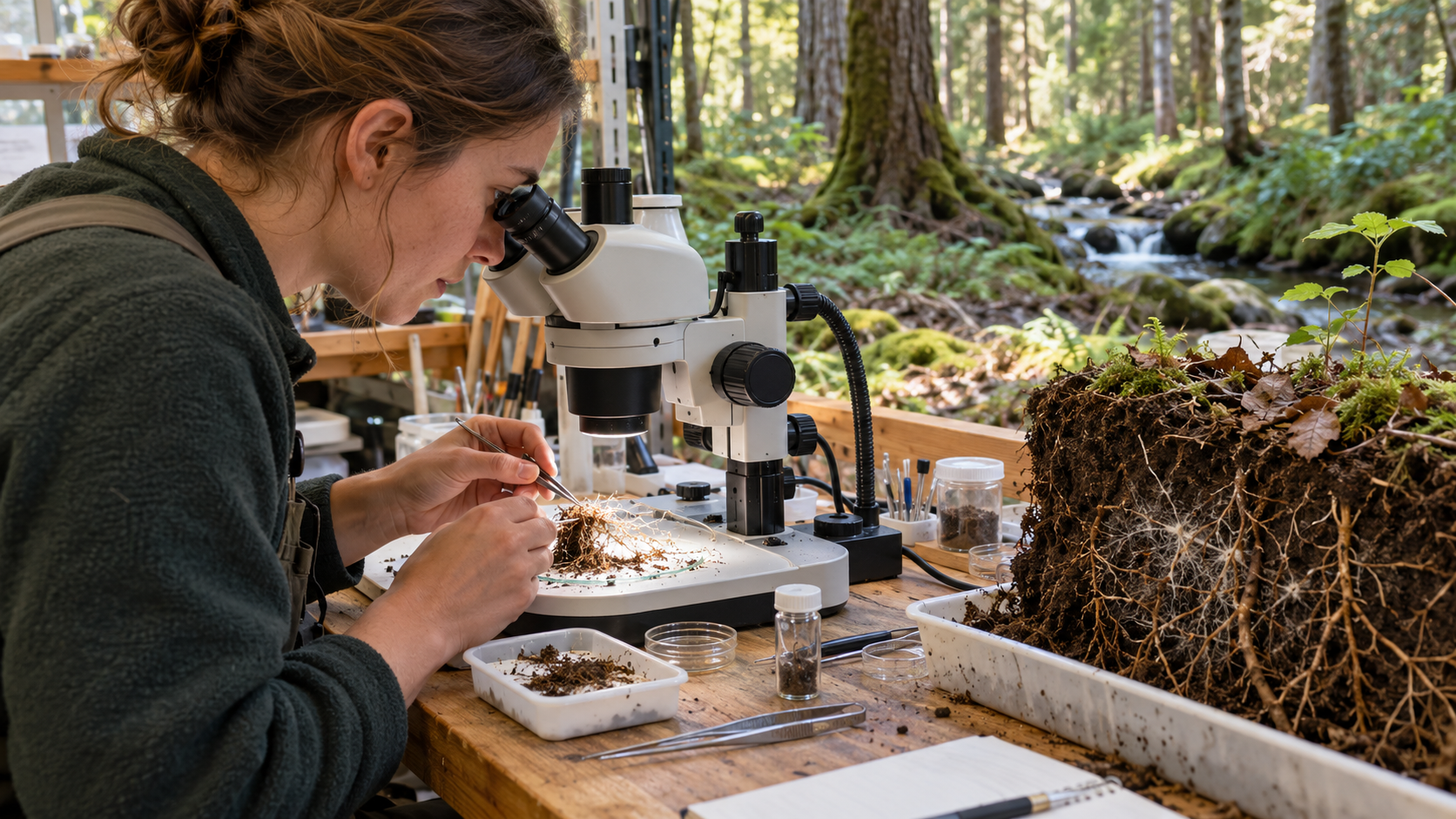
Most land plants form intimate partnerships with mycorrhizal fungi. The plant supplies the fungus with sugars or lipids made from photosynthesis. In return, the fungus explores soil with microscopic filaments called hyphae and delivers mineral nutrients and, in some settings, water to the root. The association enlarges the volume of soil that the combined partners can access.
The relationship begins through chemical signals between roots and compatible fungi. In arbuscular mycorrhizae, fungal hyphae enter the root cortex and form finely branched structures called arbuscules inside plant cell walls but outside the cell membrane. These structures create a large exchange surface. Ectomycorrhizal fungi instead wrap root tips in a sheath and grow between root cells.
Outside the root, hyphae extend through pores too small for many roots to enter. Fungal enzymes and transport proteins help acquire phosphorus, nitrogen, and micronutrients. Nutrients move through the fungal network to exchange sites at the root, while plant carbon moves in the opposite direction. The trade is regulated by both partners and changes with soil conditions and resource availability.
A single fungus can colonize multiple roots, and a plant can associate with several fungal species. Such common mycorrhizal networks may physically link different plants. Experiments show that carbon, nutrients, and chemical signals can move through some networks, but the amount, direction, and ecological importance vary widely. The popular image of a universal cooperative forest internet goes beyond what every study demonstrates.
Mycorrhizae can improve seedling establishment, nutrient uptake, soil aggregation, and tolerance of some stresses. They can also alter competition among plants and interactions with pathogens. Benefits are not automatic: the fungus consumes plant carbon, and under nutrient-rich conditions the cost may outweigh the return. Some fungal partners are more helpful than others in a particular environment.
Fertilization, tillage, soil disturbance, drought, pollution, plant identity, and microbial competition all influence these partnerships. Mycorrhizal fungi are not plant roots and do not simply donate resources. They are living organisms pursuing their own growth within a negotiated exchange. Understanding the network requires measuring both the physical connections and the actual movement and fitness effects of resources.
Plants provide photosynthetic carbon, while mycorrhizal fungi extend hyphae through soil and supply nutrients such as phosphorus and nitrogen.
Arbuscular fungi form exchange structures within the root cortex; ectomycorrhizal fungi sheath root tips and grow between cells.
Fine hyphae enter tiny soil pores and transport acquired nutrients toward the root. Specialized membranes regulate the two-way exchange.
The partnership responds to supply and demand. Plants and fungi can allocate more resources to partners that provide a better return.
Some fungi connect multiple plants, but connection alone does not prove large or beneficial resource transfers among every participant.
Soil fertility, disturbance, species identity, and stress can change costs and benefits. Mycorrhizae are mutualisms with ecological conditions, not guaranteed charity.
Explore more "Explainers"
Discover additional explainers across politics, science, business, technology, and other fields. Each explainer breaks down a complex idea into clear, everyday language—helping you better understand how major concepts, systems, and debates shape the world around us.