

On This Day in Science: March 10, 1977
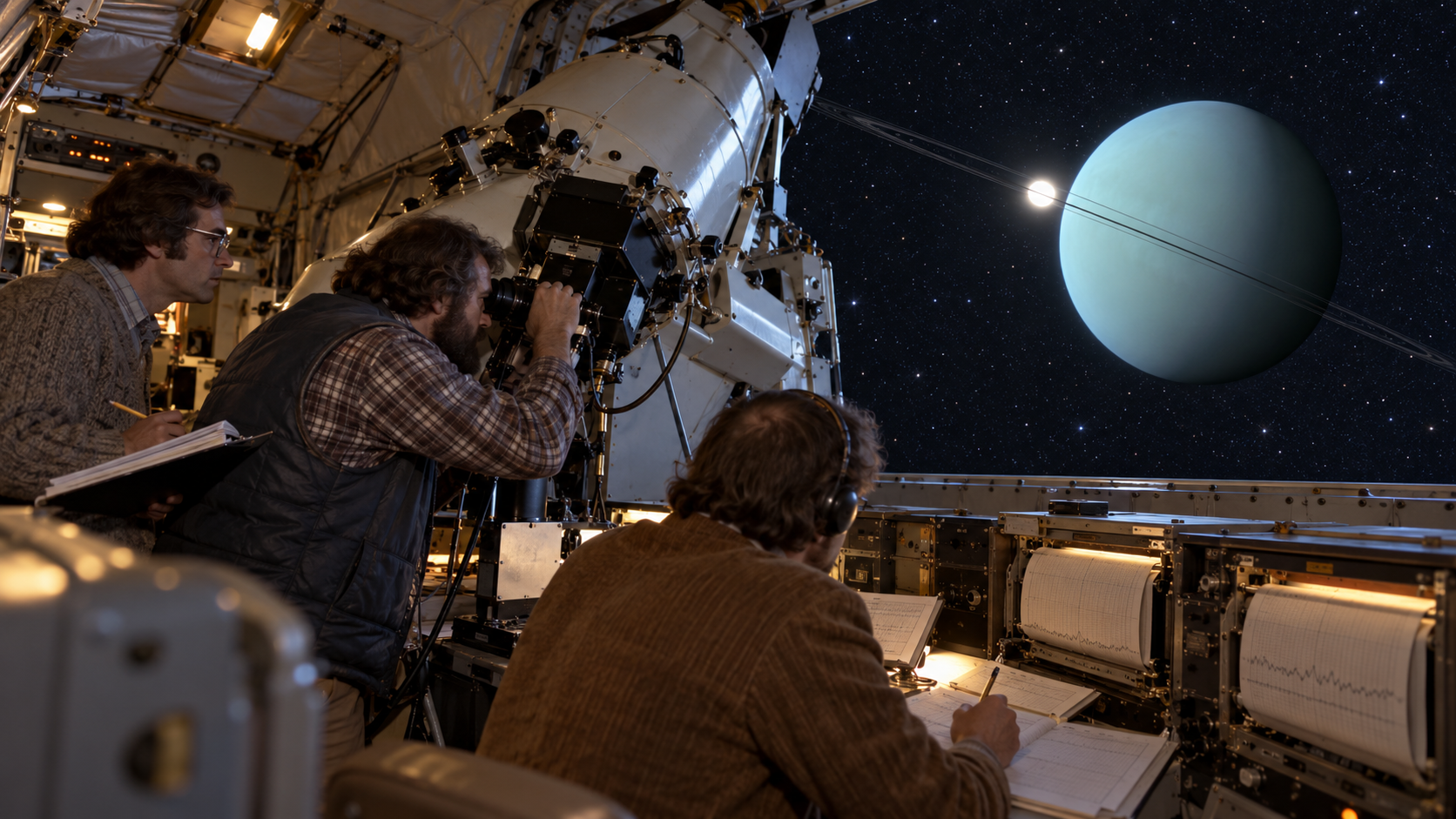
On March 10, 1977, astronomers James Elliot, Edward Dunham, and Douglas Mink used NASA’s Kuiper Airborne Observatory to watch Uranus pass in front of a star. The goal was to study the planet’s atmosphere by measuring how the starlight faded. Instead, the instruments recorded several brief dips before and after the main occultation. Their symmetry showed that material surrounding Uranus was repeatedly blocking the star: the planet had rings.
The observation was made from a telescope mounted in a high-flying aircraft, above much of the water vapor and turbulence that hinder infrared astronomy. Precise timing mattered because the team was recording a moving line of sight as Earth, Uranus, and the star aligned. Multiple narrow interruptions could not be explained by atmospheric dimming alone. The data initially revealed five rings, with additional structure identified later.
Uranus’s rings are dark, narrow, and very different in appearance from Saturn’s broad bright system. Small moons and gravitational resonances help confine some of the material, while collisions and radiation gradually alter the particles. Voyager 2 photographed the rings during its 1986 flyby, and later observatories expanded the inventory. The system showed that rings were not a rare ornament limited to Saturn.
The discovery is a model of productive surprise. The experiment was aimed at an atmosphere, yet the instrument recorded information from everything along the path of the starlight. By recognizing repeated secondary signals as real geometry rather than noise, the researchers opened a new subject for planetary dynamics. Occultations remain powerful because distant light can probe structures far too small or dark to image directly. Seen across a longer timeline, the event also shows that scientific milestones are junctions rather than isolated beginnings. Earlier experiments, tools, and institutions made the work possible, while later teams tested its limits and carried the result into new settings. What survives is more than an anniversary fact: it is a traceable chain of evidence, correction, and application that allows one moment to remain relevant as knowledge and technology continue to change. The anniversary also highlights the difference between a first result and a finished understanding. A successful observation can settle one question while opening several harder ones, and even a failed objective can return measurements that reshape later designs. Preserved data, specimens, photographs, and hardware allow new generations to revisit the work with better tools. Science advances through that continuity, where a specific date marks progress without pretending that inquiry stopped there. Its place on the calendar is therefore useful as an entry point, not an endpoint. The people involved worked with the instruments, assumptions, and social conditions of their time, and later research has both extended and corrected their conclusions. Reconstructing the event carefully means separating what was known that day from what became clear afterward. That distinction protects the history from myth while showing how cumulative evidence turns a memorable episode into lasting scientific knowledge.
Starlight dipped several times before and after Uranus itself crossed the line of sight.
The matched pattern revealed narrow rings surrounding the planet.
The Kuiper Airborne Observatory carried a telescope above much of Earth's atmospheric interference.
Accurate timing turned each change in brightness into a map across the Uranian system.
Uranus's rings contain comparatively dark material and differ sharply from Saturn's bright broad bands.
Later spacecraft and telescope observations revealed additional rings and small moons.
Explore more of "On This Day ..."
Discover more events from the same date across news, politics, technology, sports, and other fields. Each link highlights significant moments that shaped history on different fronts.