

On This Day in Science: March 12, 2008
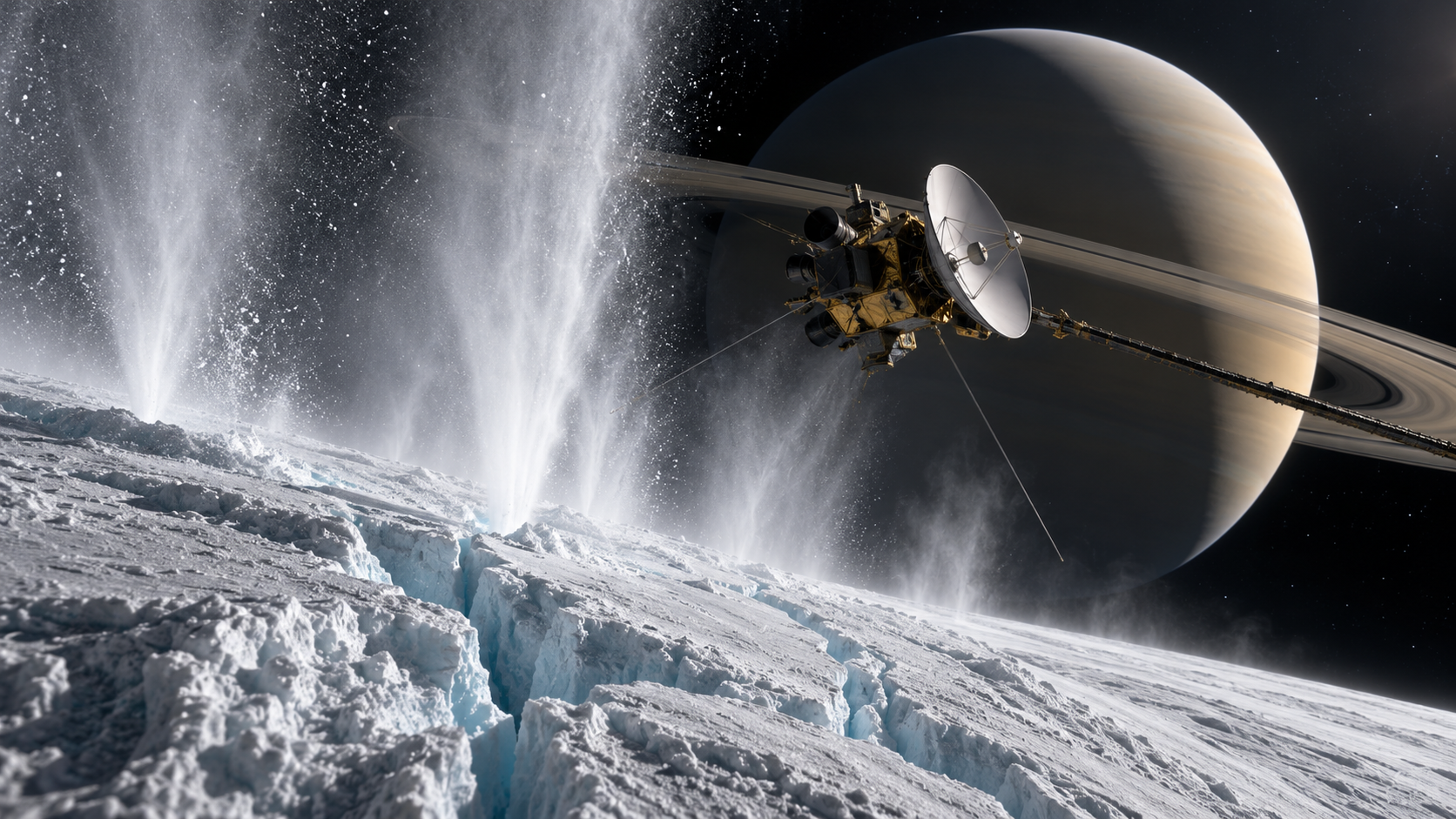
On March 12, 2008, NASA’s Cassini spacecraft swept past Saturn’s moon Enceladus and flew through material erupting from its south polar region. The probe passed only about fifty kilometers above the surface at closest approach and crossed the extended plume at greater altitude. Instead of observing an icy world only from afar, Cassini could use instruments aboard the spacecraft to sample gases and particles escaping from beneath the crust.
Earlier Cassini images had revealed jets streaming from warm fractures nicknamed tiger stripes. During the 2008 encounter, the Ion and Neutral Mass Spectrometer examined vapor while the Cosmic Dust Analyzer studied icy grains. The measurements identified water vapor along with carbon dioxide, methane, and other compounds. Later flybys and analysis strengthened the conclusion that a global salty ocean lies beneath the ice and interacts with a rocky seafloor.
Enceladus is small, but Saturn’s gravity and orbital relationships with other moons flex its interior and supply heat. Water from the subsurface ocean reaches fractures near the south pole, where it vents into space. Some particles fall back as snow, while others feed Saturn’s E ring. Because the plume delivers interior material beyond the surface, a spacecraft can investigate the ocean without drilling through kilometers of ice.
The flyby helped transform Enceladus into one of the leading places to study habitability beyond Earth. Cassini was not designed to detect life, and organic molecules do not by themselves demonstrate biology. The mission instead established several ingredients relevant to life: persistent liquid water, chemical energy, salts, and complex carbon-bearing compounds. Sampling an extraterrestrial ocean by flying through its spray remains one of planetary science’s most elegant opportunities. Its place on the calendar is therefore useful as an entry point, not an endpoint. The people involved worked with the instruments, assumptions, and social conditions of their time, and later research has both extended and corrected their conclusions. Reconstructing the event carefully means separating what was known that day from what became clear afterward. That distinction protects the history from myth while showing how cumulative evidence turns a memorable episode into lasting scientific knowledge. For science history, the episode is also a case study in how evidence moves from an observation or engineered test into a durable body of knowledge. Instruments supplied measurements, specialists debated interpretation, and later work refined what the first result could mean. Archives preserve the early record while new methods let researchers ask different questions of it. That continuing revision is not a weakness in the original achievement; it is the process through which a dated milestone remains scientifically useful. Seen across a longer timeline, the event also shows that scientific milestones are junctions rather than isolated beginnings. Earlier experiments, tools, and institutions made the work possible, while later teams tested its limits and carried the result into new settings. What survives is more than an anniversary fact: it is a traceable chain of evidence, correction, and application that allows one moment to remain relevant as knowledge and technology continue to change.
Cassini crossed material erupting above Enceladus's south pole while passing close to the icy surface.
The trajectory allowed direct analysis of vapor and frozen grains.
Water, salts, organic compounds, and heat point to a subsurface ocean interacting with rock.
Tidal flexing helps supply the energy that keeps water active inside the small moon.
Jets carry interior material into space, avoiding the need to drill through the crust.
The plume makes Enceladus a prime target for future studies of ocean-world habitability.
Explore more of "On This Day ..."
Discover more events from the same date across news, politics, technology, sports, and other fields. Each link highlights significant moments that shaped history on different fronts.