

On This Day in Science: March 15, 2004
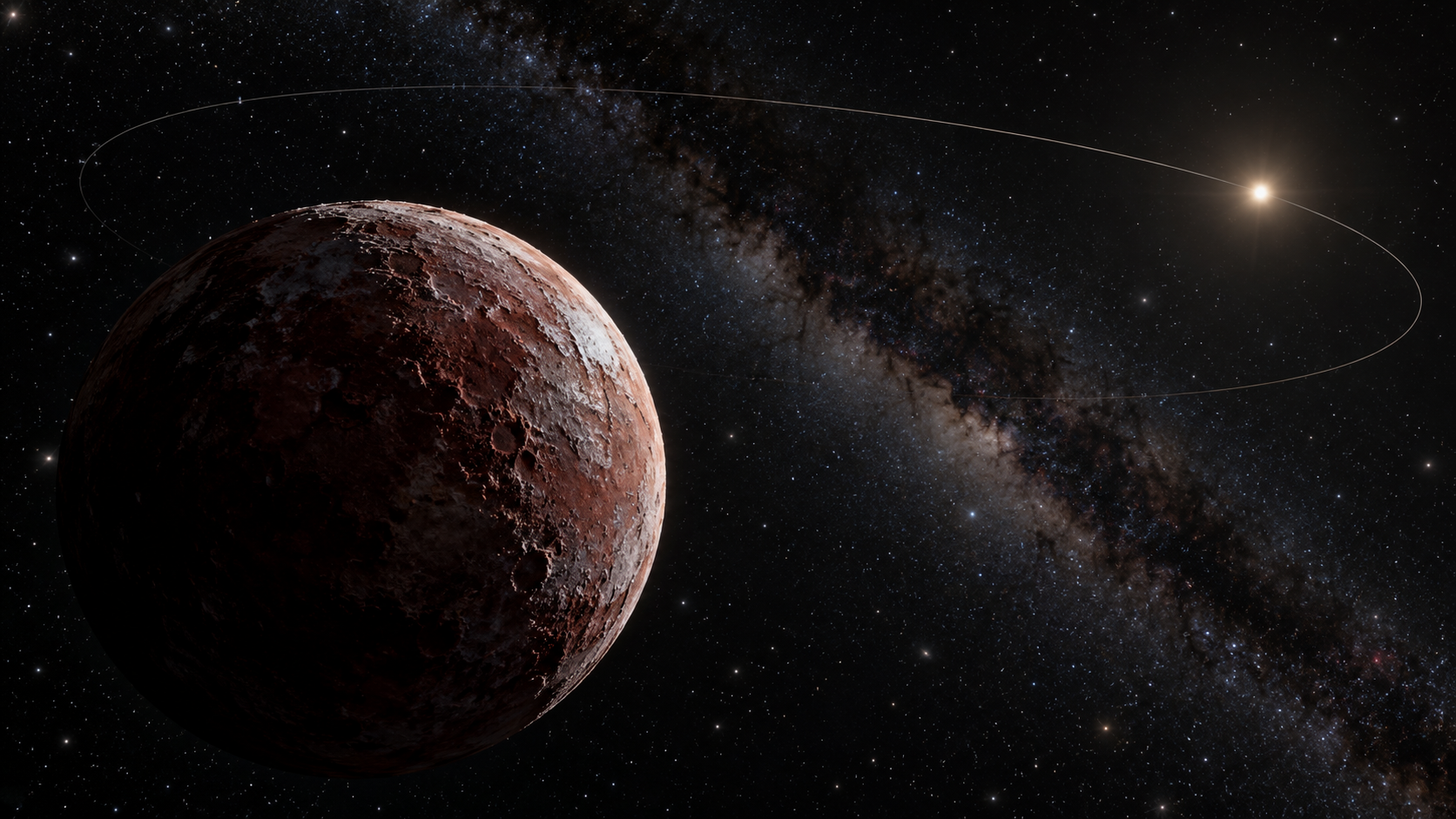
On March 15, 2004, astronomers announced the discovery of Sedna, one of the most distant large bodies then known in the Solar System. Mike Brown, Chad Trujillo, and David Rabinowitz had first imaged it in November 2003 during a survey using the Samuel Oschin Telescope at Palomar Observatory. Follow-up observations showed that the faint reddish object traveled on an extraordinarily elongated orbit unlike those of the familiar planets or most Kuiper Belt objects.
Sedna never approaches Neptune closely enough for ordinary encounters with that planet to explain its path easily. It takes roughly eleven thousand years to complete one orbit and spends most of that time far beyond the Sun. Its surface appears very red, probably from radiation-altered organic-rich material. The body’s exact size and composition remain uncertain because it is so faint, but thermal measurements indicate a diameter of roughly one thousand kilometers.
Its detached orbit prompted several hypotheses. A star passing near the young Sun might have altered Sedna’s path, or interactions within the Sun’s birth cluster may have shaped an inner Oort Cloud. Some researchers have also examined whether an unseen distant planet could organize the orbits of Sedna and similar objects. No single explanation is established, and observational bias complicates comparisons among the small number of known distant bodies.
Sedna’s announcement widened the frontier of planetary surveys just as astronomers were debating how to classify worlds beyond Neptune. It is formally a minor planet and has not been visited by spacecraft. Its scientific value lies in orbital memory: a small frozen body can preserve evidence of gravitational events from the Solar System’s youth. Finding more Sedna-like objects will be essential for distinguishing history from coincidence. The anniversary also highlights the difference between a first result and a finished understanding. A successful observation can settle one question while opening several harder ones, and even a failed objective can return measurements that reshape later designs. Preserved data, specimens, photographs, and hardware allow new generations to revisit the work with better tools. Science advances through that continuity, where a specific date marks progress without pretending that inquiry stopped there. Its place on the calendar is therefore useful as an entry point, not an endpoint. The people involved worked with the instruments, assumptions, and social conditions of their time, and later research has both extended and corrected their conclusions. Reconstructing the event carefully means separating what was known that day from what became clear afterward. That distinction protects the history from myth while showing how cumulative evidence turns a memorable episode into lasting scientific knowledge. For science history, the episode is also a case study in how evidence moves from an observation or engineered test into a durable body of knowledge. Instruments supplied measurements, specialists debated interpretation, and later work refined what the first result could mean. Archives preserve the early record while new methods let researchers ask different questions of it. That continuing revision is not a weakness in the original achievement; it is the process through which a dated milestone remains scientifically useful.
Sedna was found in survey images and confirmed through follow-up observations of its slow motion.
Its distant surface appears unusually red and remains difficult to measure in detail.
The body follows a highly elongated path lasting roughly eleven thousand years.
It stays too far from Neptune for simple close encounters with that planet to explain the orbit.
Passing stars, the Sun's birth cluster, and distant unseen planets have all been studied as possible influences.
More discoveries are needed before scientists can decide which explanation fits the outer Solar System.
Explore more of "On This Day ..."
Discover more events from the same date across news, politics, technology, sports, and other fields. Each link highlights significant moments that shaped history on different fronts.