

On This Day in Science: March 16, 1926
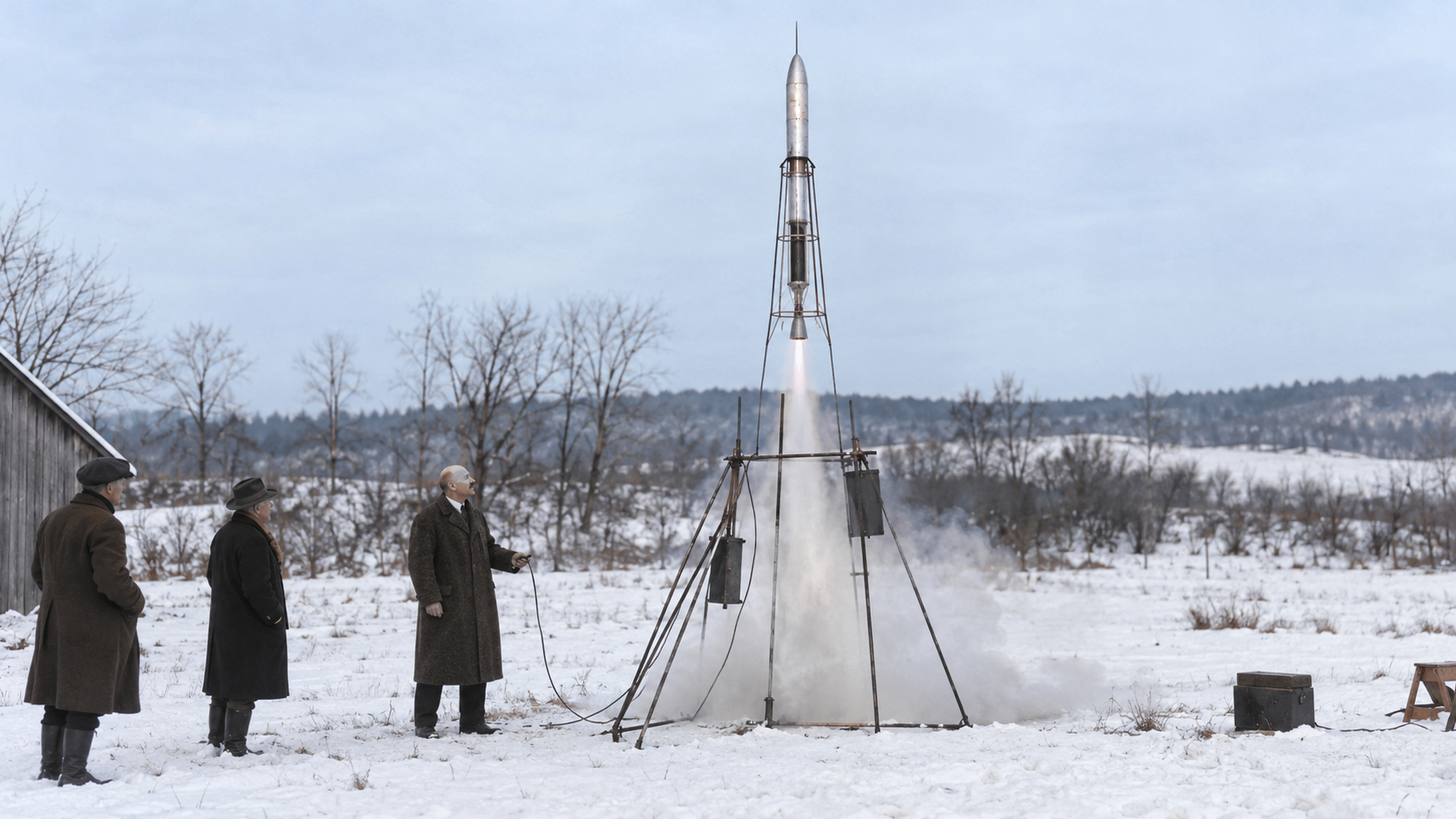
On March 16, 1926, Robert Goddard launched the world’s first successful liquid-fueled rocket from a snow-covered field in Auburn, Massachusetts. The spindly vehicle burned gasoline and liquid oxygen for only a few seconds, rose about twelve meters, and landed roughly fifty-six meters away. Its flight was modest by later standards, but it proved that a controllable liquid-propellant engine could lift its tanks, plumbing, and structure from the ground.
Goddard placed the engine at the top of the frame, with fuel tanks below and lines feeding upward. Ignition and valve timing had to work despite cold temperatures and experimental equipment. Assistants, including his wife Esther’s brother Henry Sachs, helped prepare and photograph the test. The launch occurred on a family farm, far from the large institutional ranges that would later define rocketry.
Liquid engines offered advantages over solid rockets: combustion could be sustained, regulated, and eventually restarted, while separate fuel and oxidizer allowed operation beyond the atmosphere. They also introduced difficult problems in pumps, cooling, injection, stability, and lightweight tanks. Goddard pursued gyroscopic guidance, staged designs, and high-altitude research, accumulating patents and practical knowledge even when public attention sometimes mocked his ambitions.
Modern launch vehicles are vastly larger and often use different propellants, but many still depend on the same fundamental sequence: store liquids, meter them into a chamber, release hot gas through a nozzle, and trade mass for velocity. The Auburn flight transformed that sequence from a laboratory idea into a flying machine. Its short path across a cabbage field became one of the clearest beginnings of practical liquid rocketry. Its place on the calendar is therefore useful as an entry point, not an endpoint. The people involved worked with the instruments, assumptions, and social conditions of their time, and later research has both extended and corrected their conclusions. Reconstructing the event carefully means separating what was known that day from what became clear afterward. That distinction protects the history from myth while showing how cumulative evidence turns a memorable episode into lasting scientific knowledge. For science history, the episode is also a case study in how evidence moves from an observation or engineered test into a durable body of knowledge. Instruments supplied measurements, specialists debated interpretation, and later work refined what the first result could mean. Archives preserve the early record while new methods let researchers ask different questions of it. That continuing revision is not a weakness in the original achievement; it is the process through which a dated milestone remains scientifically useful. Seen across a longer timeline, the event also shows that scientific milestones are junctions rather than isolated beginnings. Earlier experiments, tools, and institutions made the work possible, while later teams tested its limits and carried the result into new settings. What survives is more than an anniversary fact: it is a traceable chain of evidence, correction, and application that allows one moment to remain relevant as knowledge and technology continue to change.
The rocket burned gasoline and liquid oxygen, rose about twelve meters, and flew for only a few seconds.
It was the first successful launch of a liquid-fueled rocket.
Tanks, valves, feed lines, ignition, and combustion all had to function in a lightweight moving vehicle.
The complexity offered control and performance that solid propellants could not match.
Goddard continued developing guidance, staging, and propulsion ideas through later experiments and patents.
Liquid engines became central to launch vehicles and spacecraft across the world.
Explore more of "On This Day ..."
Discover more events from the same date across news, politics, technology, sports, and other fields. Each link highlights significant moments that shaped history on different fronts.