

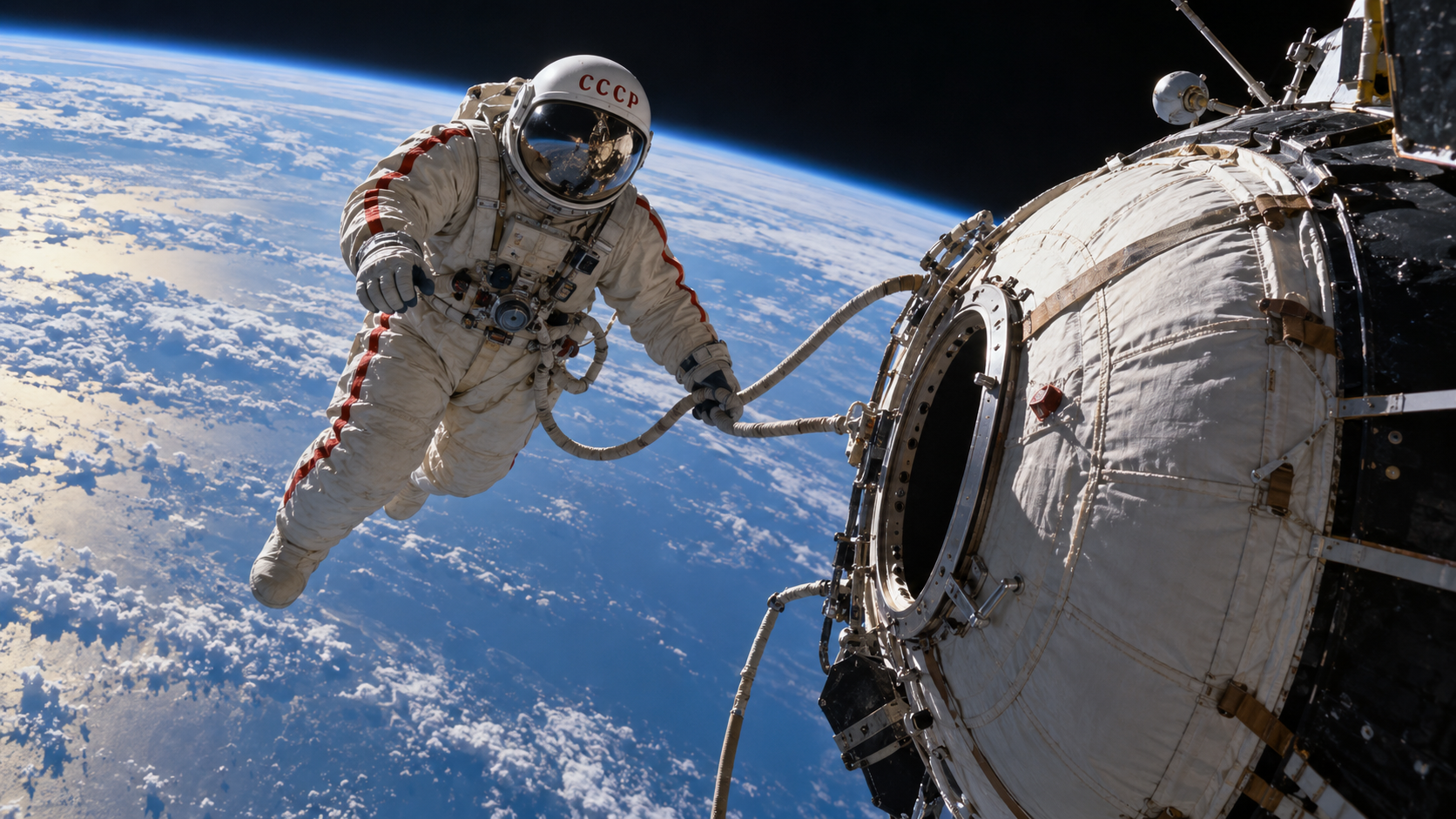
On This Day in Science: March 18, 1965
On March 18, 1965, Soviet cosmonaut Alexei Leonov climbed through an inflatable airlock attached to Voskhod 2 and pushed into open space. Tethered to the spacecraft, he floated outside for about twelve minutes while crewmate Pavel Belyayev remained inside. Leonov became the first person to perform an extravehicular activity, demonstrating that a human could leave a pressurized vehicle, move in vacuum, and return.
The achievement nearly became a disaster. In vacuum, Leonov’s suit expanded and became so stiff that he could not fit back through the airlock as planned. With limited oxygen and no opportunity for lengthy consultation, he reduced suit pressure below the prescribed setting and entered headfirst rather than feetfirst. He then had to turn inside the narrow airlock before sealing the hatch. His body temperature and heart rate rose sharply during the struggle.
Voskhod 2 faced additional problems during reentry. Automatic systems failed, forcing Belyayev to orient the spacecraft manually, and the capsule landed far from the intended recovery area in a snowy forest. The crew waited through the cold before rescuers could reach and extract them. The mission revealed how a successful headline could contain layers of operational risk concealed from the public at the time.
Spacewalking later became essential for assembling stations, repairing telescopes, conducting experiments, and servicing spacecraft. Modern suits, handrails, tethers, airlocks, and rescue procedures reflect decades of lessons from early EVAs. Leonov’s flight remains remarkable not because the difficulties disappeared, but because it exposed them. The first walk proved the concept while showing that pressure garments become small spacecraft whose mobility and life support must work under unforgiving conditions. Seen across a longer timeline, the event also shows that scientific milestones are junctions rather than isolated beginnings. Earlier experiments, tools, and institutions made the work possible, while later teams tested its limits and carried the result into new settings. What survives is more than an anniversary fact: it is a traceable chain of evidence, correction, and application that allows one moment to remain relevant as knowledge and technology continue to change. The anniversary also highlights the difference between a first result and a finished understanding. A successful observation can settle one question while opening several harder ones, and even a failed objective can return measurements that reshape later designs. Preserved data, specimens, photographs, and hardware allow new generations to revisit the work with better tools. Science advances through that continuity, where a specific date marks progress without pretending that inquiry stopped there. Its place on the calendar is therefore useful as an entry point, not an endpoint. The people involved worked with the instruments, assumptions, and social conditions of their time, and later research has both extended and corrected their conclusions. Reconstructing the event carefully means separating what was known that day from what became clear afterward. That distinction protects the history from myth while showing how cumulative evidence turns a memorable episode into lasting scientific knowledge.
Leonov left Voskhod 2 through a deployable airlock and floated outside on a tether.
The excursion lasted about twelve minutes and demonstrated human movement in vacuum.
Internal pressure made the suit expand and stiffen until Leonov could not reenter normally.
He lowered the pressure and climbed in headfirst, accepting serious physical risk.
The mission exposed problems in suit mobility, airlock design, reentry, and remote recovery.
Later spacewalk systems built on those lessons for construction, science, and repair.
Explore more of "On This Day ..."
Discover more events from the same date across news, politics, technology, sports, and other fields. Each link highlights significant moments that shaped history on different fronts.