

On This Day in Science: March 21, 1965
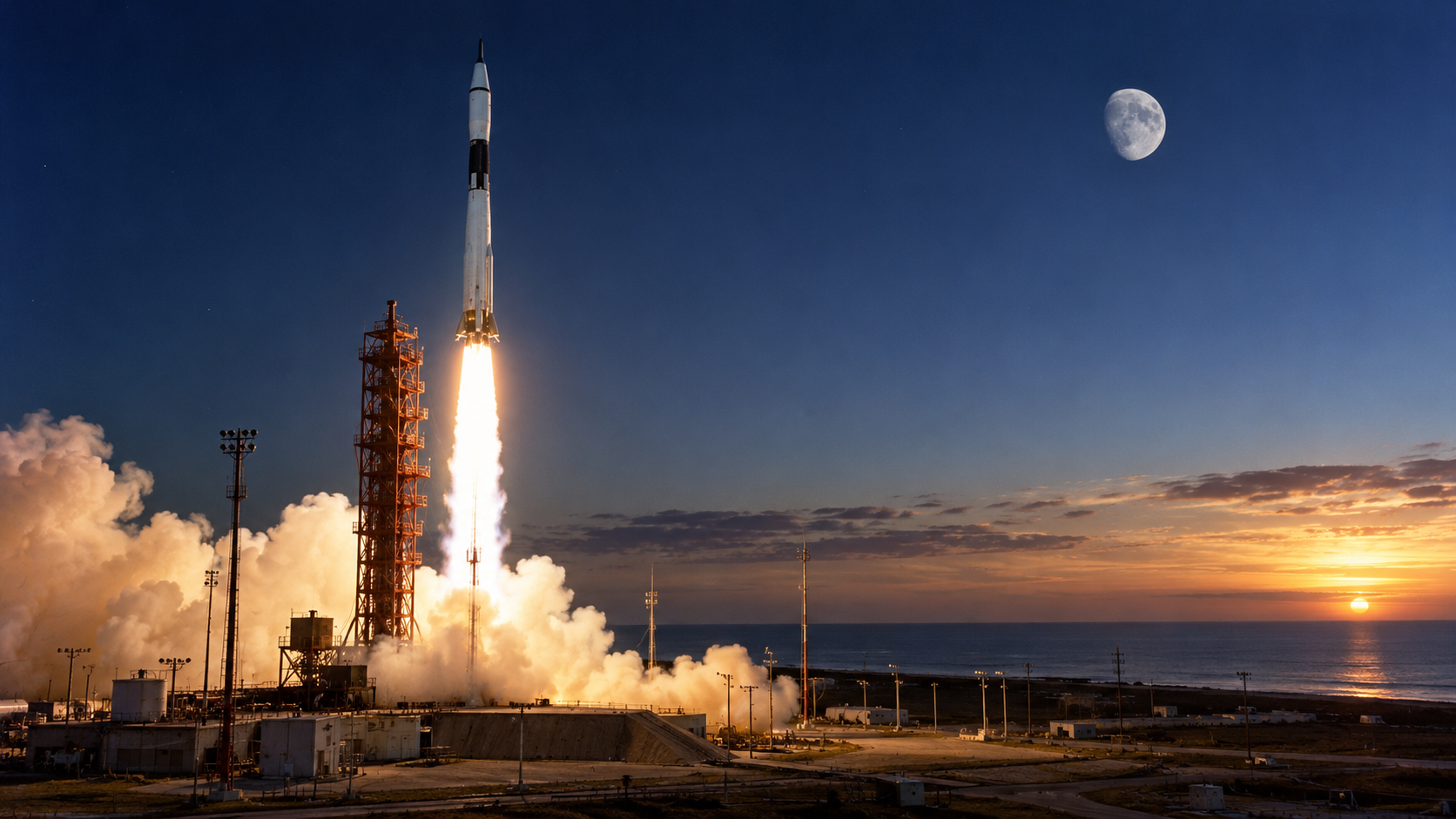
On March 21, 1965, NASA launched Ranger 9 from Cape Kennedy on an Atlas-Agena rocket. The spacecraft was the last of the Ranger series and was designed to photograph the Moon while descending on a deliberate impact trajectory. Earlier successful Rangers had imaged broad mare regions, but Ranger 9 targeted the geologically complex Alphonsus crater in the lunar highlands, an area then discussed as a possible site of relatively recent volcanic activity.
Ranger 9 carried six television cameras arranged in two channels with different fields of view and exposure patterns. Unlike earlier Block III spacecraft, its cameras were aligned more directly with the direction of flight, improving the final approach imagery. Solar panels supplied power while a high-gain antenna returned the signal. A course correction on March 23 refined the path toward the intended target.
The mission had no braking engine or landing gear because impact was part of the design. As the spacecraft fell, each successive frame would cover a smaller area at better resolution, creating a nested sequence from regional geology to details only tens of centimeters across. The final image stream would last minutes, and the spacecraft itself would not survive to confirm what it had transmitted.
Ranger 9’s launch reflected a method of learning through purposeful loss. The probe converted its remaining altitude into image scale, sending the most valuable information immediately before destruction. The series gave scientists and Apollo planners close views before orbiters and landers could provide broader maps and surface measurements. Three days after launch, the final descent would also become a public television event. For science history, the episode is also a case study in how evidence moves from an observation or engineered test into a durable body of knowledge. Instruments supplied measurements, specialists debated interpretation, and later work refined what the first result could mean. Archives preserve the early record while new methods let researchers ask different questions of it. That continuing revision is not a weakness in the original achievement; it is the process through which a dated milestone remains scientifically useful. Seen across a longer timeline, the event also shows that scientific milestones are junctions rather than isolated beginnings. Earlier experiments, tools, and institutions made the work possible, while later teams tested its limits and carried the result into new settings. What survives is more than an anniversary fact: it is a traceable chain of evidence, correction, and application that allows one moment to remain relevant as knowledge and technology continue to change. The anniversary also highlights the difference between a first result and a finished understanding. A successful observation can settle one question while opening several harder ones, and even a failed objective can return measurements that reshape later designs. Preserved data, specimens, photographs, and hardware allow new generations to revisit the work with better tools. Science advances through that continuity, where a specific date marks progress without pretending that inquiry stopped there.
Ranger 9 was the last spacecraft in NASA's first program for close lunar imaging.
Its target was Alphonsus crater in the geologically varied lunar highlands.
Two camera channels recorded nested views as the spacecraft approached the surface.
Direct camera alignment improved the detail available during the final plunge.
Ranger 9 had no landing system and transmitted data until deliberate impact.
The disposable architecture exchanged the spacecraft for rapidly improving close-range photographs.
Explore more of "On This Day ..."
Discover more events from the same date across news, politics, technology, sports, and other fields. Each link highlights significant moments that shaped history on different fronts.