

On This Day in Science: March 25, 1655
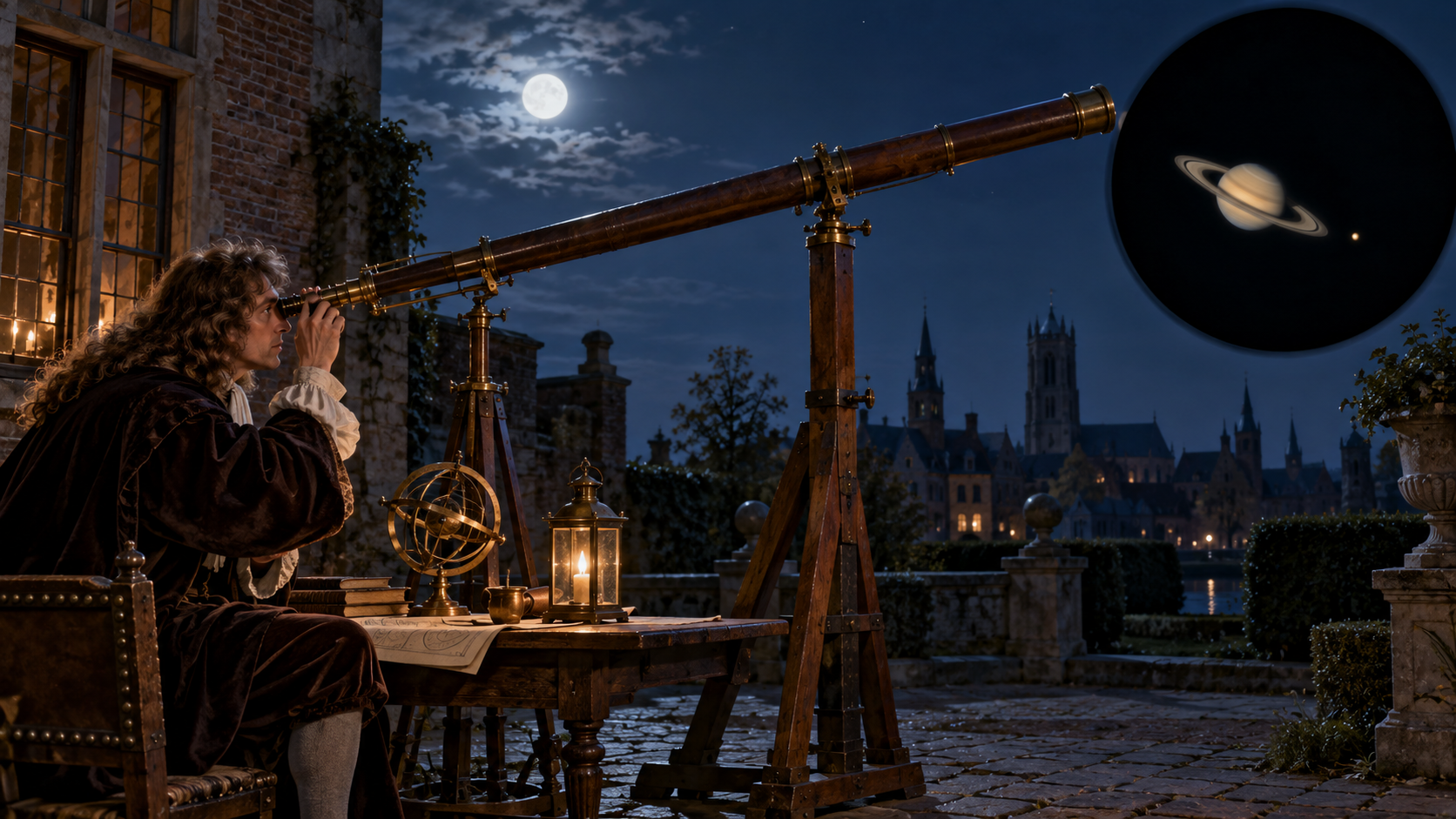
On March 25, 1655, Dutch astronomer Christiaan Huygens observed a small point accompanying Saturn and recognized it as a moon. It was the first satellite found around Saturn and would later be named Titan. Huygens used a refracting telescope made with his brother Constantijn Jr., whose improved lenses provided the clarity and magnification needed to separate the object from Saturn’s glare and follow its motion over successive nights.
Saturn was already a puzzle because early telescopes showed changing appendages that observers could not explain. Huygens eventually proposed that a thin flat ring surrounded the planet without touching it. Tracking Titan helped him establish the geometry and timescale of the Saturnian system. He called the moon simply Saturn’s moon; the name Titan became standard much later as more satellites were discovered.
Modern observations reveal Titan as larger than Mercury, wrapped in a dense nitrogen atmosphere with methane clouds, rivers, lakes, dunes, and water ice. NASA’s Cassini mission mapped its surface by radar, while ESA’s Huygens probe descended through the haze and landed in 2005. Those findings turned the seventeenth-century point of light into one of the Solar System’s most chemically rich worlds.
The discovery shows how better optics expanded the planetary system one companion at a time. Huygens did not see Titan’s surface or atmosphere; he established its existence through position and repeated motion. That careful separation of a persistent orbiting body from background stars is the same logic used in later moon searches, even as detectors replaced the human eye and telescopes moved into space. For science history, the episode is also a case study in how evidence moves from an observation or engineered test into a durable body of knowledge. Instruments supplied measurements, specialists debated interpretation, and later work refined what the first result could mean. Archives preserve the early record while new methods let researchers ask different questions of it. That continuing revision is not a weakness in the original achievement; it is the process through which a dated milestone remains scientifically useful. Seen across a longer timeline, the event also shows that scientific milestones are junctions rather than isolated beginnings. Earlier experiments, tools, and institutions made the work possible, while later teams tested its limits and carried the result into new settings. What survives is more than an anniversary fact: it is a traceable chain of evidence, correction, and application that allows one moment to remain relevant as knowledge and technology continue to change. The anniversary also highlights the difference between a first result and a finished understanding. A successful observation can settle one question while opening several harder ones, and even a failed objective can return measurements that reshape later designs. Preserved data, specimens, photographs, and hardware allow new generations to revisit the work with better tools. Science advances through that continuity, where a specific date marks progress without pretending that inquiry stopped there.
Huygens followed a point of light that moved consistently with Saturn rather than the background stars.
The object became the first known Saturnian moon and was later named Titan.
Improved long-focus lenses built with his brother helped reduce distortion and separate faint detail.
The same observations supported Huygens's explanation of Saturn's ring.
Titan is now known to have a thick atmosphere, methane weather, organic chemistry, and surface lakes.
Cassini and the Huygens lander transformed the remote dot into a mapped planetary environment.
Explore more of "On This Day ..."
Discover more events from the same date across news, politics, technology, sports, and other fields. Each link highlights significant moments that shaped history on different fronts.