

How Ocean Acidification Changes Seawater Explainer
The ocean naturally exchanges carbon dioxide with the atmosphere. As human activities raise atmospheric carbon dioxide, more of the gas dissolves into surface seawater. That uptake slows the accumulation of carbon dioxide in air, but it also changes the ocean’s acid-base balance. Ocean acidification refers to this long-term chemical shift, not to the ocean suddenly becoming a strong acid.
Dissolved carbon dioxide reacts with water to form carbonic acid. The acid can release hydrogen ions, which lowers pH. Much of the added hydrogen then combines with carbonate ions to form bicarbonate. Seawater remains mildly basic, but its average surface pH has fallen relative to preindustrial conditions, and the change is large on the logarithmic pH scale.
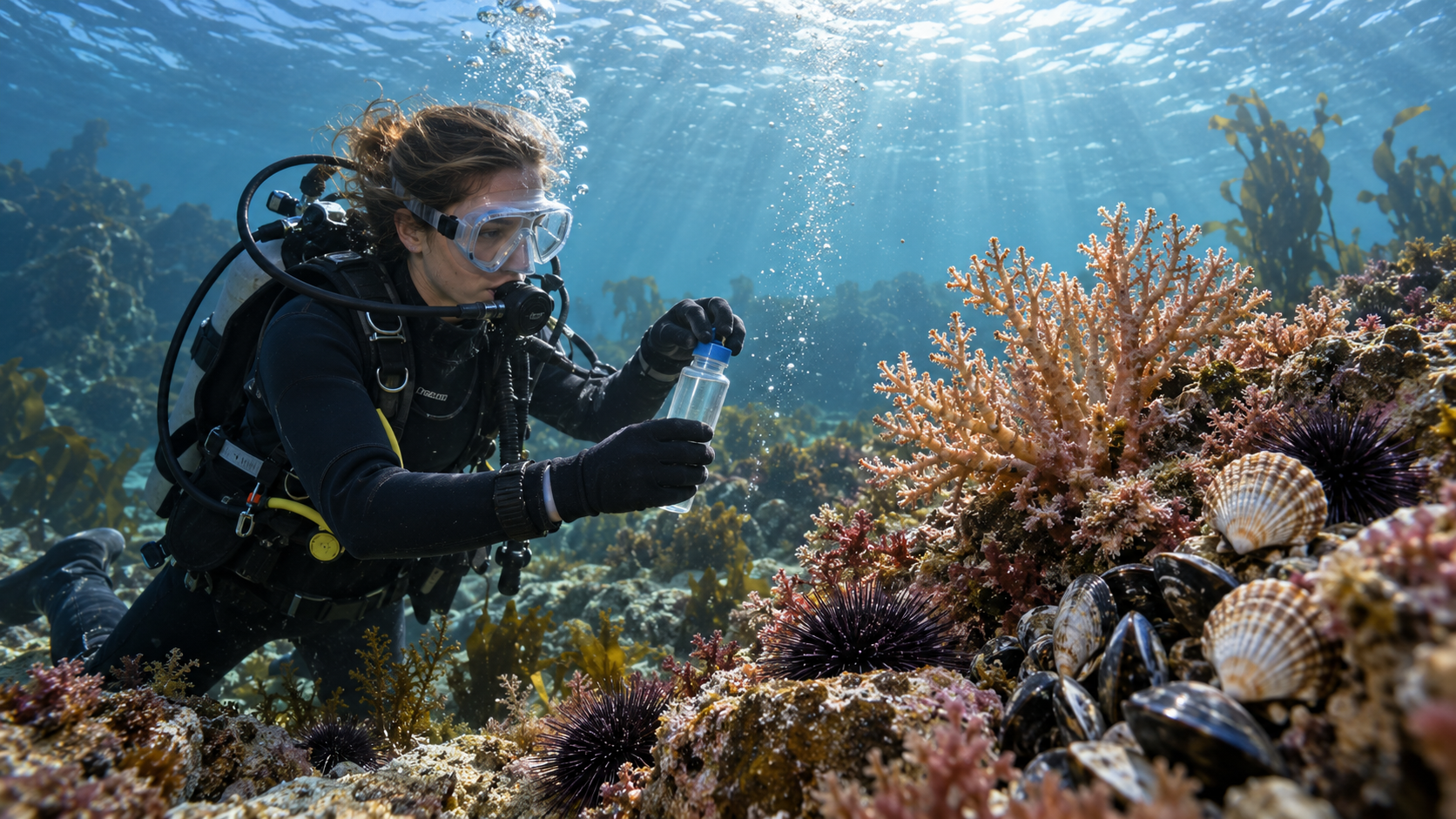
Carbonate ions are important because corals, oysters, clams, some plankton, and other organisms use them with calcium to build calcium carbonate shells or skeletons. When carbonate becomes less available, forming and maintaining those structures can require more energy. In sufficiently corrosive water, some forms of calcium carbonate can dissolve more readily.
The biological response is not identical for every species or life stage. Some organisms tolerate a wide range, while others show changes in growth, reproduction, behavior, or survival. Temperature, oxygen, food, pollution, and local adaptation can strengthen or soften the effects. Reef communities may also lose habitat if calcification slows while erosion continues.
Acidification varies across the ocean. Upwelling can bring naturally carbon-rich, lower-pH water toward coasts. Freshwater, respiration, photosynthesis, and local runoff create additional swings. Polar waters are especially vulnerable because cold water holds more carbon dioxide and often has lower carbonate saturation. Coastal monitoring is therefore needed alongside global averages.
Cutting carbon dioxide emissions addresses the main global driver. Local actions such as reducing nutrient pollution and protecting seagrass or kelp habitats may improve resilience in some places, but they cannot cancel continued atmospheric accumulation. Scientists track pH, dissolved inorganic carbon, alkalinity, and biological responses to understand both the chemistry and its ecological consequences.
Atmospheric carbon dioxide dissolves into the ocean, where it reacts with water and changes the carbonate system.
Carbonic acid releases hydrogen ions, lowering pH even though seawater remains on the basic side of the scale.
Hydrogen ions convert carbonate to bicarbonate, leaving less carbonate available for calcium carbonate structures.
Corals, shellfish, and plankton differ in sensitivity, and warming, oxygen, food, and pollution modify the response.
Upwelling, freshwater, photosynthesis, and respiration make acidification vary by depth, season, and location.
Monitoring and local resilience measures help, but limiting carbon dioxide emissions addresses the global cause.
Explore more "Explainers"
Discover additional explainers across politics, science, business, technology, and other fields. Each explainer breaks down a complex idea into clear, everyday language—helping you better understand how major concepts, systems, and debates shape the world around us.