

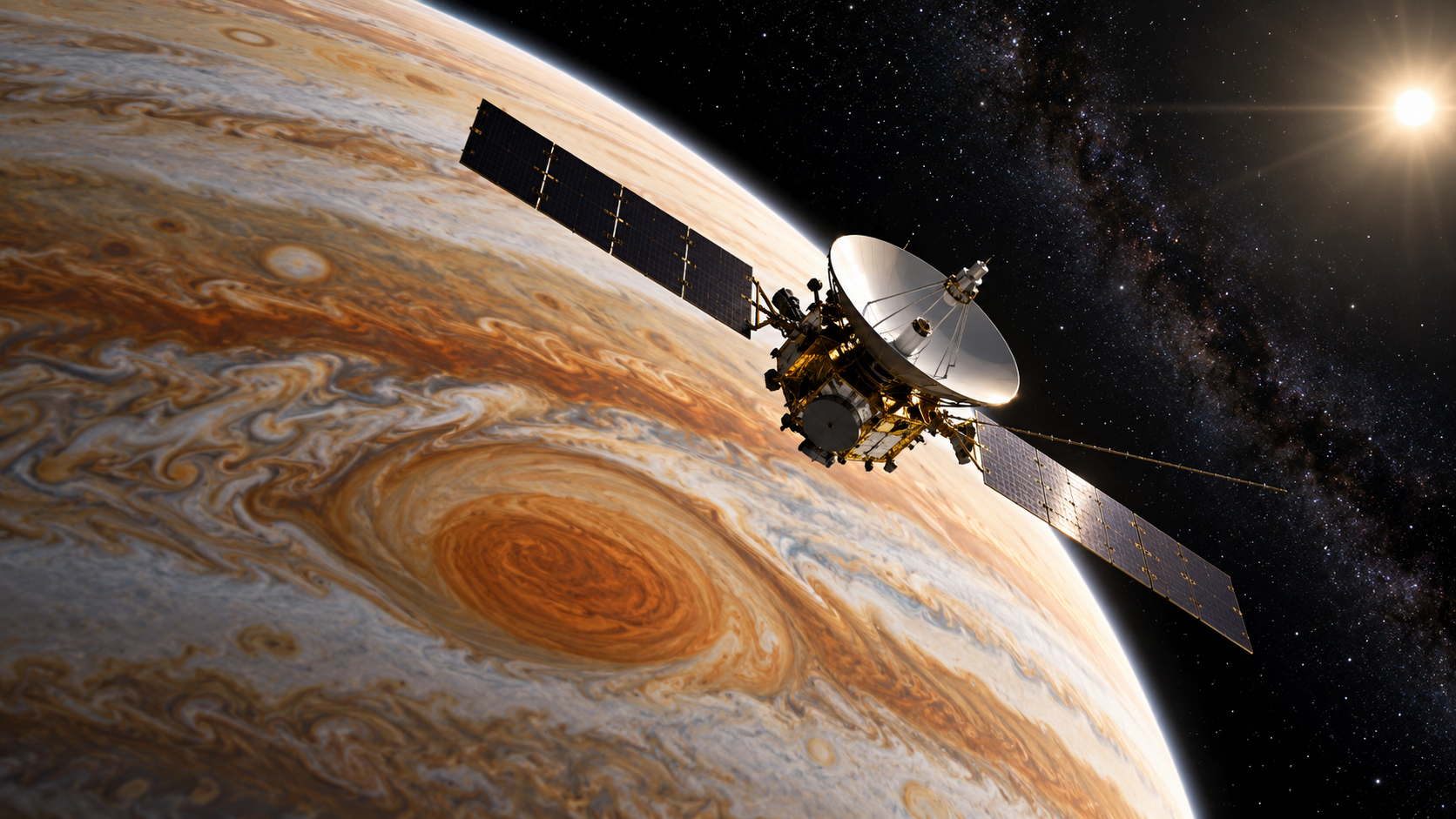
How Spacecraft Use Gravity Assists Explainer
A gravity assist uses a close planetary flyby to change a spacecraft’s path and speed relative to the Sun. As the craft approaches, the planet’s gravity pulls it inward and bends its trajectory. It speeds up while falling toward the planet and slows while climbing away, so relative to the planet alone its far-away speed is nearly unchanged.
The crucial fact is that the planet is moving around the Sun. In the solar frame, the spacecraft approaches a moving gravitational target and leaves in a different direction. If it passes behind the planet in its orbit, the planet can pull the craft forward and increase its solar orbital energy. Passing ahead can reduce that energy and slow the craft.
Energy and momentum are conserved. The spacecraft gains or loses momentum while the planet experiences the opposite change. Because a planet is enormously more massive, its resulting speed change is immeasurably small for practical purposes. The encounter is analogous to an elastic interaction mediated by gravity, not a free creation of energy.
Mission designers choose the arrival direction, closest approach, and departure geometry years in advance. A flyby can also rotate the orbital plane or aim a spacecraft toward the next target. The atmosphere, rings, moons, radiation, navigation uncertainty, and the planet’s radius limit how close the trajectory can safely pass.
Gravity assists make otherwise impractical missions possible with smaller rockets and less propellant. Voyagers used Jupiter and Saturn to reach the outer planets, Cassini used several flybys on its route to Saturn, and missions to the inner solar system can use planets to shed energy. The tradeoff is time and dependence on planetary alignment.
A flyby does not eliminate propulsion. Rockets are still needed for launch, navigation corrections, orbit insertion, and science operations. The assist replaces part of the velocity change that fuel would otherwise provide. It is best understood as careful celestial choreography: redirect a spacecraft within a moving planet’s gravitational field and borrow an undetectably tiny share of its orbital momentum.
The planet bends the spacecraft's trajectory while the craft speeds up on approach and slows on departure in the planet frame.
Because the planet moves around the Sun, changing the direction of the relative velocity changes solar orbital energy.
A pass behind the planet can add energy, while a pass ahead can remove it, depending on the exact geometry.
The planet receives the opposite momentum change, but its huge mass makes that response negligible.
Flybys can change speed, direction, and orbital plane but require precise timing and safe closest approach.
Propulsion remains necessary; a gravity assist substitutes for part of the fuel-intensive velocity change.
Explore more "Explainers"
Discover additional explainers across politics, science, business, technology, and other fields. Each explainer breaks down a complex idea into clear, everyday language—helping you better understand how major concepts, systems, and debates shape the world around us.