

On This Day in Science: April 7, 2001
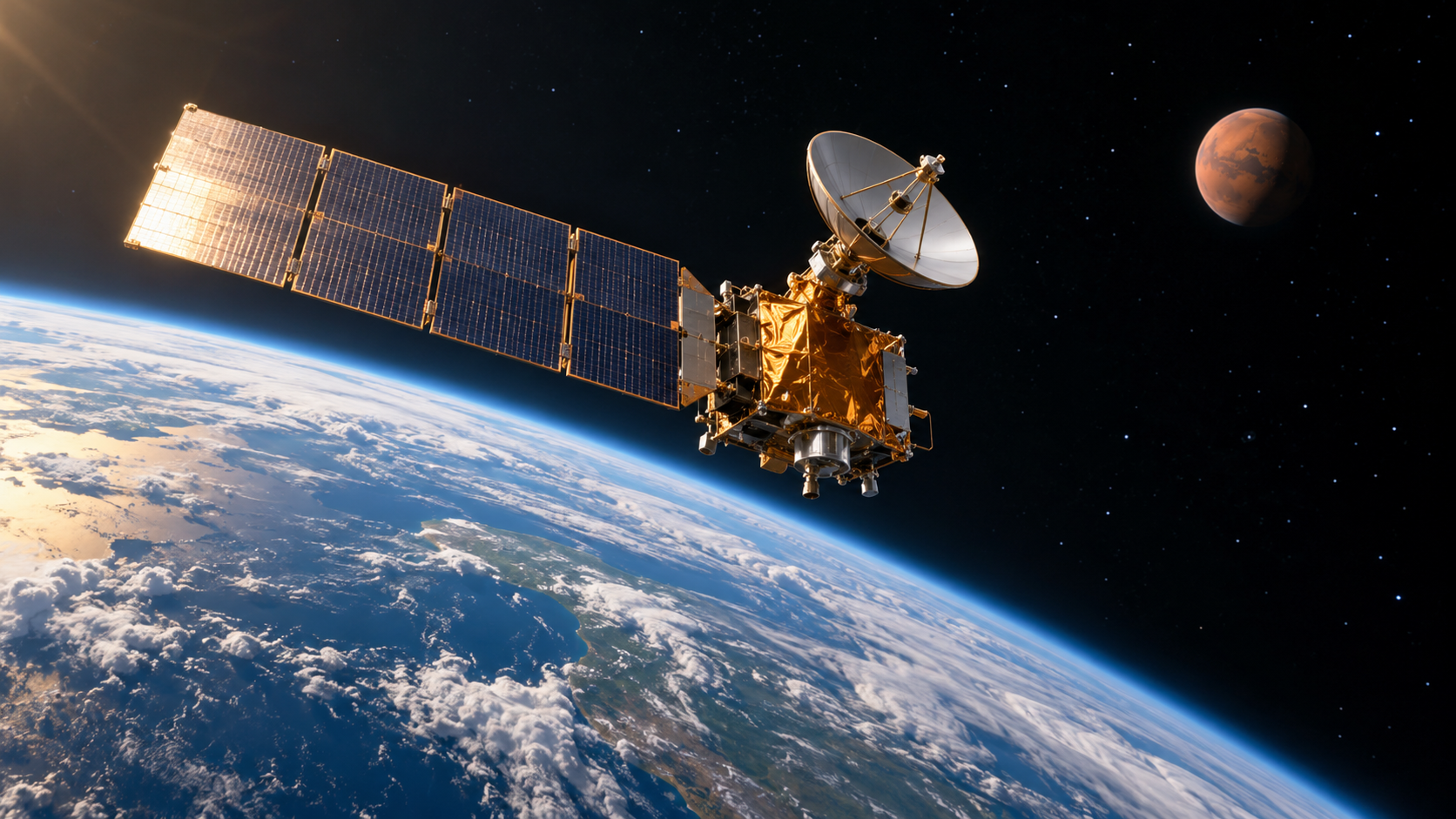
On April 7, 2001, NASA’s 2001 Mars Odyssey spacecraft lifted off from Cape Canaveral on a Delta II rocket. The orbiter was designed to map the Martian surface, measure its chemical and mineral composition, and characterize radiation that future explorers would face. It arrived in October and used repeated passes through the upper atmosphere to reshape its initial elongated orbit into a lower science orbit.
Odyssey carried the Thermal Emission Imaging System, a gamma-ray spectrometer suite, neutron detectors, and a radiation experiment. Infrared observations distinguished minerals and temperatures, while gamma rays and neutrons revealed elements in the shallow subsurface. The instruments detected abundant hydrogen at high latitudes, evidence for large deposits of water ice buried beneath a thin cover of soil.
The orbiter also photographed landing sites, monitored weather and seasonal frost, and became a communications relay for landers and rovers. Data from the mission helped motivate the Phoenix lander, which later exposed and sampled near-surface ice. Odyssey’s maps and relay service supported a growing network of spacecraft rather than a single isolated investigation.
The mission became the longest-operating spacecraft at Mars. Its longevity reflects conservative engineering, careful fuel and power management, and the continuing value of a stable orbital platform. The launch began a project that combined direct science with infrastructure, letting one orbiter keep contributing as new missions arrived below it. The anniversary highlights the difference between a first result and a finished understanding. A successful observation can settle one question while opening several harder ones, and even a failed objective can reshape later designs. Preserved data, specimens, photographs, and hardware allow new generations to revisit the work with better tools. Science advances through that continuity rather than stopping on a memorable date. Its calendar date is an entry point, not an endpoint. The people involved worked with the instruments, assumptions, and social conditions of their time, and later research has both extended and corrected their conclusions. Separating what was known that day from what became clear afterward protects the history from myth and shows how cumulative evidence turns an episode into lasting scientific knowledge. For science history, the event also shows how evidence moves from an observation or engineered test into a durable body of knowledge. Instruments supplied measurements, specialists debated interpretation, and later work refined what the first result could mean. Archives preserve the early record while new methods let researchers ask different questions of it. That continuing revision is the process through which a dated milestone remains scientifically useful.
Odyssey's instruments measured minerals, elements, temperature, and radiation across Mars.
Gamma-ray and neutron data revealed hydrogen associated with buried polar water ice.
Repeated passes through the upper atmosphere gradually lowered and circularized the spacecraft's orbit.
The method saved propellant while demanding careful control of heating and drag.
Odyssey became a long-lived communications bridge for landers and rovers.
Its maps and relay service remained useful long after the original prime mission.
Explore more of "On This Day ..."
Discover more events from the same date across news, politics, technology, sports, and other fields. Each link highlights significant moments that shaped history on different fronts.