

On This Day in Science: April 10, 2019
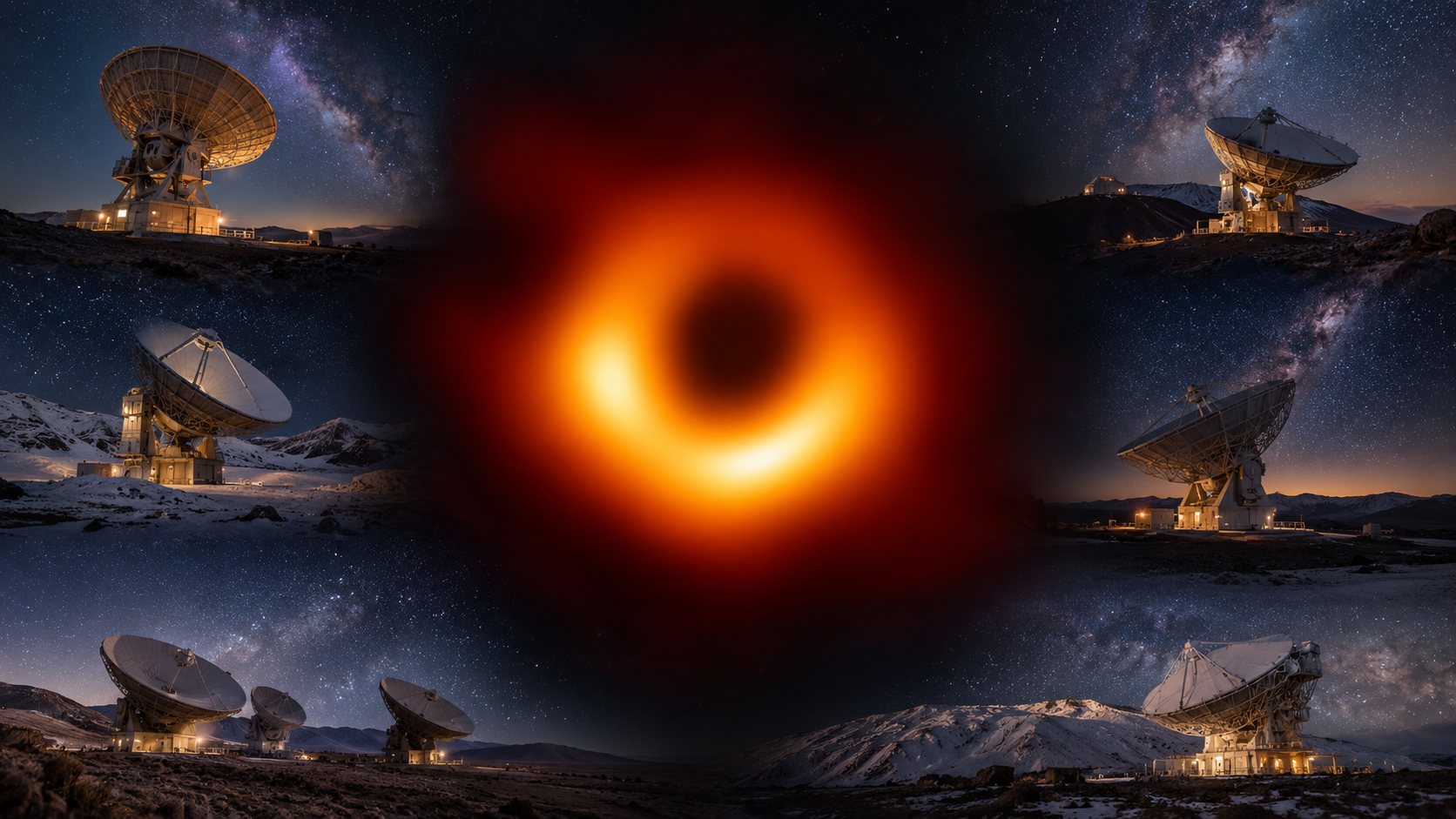
On April 10, 2019, the Event Horizon Telescope collaboration unveiled the first image showing the shadow of a black hole. The target was the supermassive object at the center of galaxy Messier 87, about fifty-five million light-years away. A bright, uneven ring of radio emission surrounded a dark central region created as gravity captured light and bent the paths of radiation near the event horizon.
No single telescope could resolve a structure that small at that distance. The project linked radio observatories across Earth using very long baseline interferometry, effectively creating a planet-sized instrument. Each station recorded enormous volumes of precisely timed data. Hard drives were physically transported to correlation centers, where atomic-clock timing allowed signals from different continents to be combined.
Independent imaging teams reconstructed the source using different algorithms and tested whether the ring persisted under alternative assumptions. The measured size matched predictions from general relativity for a black hole of roughly 6.5 billion solar masses. The picture was not an ordinary snapshot of the object itself; it was a map of radio brightness assembled from sparse measurements and careful calibration.
The result gave scientists a new way to test gravity and study how matter behaves around event horizons. Later EHT work imaged the black hole in the Milky Way and examined changing structure and magnetic fields. The announcement demonstrated that global coordination, timing, computation, and transparency about reconstruction can turn indirect signals into compelling visual evidence. Seen across a longer timeline, scientific milestones are junctions rather than isolated beginnings. Earlier experiments, tools, and institutions made the work possible, while later teams tested its limits and carried the result into new settings. What survives is a traceable chain of evidence, correction, and application that allows one moment to remain relevant as knowledge and technology continue to change. The anniversary highlights the difference between a first result and a finished understanding. A successful observation can settle one question while opening several harder ones, and even a failed objective can reshape later designs. Preserved data, specimens, photographs, and hardware allow new generations to revisit the work with better tools. Science advances through that continuity rather than stopping on a memorable date. Its calendar date is an entry point, not an endpoint. The people involved worked with the instruments, assumptions, and social conditions of their time, and later research has both extended and corrected their conclusions. Separating what was known that day from what became clear afterward protects the history from myth and shows how cumulative evidence turns an episode into lasting scientific knowledge.
Radio observatories on several continents observed M87 at the same wavelength and time.
Very long baseline interferometry combined them into an instrument with planetary-scale resolution.
The dark center marks light captured or redirected by extreme gravity near the event horizon.
The bright ring comes from hot material whose radiation is strongly bent.
Independent teams reconstructed the ring from calibrated interferometric measurements.
Agreement across methods helped show that the observed structure was robust rather than an algorithmic artifact.
Explore more of "On This Day ..."
Discover more events from the same date across news, politics, technology, sports, and other fields. Each link highlights significant moments that shaped history on different fronts.