

On This Day in Science: April 12, 1961
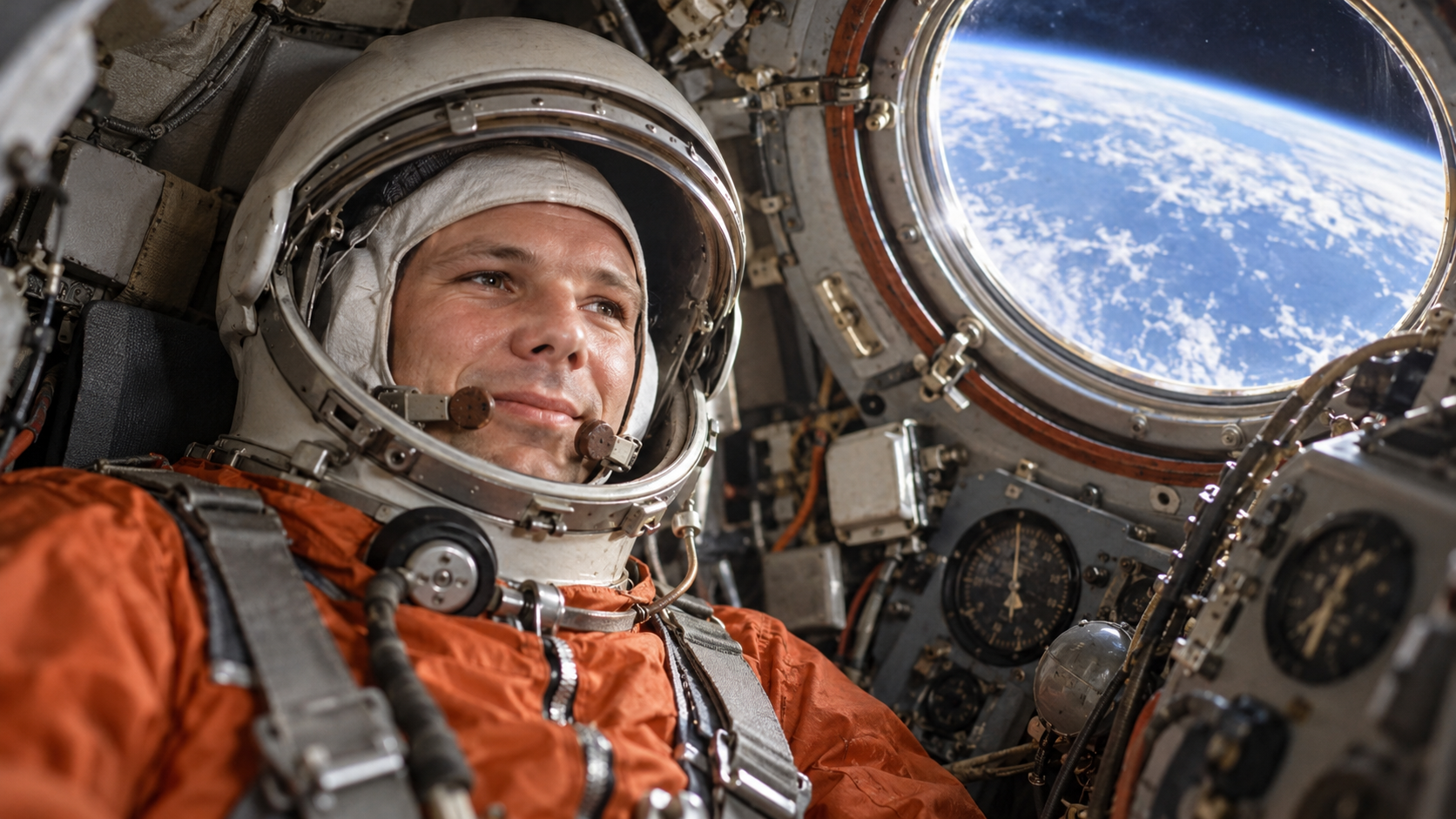
On April 12, 1961, Yuri Gagarin launched from Baikonur aboard Vostok 1 and became the first human to travel into space. The spacecraft completed one orbit of Earth in 108 minutes before its descent module returned over the Soviet Union. Gagarin ejected from the capsule and parachuted separately, landing near the Volga River after a flight that immediately became a global symbol of the space age.
Vostok was largely automated because engineers were uncertain how a person would function in weightlessness. Gagarin monitored instruments, spoke with ground stations, ate and drank, and reported that he remained capable. A sealed code allowed manual control in an emergency. The spherical descent module relied on atmospheric drag for orientation and used a heat shield to survive reentry.
The flight was successful despite risks that included a hatch-seal problem before launch and a delayed separation between the equipment and descent modules during reentry. The orbit also reached a higher apogee than planned, making natural decay too slow for a quick return if the retrorocket had failed. Gagarin’s calm performance supplied direct evidence that humans could work through launch, weightlessness, and reentry.
Vostok 1 changed political competition and scientific planning at once. It accelerated American human-spaceflight goals and gave biomedical researchers a real case instead of speculation. The mission did not answer every physiological question, but it established that a person could survive and remain functional during an orbital flight. Its calendar date is an entry point, not an endpoint. The people involved worked with the instruments, assumptions, and social conditions of their time, and later research has both extended and corrected their conclusions. Separating what was known that day from what became clear afterward protects the history from myth and shows how cumulative evidence turns an episode into lasting scientific knowledge. For science history, the event also shows how evidence moves from an observation or engineered test into a durable body of knowledge. Instruments supplied measurements, specialists debated interpretation, and later work refined what the first result could mean. Archives preserve the early record while new methods let researchers ask different questions of it. That continuing revision is the process through which a dated milestone remains scientifically useful. Seen across a longer timeline, scientific milestones are junctions rather than isolated beginnings. Earlier experiments, tools, and institutions made the work possible, while later teams tested its limits and carried the result into new settings. What survives is a traceable chain of evidence, correction, and application that allows one moment to remain relevant as knowledge and technology continue to change.
Vostok 1 carried Gagarin around Earth once before returning over the Soviet Union.
He ejected from the descent capsule and completed the landing by parachute.
The spacecraft flew mostly automatically because weightlessness effects were uncertain.
Gagarin monitored systems and demonstrated that he could communicate and function normally.
Prelaunch sealing and reentry separation problems showed how much risk remained.
Success established human orbital flight as a demonstrated capability rather than a theory.
Explore more of "On This Day ..."
Discover more events from the same date across news, politics, technology, sports, and other fields. Each link highlights significant moments that shaped history on different fronts.