

On This Day in Science: April 21, 1972
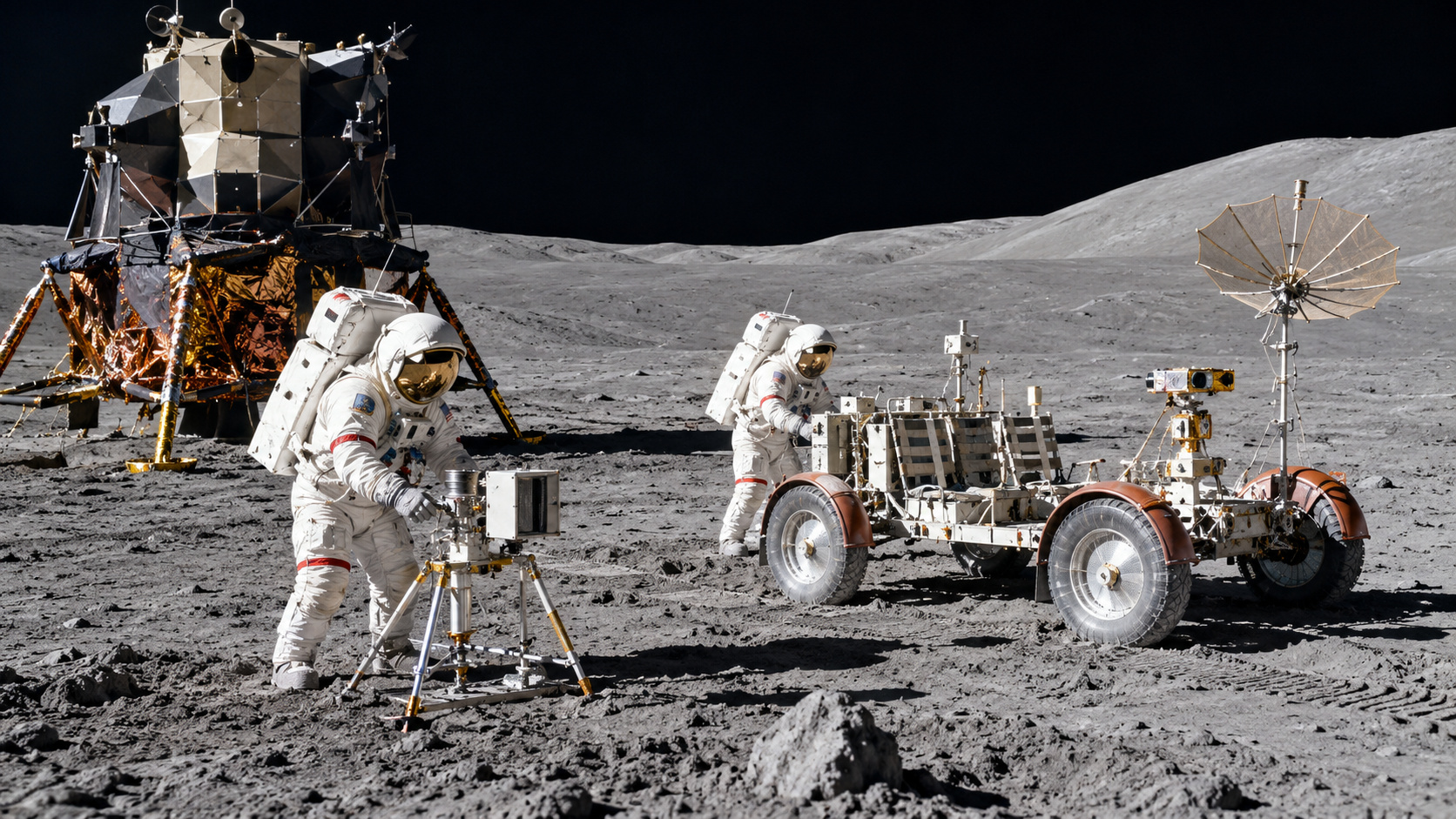
On April 21, 1972, John Young and Charles Duke depressurized Apollo 16’s lunar module and began their first moonwalk in the Descartes highlands. They unloaded and deployed the Lunar Roving Vehicle, set up the only astronomical observatory used on the lunar surface during Apollo, and began collecting geological samples. Ken Mattingly continued orbital observations above them.
The far-ultraviolet camera and spectrograph used the Moon’s airless environment to observe Earth, stars, and interplanetary hydrogen without atmospheric absorption. The crew also deployed the Apollo Lunar Surface Experiments Package, including instruments for seismic activity, solar wind, magnetic fields, and heat flow. A drilling problem prevented the heat-flow experiment from being completed as planned.
Young and Duke drove to Flag and Spook craters, described rocks and soil, photographed contexts, and collected samples that laboratories could later analyze. Their observations helped distinguish local impact breccias from volcanic materials expected before the mission. The rover carried tools, cameras, and communications equipment while extending the area that two astronauts could inspect during limited surface time.
The day turned a landing site into a field laboratory. Some experiments succeeded, one important installation failed, and the geologic interpretation changed as evidence accumulated. That mixture reflects real exploration: hardware, human judgment, terrain, schedule, and scientific hypotheses all interact under constraints that cannot be reproduced completely beforehand. For science history, the event also shows how evidence moves from an observation or engineered test into a durable body of knowledge. Instruments supplied measurements, specialists debated interpretation, and later work refined what the first result could mean. Archives preserve the early record while new methods let researchers ask different questions of it. That continuing revision is the process through which a dated milestone remains scientifically useful. Seen across a longer timeline, scientific milestones are junctions rather than isolated beginnings. Earlier experiments, tools, and institutions made the work possible, while later teams tested its limits and carried the result into new settings. What survives is a traceable chain of evidence, correction, and application that allows one moment to remain relevant as knowledge and technology continue to change. The anniversary highlights the difference between a first result and a finished understanding. A successful observation can settle one question while opening several harder ones, and even a failed objective can reshape later designs. Preserved data, specimens, photographs, and hardware allow new generations to revisit the work with better tools. Science advances through that continuity rather than stopping on a memorable date.
Young and Duke deployed the Lunar Roving Vehicle and began traversing beyond the immediate landing site.
Mobility expanded the range of rocks, craters, and soil they could compare.
A far-ultraviolet camera used the airless surface to observe Earth and the sky.
The instrument remains the only astronomical observatory operated on the lunar surface during Apollo.
The crew installed seismic, magnetic, and solar-wind instruments.
A damaged cable prevented the heat-flow experiment from returning its planned measurements.
Explore more of "On This Day ..."
Discover more events from the same date across news, politics, technology, sports, and other fields. Each link highlights significant moments that shaped history on different fronts.