

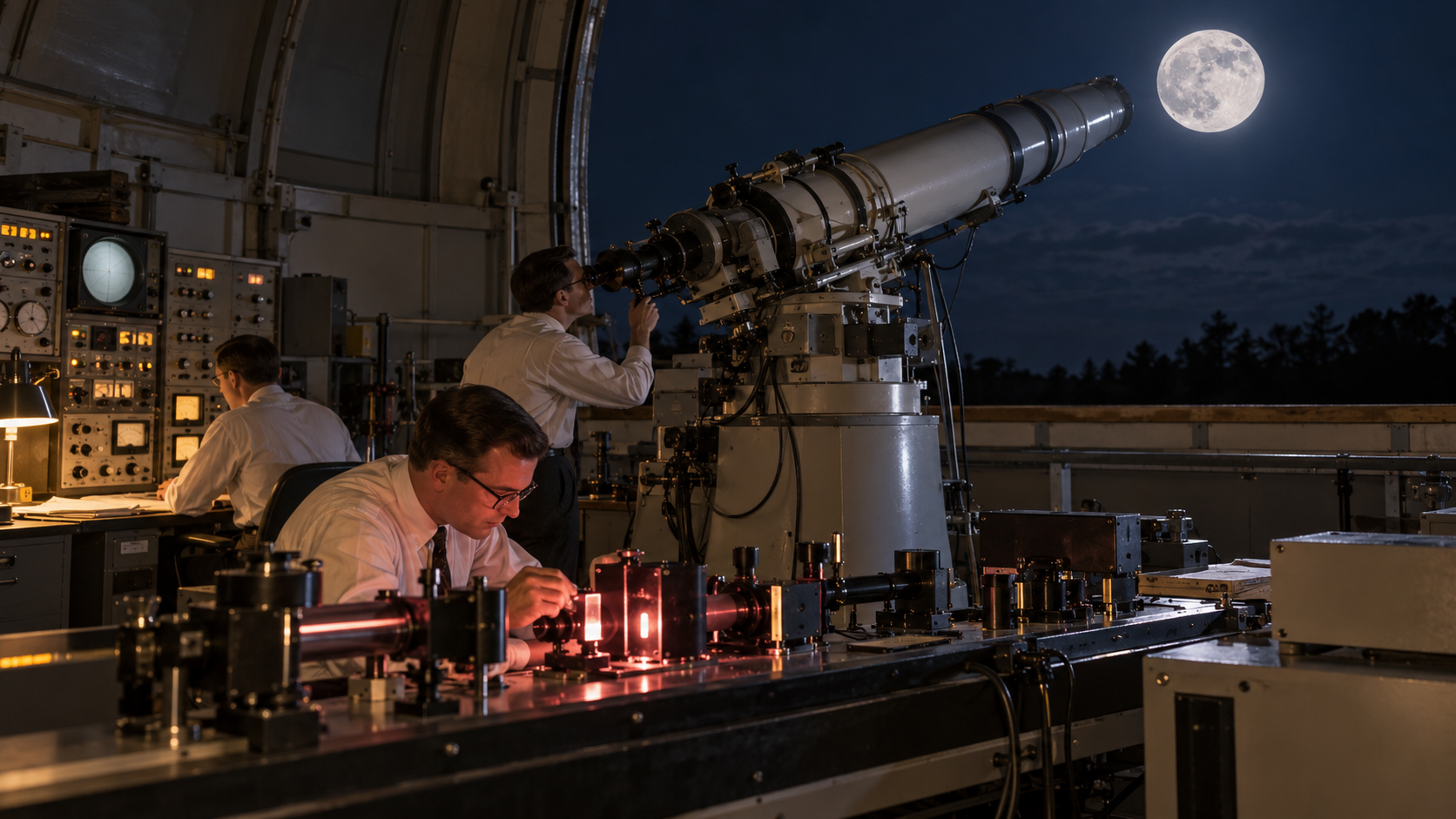
On This Day in Science: May 9, 1962
On May 9, 1962, researchers at MIT Lincoln Laboratory directed pulses from a ruby laser toward the Moon and detected a faint return from the lunar surface. The experiment sent coherent light across roughly 384,000 kilometers of space and measured photons scattered back to Earth. It was the first successful optical moon-bounce, achieved without the retroreflectors that later Apollo crews would place on the surface.
The technical challenge was not simply generating a bright pulse. The beam spread during its journey, atmospheric turbulence disturbed its path, the Moon’s rough ground scattered light in many directions, and the returning signal was extraordinarily weak. Accurate telescope pointing, timing, filtering, and sensitive detectors were needed to distinguish the echo from background light and electronic noise.
The initial pulse was too long and the signal too limited for the precision later associated with lunar laser ranging. After Apollo 11 and later missions deployed corner-cube reflector arrays, observatories could send shorter pulses to a known target and time their return. Repeated measurements have tracked the Moon’s orbit, tested gravity, and shown that the Moon is slowly receding from Earth.
The experiment linked a new laboratory invention with planetary measurement only two years after the first working laser. It demonstrated that optical signals could cross deep space and return information, opening a path toward modern laser ranging and communications. For science history, the event also shows how evidence moves from an observation or engineered test into a durable body of knowledge. Instruments supplied measurements, specialists debated interpretation, and later work refined what the first result could mean. Archives preserve the early record while new methods let researchers ask different questions of it. That continuing revision is the process through which a dated milestone remains scientifically useful. Seen across a longer timeline, scientific milestones are junctions rather than isolated beginnings. Earlier experiments, tools, and institutions made the work possible, while later teams tested limits and carried the result into new settings. What survives is a traceable chain of evidence, correction, and application that allows one moment to remain relevant as knowledge and technology continue to change. The anniversary highlights the difference between a first result and a finished understanding. A successful observation can settle one question while opening several harder ones, and even a failed objective can reshape later designs. Preserved data, specimens, photographs, and hardware allow new generations to revisit the work with better tools. Science advances through that continuity rather than stopping on a memorable date. Its calendar date is an entry point, not an endpoint. The people involved worked with the instruments, assumptions, and social conditions of their time, and later research has both extended and corrected their conclusions. Separating what was known that day from what became clear afterward protects the history from myth and shows how cumulative evidence turns an episode into lasting scientific knowledge.
The lunar surface scattered most of the incoming laser light away from Earth.
Detectors had to isolate a tiny timed return from sky brightness and instrument noise.
The 1962 test used the Moon's natural surface rather than a placed mirror array.
Apollo reflectors later made the measurement much more precise and repeatable.
Travel time converts directly into the Earth-Moon distance.
Long records now support studies of lunar motion, Earth's rotation, and gravitational theory.
Explore more of "On This Day ..."
Discover more events from the same date across news, politics, technology, sports, and other fields. Each link highlights significant moments that shaped history on different fronts.