

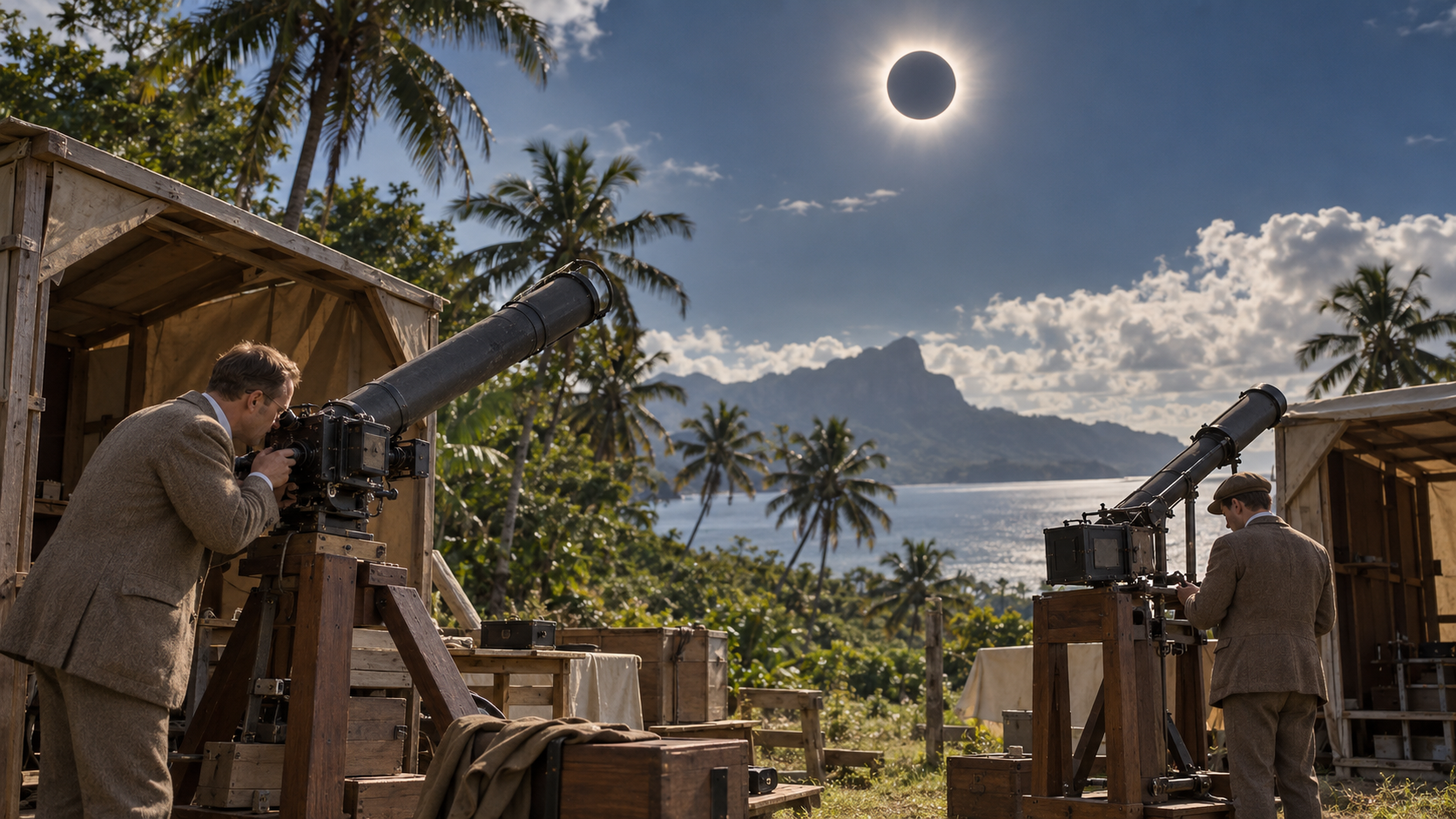
On This Day in Science: May 29, 1919
On May 29, 1919, British-led teams photographed stars near the eclipsed Sun from Príncipe off West Africa and Sobral in Brazil. Astronomer Royal Frank Dyson organized the test, with Arthur Eddington and Edwin Cottingham at Príncipe and Andrew Crommelin and Charles Davidson at Sobral. The goal was to measure whether the Sun’s gravity shifted the apparent positions of background stars as Albert Einstein’s general theory of relativity predicted.
A total eclipse made the nearby stars visible while the Sun was in the same part of the sky as the Hyades cluster. The teams compared photographic plates with reference exposures taken when the Sun was elsewhere. Weather, optical focus, temperature, plate distortion, and the tiny angular deflection made the measurement extremely difficult. Some instruments produced better data than others.
Dyson, Eddington, and Davidson announced results in November that favored Einstein’s predicted deflection over the simpler Newtonian value. The finding made Einstein internationally famous. Historians and physicists have since reexamined the reductions, instrument choices, and uncertainties, while later radio, eclipse, lensing, and spacecraft experiments confirmed gravitational light bending with far greater precision.
The eclipse did not make relativity true by itself; it provided an early observational test under difficult conditions. Its importance lies in connecting an abstract theory of spacetime with measurable changes in where stars appeared. For science history, the event also shows how evidence moves from an observation or engineered test into a durable body of knowledge. Instruments supplied measurements, specialists debated interpretation, and later work refined what the first result could mean. Archives preserve the early record while new methods let researchers ask different questions of it. That continuing revision is the process through which a dated milestone remains scientifically useful. Seen across a longer timeline, scientific milestones are junctions rather than isolated beginnings. Earlier experiments, tools, and institutions made the work possible, while later teams tested limits and carried the result into new settings. What survives is a traceable chain of evidence, correction, and application that allows one moment to remain relevant as knowledge and technology continue to change. The anniversary highlights the difference between a first result and a finished understanding. A successful observation can settle one question while opening several harder ones, and even a failed objective can reshape later designs. Preserved data, specimens, photographs, and hardware allow new generations to revisit the work with better tools. Science advances through that continuity rather than stopping on a memorable date. Its calendar date is an entry point, not an endpoint. The people involved worked with the instruments, assumptions, and social conditions of their time, and later research has both extended and corrected their conclusions. Separating what was known that day from what became clear afterward protects the history from myth and shows how cumulative evidence turns an episode into lasting scientific knowledge.
Totality blocked the bright solar disk so nearby background stars could be photographed.
Gravity should make their apparent positions shift slightly outward from the Sun.
Teams worked at Príncipe and Sobral to reduce the risk of weather or equipment failure.
Clouds and focus changes left some observations much more useful than others.
The announced values favored Einstein's general-relativistic prediction.
Later methods have measured gravitational light bending far more precisely.
Explore more of "On This Day ..."
Discover more events from the same date across news, politics, technology, sports, and other fields. Each link highlights significant moments that shaped history on different fronts.