

How Radio Telescopes Detect Invisible Signals Explainer
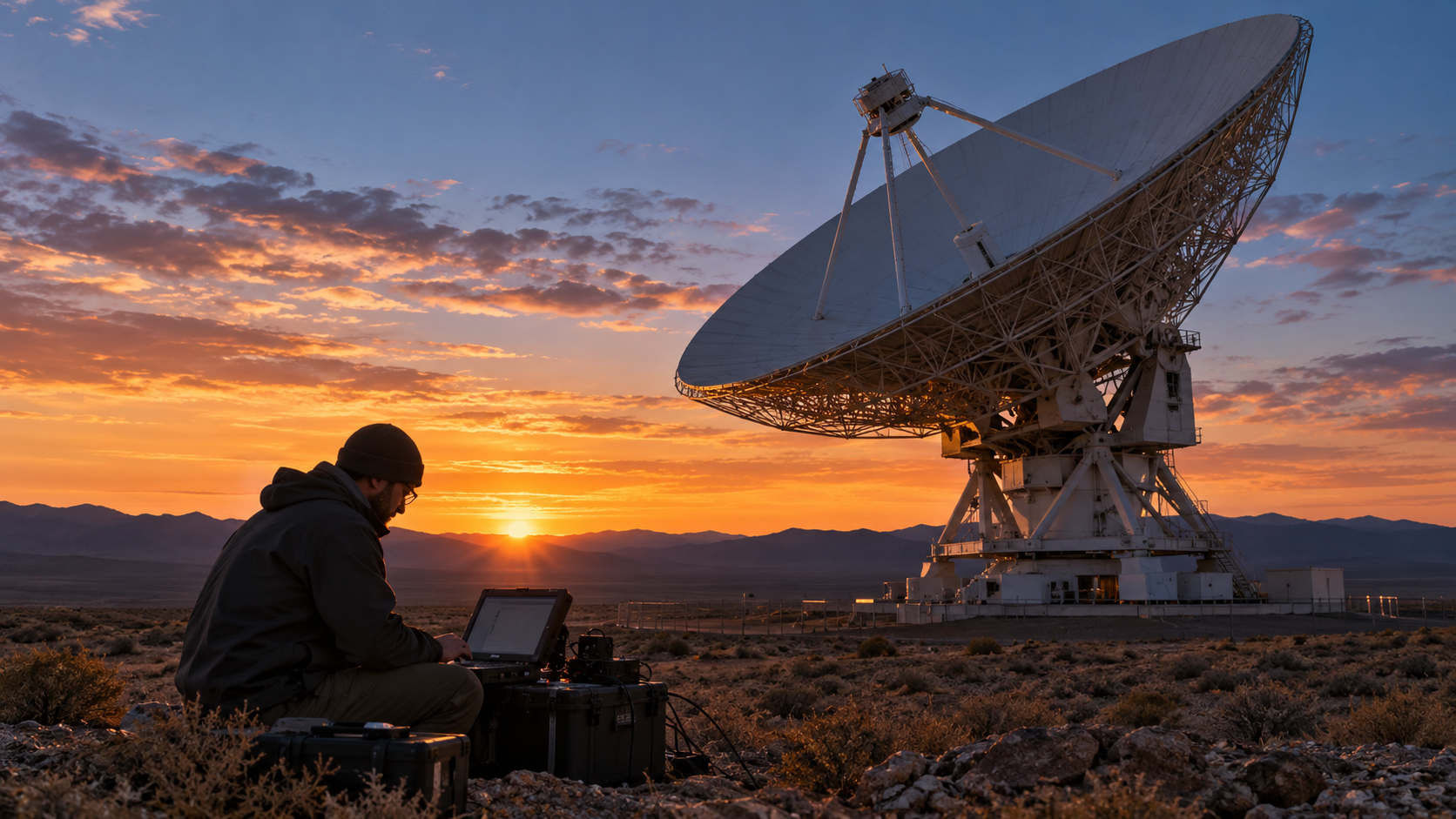
Cosmic objects emit electromagnetic radiation across many wavelengths, and radio waves are invisible to human eyes. A radio telescope uses an antenna to turn a tiny oscillating electric field into an electrical signal. A parabolic dish reflects incoming waves toward a feed at its focus. Other antenna shapes are used for different bands, but every design tries to collect weak radiation over a large area.
The receiver amplifies the signal and separates it into frequency channels. Because electronics generate their own noise, sensitive receivers are often cooled to very low temperatures. Calibration compares the instrument with known references so measurements can be expressed as physical brightness or flux. The telescope records numbers rather than an image seen through an eyepiece.
A spectrum reveals how signal strength changes with frequency. Narrow lines from atoms and molecules can indicate composition, temperature, density, magnetic fields, and motion through Doppler shift. Broad radio emission can trace energetic particles, magnetic fields, planets, stars, supernova remnants, galaxies, and the cosmic microwave background. Radio waves can also pass through dust that blocks visible light.
Resolution depends on wavelength and antenna size. Long radio wavelengths would require a single enormous dish for fine detail, so astronomers combine separated antennas using interferometry. Precisely timed signals are correlated as if the antennas were parts of one telescope. The longest separation, or baseline, sets the finest angular scale, while many antenna positions improve image reconstruction.
Radio-frequency interference from phones, satellites, vehicles, electronics, and transmitters can overwhelm natural cosmic signals. Observatories use remote sites, protected frequency bands, shielding, scheduling, and data filters. Not every unwanted signal can be removed without losing information, so researchers document interference and compare observations across times, antennas, and frequencies.
Computers calibrate phases, combine channels and baselines, and reconstruct maps from incomplete spatial information. Colors in published radio images are assigned to intensity or frequency and are not what an eye would see. Radio astronomy is therefore a chain from electromagnetic field to voltage, digitized data, and model-supported image, revealing parts of the universe that visible-light telescopes miss.
Antennas collect invisible radio waves and convert their electric fields into tiny electrical signals.
Low-noise receivers amplify and divide the signal into calibrated frequency channels.
Spectral lines and broad emission reveal composition, motion, temperature, fields, and energetic particles.
Interferometry combines precisely timed antennas to achieve the detail of a much larger instrument.
Human transmitters create interference that remote sites, protected bands, and filtering only partly control.
Radio images are computer reconstructions whose displayed colors represent measured quantities.
Explore more "Explainers"
Discover additional explainers across politics, science, business, technology, and other fields. Each explainer breaks down a complex idea into clear, everyday language—helping you better understand how major concepts, systems, and debates shape the world around us.