

How Electrolysis Splits Water Explainer
Water electrolysis uses electricity to drive a chemical reaction that is not spontaneous under the operating conditions. In the overall reaction, two water molecules form two hydrogen molecules and one oxygen molecule. The process occurs in an electrolyzer containing an anode, a cathode, and an electrolyte or membrane that carries ions while keeping product gases separated.
In a proton-exchange-membrane electrolyzer, water at the anode loses electrons and forms oxygen, protons, and electrons. The membrane conducts protons to the cathode, while electrons travel through the external circuit. At the cathode, protons accept electrons and combine into hydrogen gas. Alkaline and solid-oxide systems move different ions but accomplish the same overall chemical conversion.
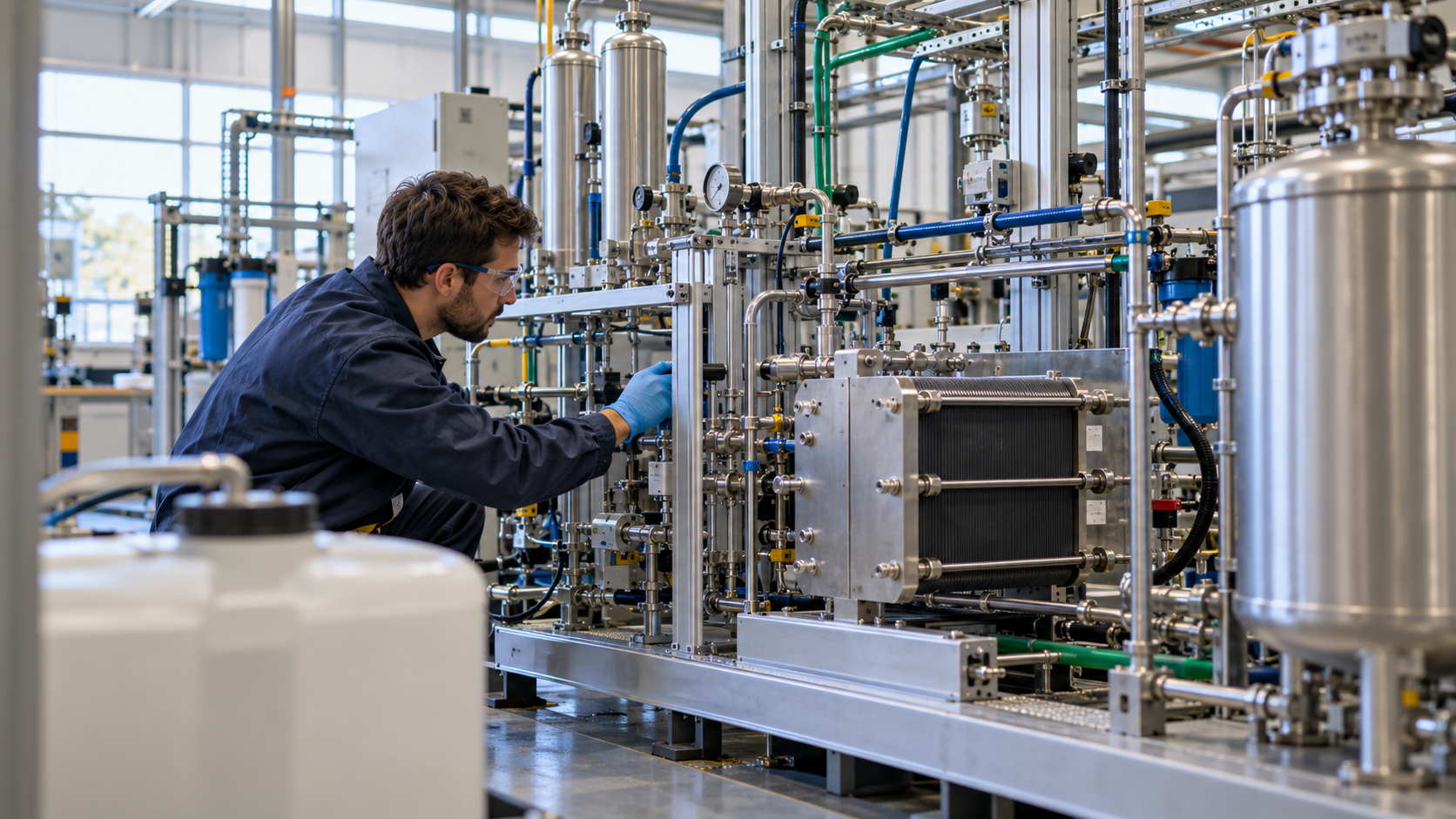
The required voltage exceeds the ideal thermodynamic value because real cells have activation losses at catalysts, electrical resistance, mass-transport limits, and gas bubbles that block active area. Temperature, pressure, current density, water purity, catalyst choice, and membrane condition affect efficiency. Stacks connect many cells to produce useful gas flow, while balance-of-plant equipment manages water, power, cooling, drying, and pressure.
Hydrogen and oxygen must remain separated because mixtures can ignite. Sensors, ventilation, pressure relief, compatible materials, and controlled shutdown protect the system. Water impurities can poison catalysts or foul membranes. The hydrogen may be dried, purified, compressed, stored, or sent directly to an industrial process, while oxygen can be used or safely released depending on system design.
Electrolysis stores input energy in hydrogen’s chemical bonds. A fuel cell or combustion process can later release that energy, but every conversion has losses. The climate impact depends strongly on how the electricity was generated and what the hydrogen replaces. Electrolysis powered by low-emission electricity can reduce emissions in some industries, while grid-intensive operation may not.
Electrolyzers are not a source of free energy. They are conversion devices that trade electricity and water for transportable chemical fuel and oxygen. Researchers work to reduce catalyst cost, improve durability, handle fluctuating renewable power, and use heat efficiently. The core chemistry is simple, but practical production depends on electrochemistry, materials, safety, and the surrounding energy system.
Electricity drives water oxidation at one electrode and hydrogen formation at the other.
The electrolyte or membrane transports ions while the external circuit carries electrons.
Catalysis, resistance, bubbles, transport, temperature, and current create voltage losses.
Stacks need water treatment, cooling, drying, pressure control, and gas-separation equipment.
Hydrogen and oxygen safety requires reliable separation, detection, ventilation, and relief systems.
Environmental benefit depends on electricity source, conversion losses, and the application displaced.
Explore more "Explainers"
Discover additional explainers across politics, science, business, technology, and other fields. Each explainer breaks down a complex idea into clear, everyday language—helping you better understand how major concepts, systems, and debates shape the world around us.