

On This Day in Science: June 4, 1996
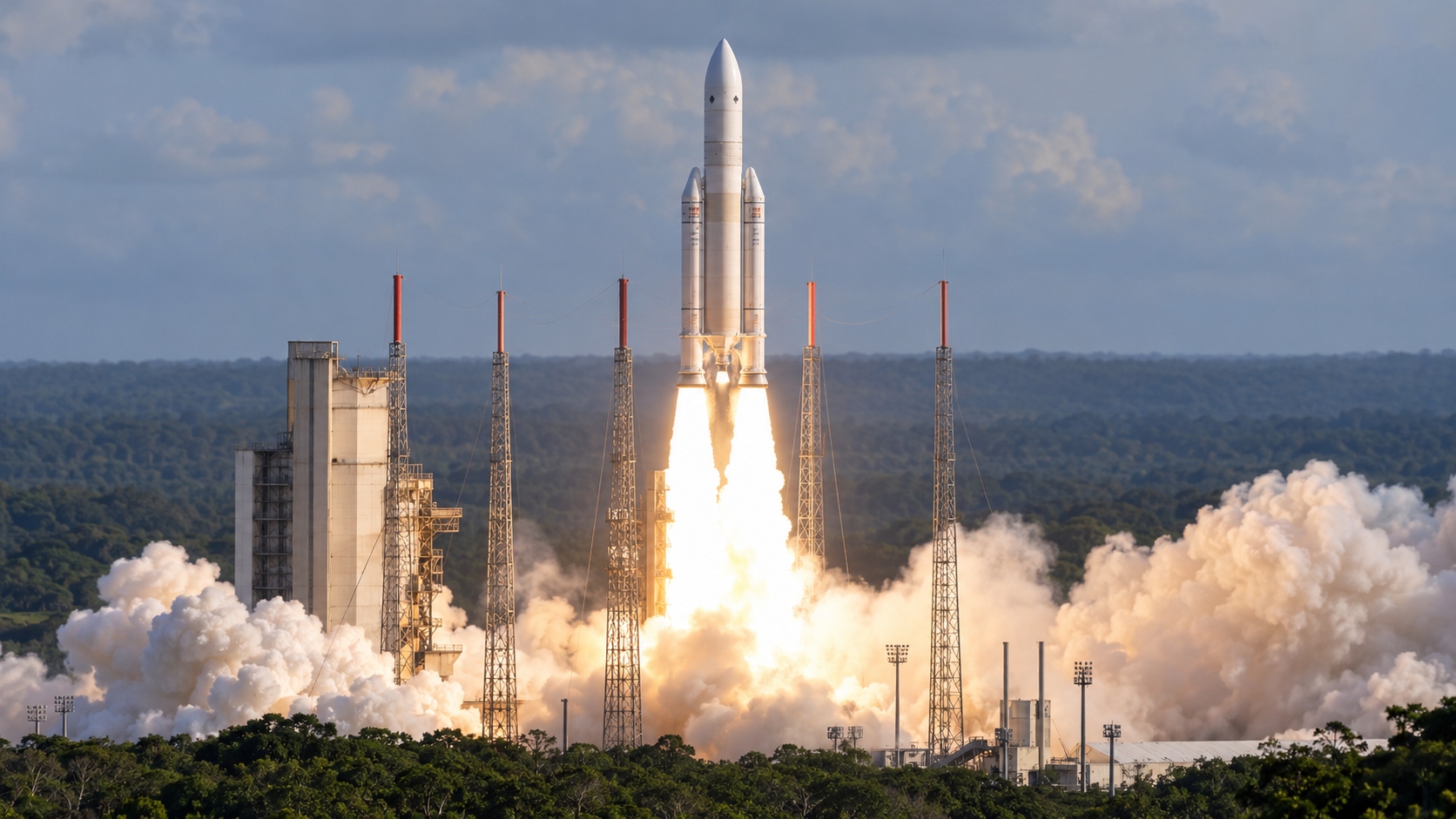
On June 4, 1996, the first Ariane 5 rocket lifted from Kourou, French Guiana, carrying four Cluster science spacecraft. About thirty-seven seconds after the main engine ignited, the launcher veered from its planned path, broke apart under aerodynamic forces, and was destroyed by its flight-safety system. No people were aboard or injured.
An inquiry traced the loss to software in the inertial reference system. A 64-bit floating-point value representing horizontal motion was converted into a 16-bit signed integer, and the value exceeded the available range. The active unit shut down; its identical backup, running the same software, had already failed for the same reason. Diagnostic data were then interpreted by the flight computer as valid guidance information.
The troublesome calculation had been retained from Ariane 4 even though it was not needed after liftoff. Ariane 5’s different trajectory produced values outside assumptions that had been safe on the earlier vehicle. Testing had not exercised the complete guidance system with a representative Ariane 5 flight profile, so the interaction escaped detection.
Flight 501 became a widely taught case in software engineering because every component followed its programmed logic while the system failed. The inquiry led to changes in exception handling, redundancy, requirements review, and end-to-end testing before Ariane 5 returned to flight. Its calendar date is an entry point, not an endpoint. The people involved worked with the instruments, assumptions, and social conditions of their time, and later research has both extended and corrected their conclusions. Separating what was known that day from what became clear afterward protects the history from myth and shows how cumulative evidence turns an episode into lasting scientific knowledge. For science history, the event also shows how evidence moves from an observation or engineered test into a durable body of knowledge. Instruments supplied measurements, specialists debated interpretation, and later work refined what the first result could mean. Archives preserve the early record while new methods let researchers ask different questions of it. That continuing revision is the process through which a dated milestone remains scientifically useful. Seen across a longer timeline, scientific milestones are junctions rather than isolated beginnings. Earlier experiments, tools, and institutions made the work possible, while later teams tested limits and carried the result into new settings. What survives is a traceable chain of evidence, correction, and application that allows one moment to remain relevant as knowledge and technology continue to change. The anniversary highlights the difference between a first result and a finished understanding. A successful observation can settle one question while opening several harder ones, and even a failed objective can reshape later designs. Preserved data, specimens, photographs, and hardware allow new generations to revisit the work with better tools. Science advances through that continuity rather than stopping on a memorable date.
A conversion attempted to store a large horizontal-velocity value in a smaller integer format.
The resulting exception stopped both inertial reference units because they shared the same software.
The backup protected against random hardware failure but not an identical design error.
Common-mode failures can defeat redundant systems unless their assumptions are independently tested.
Code inherited from Ariane 4 encountered a trajectory it had not been designed to handle.
Representative end-to-end simulation became a central recommendation of the inquiry.
Explore more of "On This Day ..."
Discover more events from the same date across news, politics, technology, sports, and other fields. Each link highlights significant moments that shaped history on different fronts.