

How Ocean Waves Form and Break Explainer
Most everyday ocean waves begin when wind transfers energy to the water surface. Tiny ripples make the surface rougher, allowing the wind to push more effectively. Wave size grows with wind speed, how long the wind blows, and fetch, the uninterrupted distance over water. The water mostly moves in orbital paths while the wave pattern and its energy travel forward; a single parcel does not cross an ocean with each crest.
A developing sea contains waves of many periods and directions. Once waves leave the generating storm, they organize into swell. Longer-period waves travel faster in deep water and can outrun shorter ones, so distant swell often arrives as smoother, more regular sets. Several wave trains can overlap, briefly adding or canceling through interference and producing variable individual heights.
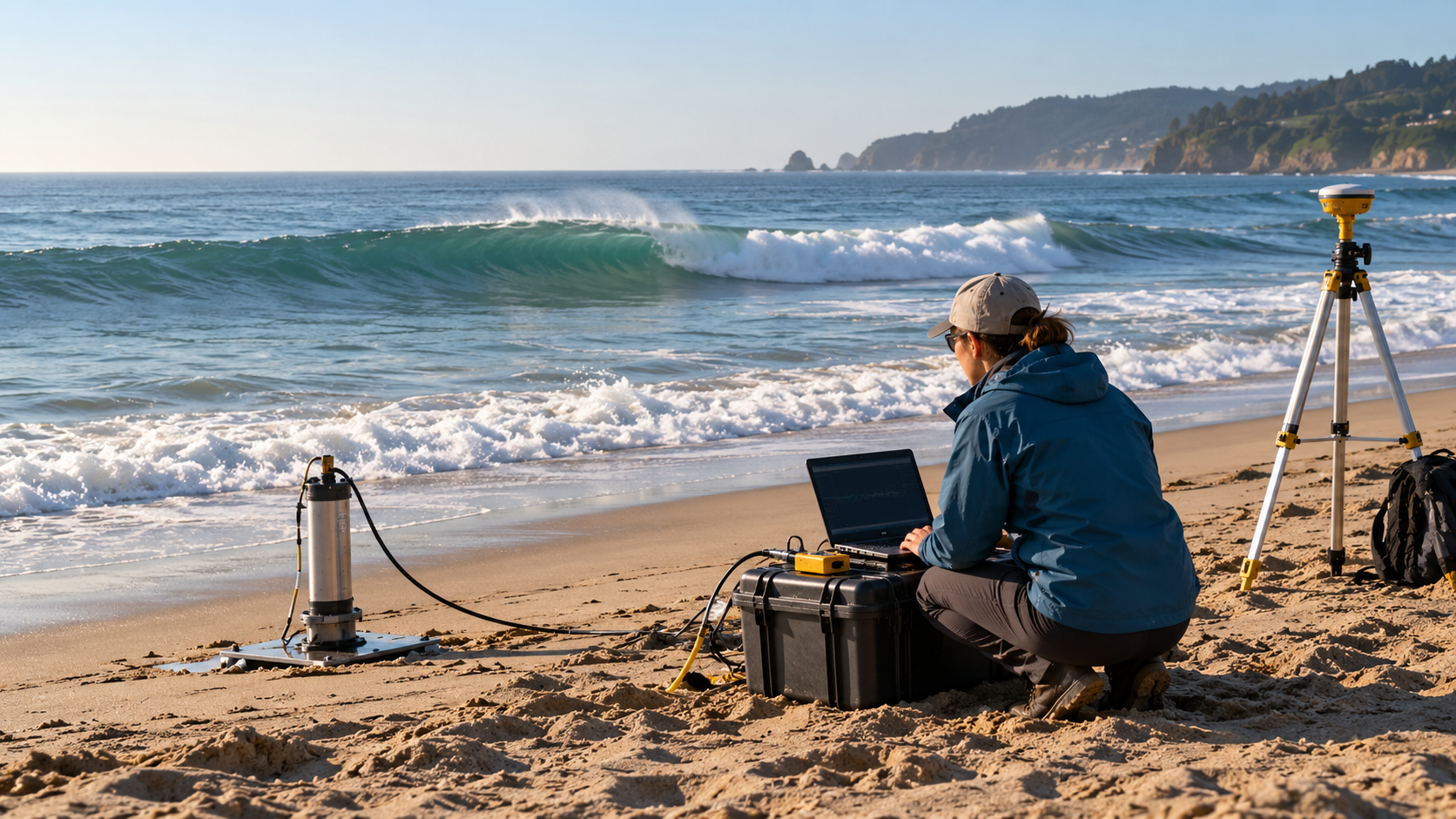
In deep water, wave motion fades with depth and the seafloor has little influence. As a wave enters water shallower than about half its wavelength, its lower motion interacts with the bottom. The wave slows, wavelength shortens, and energy is compressed into a smaller depth. Height can increase and the crest steepens, a transformation called shoaling.
A wave breaks when it becomes too steep for its crest to remain supported, commonly when depth is roughly comparable to wave height. Gently sloping beaches favor spilling breakers that lose energy gradually, while steeper bottoms can produce plunging or surging breakers. Exact behavior depends on wave period, height, bottom slope, currents, and irregular seabed features.
Refraction turns waves as different parts of a crest enter shallow water at different times, often aligning crests more nearly with the shore and concentrating or spreading energy around headlands and bays. Breaking waves drive nearshore currents and move sediment. Rip currents form where piled-up water finds focused paths back offshore; they are currents, not a special kind of wave.
Not all ocean waves are wind waves. Tides are extremely long waves driven by gravity, and tsunamis come from rapid displacement of large water volumes. Forecasts use buoys, satellites, winds, and numerical models, but local bathymetry controls the final surf. Wave science matters because an invisible transfer of energy becomes erosion, mixing, navigation conditions, and breaking motion at the coast.
Wind speed, duration, and fetch determine how much energy builds into a wind sea.
Water particles mainly move in orbits while the wave form and energy propagate.
Longer-period swell can travel away from storms and sort into regular sets.
Shallow-water interaction slows and steepens waves through shoaling.
Bottom slope and wave steepness determine whether breakers spill, plunge, or surge.
Refraction, currents, and bathymetry redistribute wave energy along the coast.
Explore more "Explainers"
Discover additional explainers across politics, science, business, technology, and other fields. Each explainer breaks down a complex idea into clear, everyday language—helping you better understand how major concepts, systems, and debates shape the world around us.