

On This Day in Science: July 13, 1995
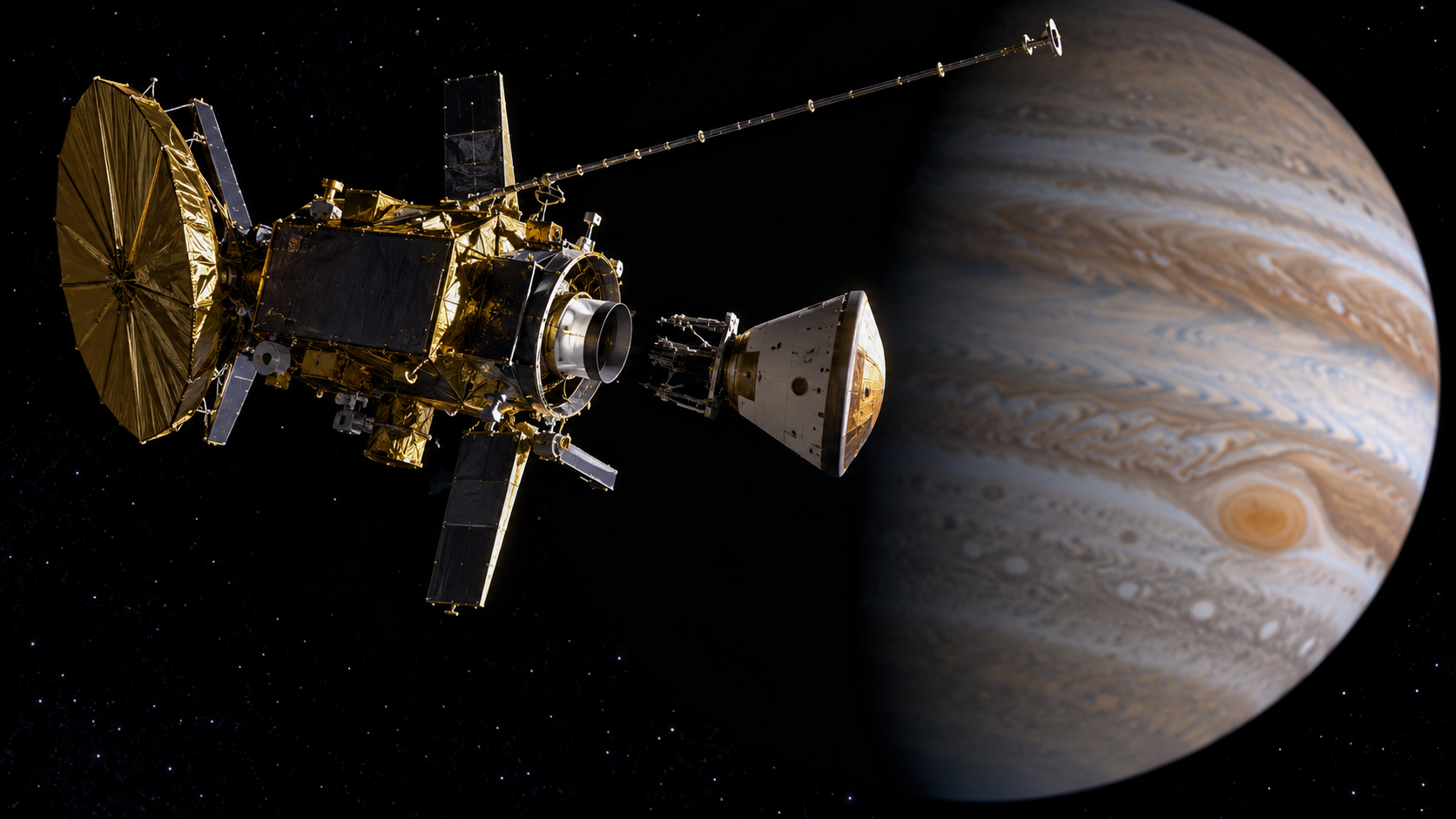
On July 13, 1995, NASA’s Galileo spacecraft released a 339-kilogram atmospheric probe toward Jupiter. The orbiter and probe had traveled together since launch in 1989, using flybys of Venus and Earth to gain speed. Five months before arrival, springs pushed the unpowered probe away on a precisely targeted trajectory.
The probe carried instruments to measure temperature, pressure, atmospheric composition, clouds, radiation, and winds. It had no engine after release, so navigation had to place it correctly in advance. Galileo later adjusted the orbiter’s path so it would avoid Jupiter while preparing to relay the probe’s data during entry.
On December 7, the probe struck the atmosphere at about 47 kilometers per second. A heat shield absorbed intense energy, then a parachute opened and instruments sampled the air for nearly an hour before pressure and heat ended transmission. The entry site proved unexpectedly dry and relatively clear, demonstrating the risk of treating one descent as globally representative.
Releasing the probe converted Galileo from a single spacecraft into a coordinated encounter. The capsule made the first direct measurements inside a giant planet’s atmosphere, while the orbiter began years of study of Jupiter and its moons. The operation showed how long-range planning can place a small laboratory into an environment no spacecraft can survive for long. For science history, the event also shows how evidence moves from an observation or engineered test into a durable body of knowledge. Instruments supplied measurements, specialists debated interpretation, and later work refined what the first result could mean. Archives preserve the early record while new methods let researchers ask different questions of it. That continuing revision is the process through which a dated milestone remains scientifically useful. Seen across a longer timeline, scientific milestones are junctions rather than isolated beginnings. Earlier experiments, tools, and institutions made the work possible, while later teams tested limits and carried the result into new settings. What survives is a traceable chain of evidence, correction, and application that allows one moment to remain relevant as knowledge and technology continue to change. The anniversary highlights the difference between a first result and a finished understanding. A successful observation can settle one question while opening several harder ones, and even a failed objective can reshape later designs. Preserved data, specimens, photographs, and hardware allow new generations to revisit the work with better tools. Science advances through that continuity rather than stopping on a memorable date. Its calendar date is an entry point, not an endpoint. The people involved worked with the instruments, assumptions, and social conditions of their time, and later research has both extended and corrected their conclusions. Separating what was known that day from what became clear afterward protects the history from myth and shows how cumulative evidence turns an episode into lasting scientific knowledge.
The probe coasted without propulsion after separation.
Its entry corridor depended on navigation completed far from Jupiter.
Sensors sampled pressure, temperature, winds, clouds, and gases.
The carrier orbiter received and stored the radio transmission.
The probe entered an unusually dry atmospheric region.
Later interpretation had to distinguish local conditions from global composition.
Explore more of "On This Day ..."
Discover more events from the same date across news, politics, technology, sports, and other fields. Each link highlights significant moments that shaped history on different fronts.