

On This Day in Science: July 15, 1975
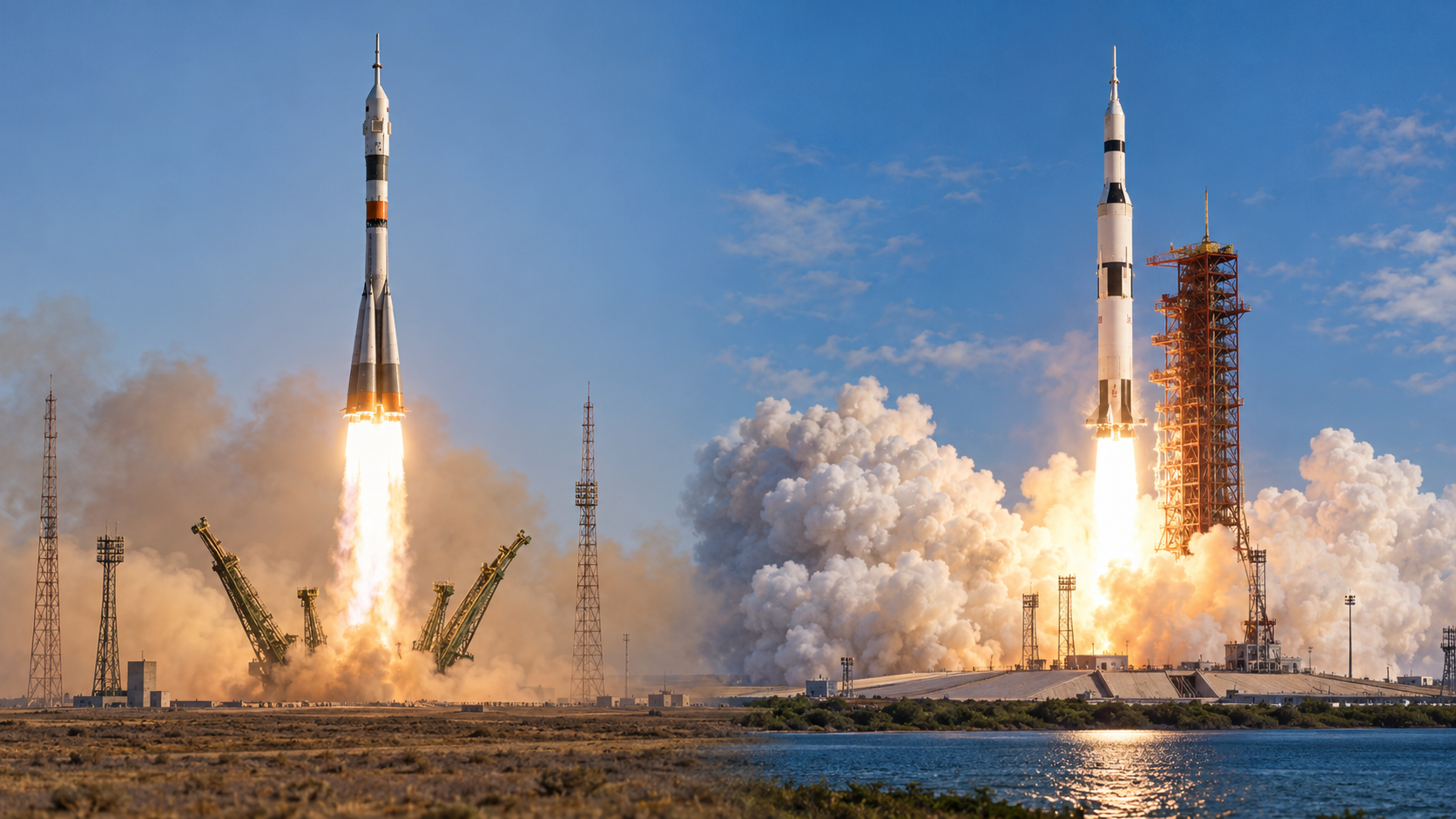
On July 15, 1975, a Soviet Soyuz spacecraft launched from Baikonur, followed about seven and a half hours later by an American Apollo from Kennedy Space Center. The two launches began the Apollo-Soyuz Test Project, the first crewed international spaceflight between the Cold War rivals.
Soyuz carried Alexei Leonov and Valeri Kubasov. Apollo carried Thomas Stafford, Vance Brand, and Deke Slayton. Their vehicles used different atmospheres, pressure levels, docking systems, languages, and operating traditions. Engineers created a docking module that served as an airlock and developed a compatible capture mechanism for the planned linkup.
After launch, both crews checked systems and began orbital maneuvers toward rendezvous. The sequence demanded shared radio procedures and precise coordination across control centers near Moscow and in Houston. Two days later the spacecraft docked, and crews exchanged visits, meals, gifts, and scientific work.
The July 15 departures were demonstrations of technical compatibility as much as rocket performance. Apollo-Soyuz did not end strategic competition, but it proved that independent programs could define common interfaces and emergency procedures. Those habits became important precedents for Shuttle-Mir and the International Space Station. The anniversary highlights the difference between a first result and a finished understanding. A successful observation can settle one question while opening several harder ones, and even a failed objective can reshape later designs. Preserved data, specimens, photographs, and hardware allow new generations to revisit the work with better tools. Science advances through that continuity rather than stopping on a memorable date. Its calendar date is an entry point, not an endpoint. The people involved worked with the instruments, assumptions, and social conditions of their time, and later research has both extended and corrected their conclusions. Separating what was known that day from what became clear afterward protects the history from myth and shows how cumulative evidence turns an episode into lasting scientific knowledge. For science history, the event also shows how evidence moves from an observation or engineered test into a durable body of knowledge. Instruments supplied measurements, specialists debated interpretation, and later work refined what the first result could mean. Archives preserve the early record while new methods let researchers ask different questions of it. That continuing revision is the process through which a dated milestone remains scientifically useful. Seen across a longer timeline, scientific milestones are junctions rather than isolated beginnings. Earlier experiments, tools, and institutions made the work possible, while later teams tested limits and carried the result into new settings. What survives is a traceable chain of evidence, correction, and application that allows one moment to remain relevant as knowledge and technology continue to change.
Soyuz departed Baikonur before Apollo launched from Florida.
Orbital planning brought the separately launched spacecraft together.
Cabin pressures, atmospheres, controls, and docking hardware were not naturally compatible.
A purpose-built module and common mechanism bridged the differences.
The mission required shared vocabulary, procedures, training, and rescue planning.
That practical collaboration influenced later long-duration partnerships.
Explore more of "On This Day ..."
Discover more events from the same date across news, politics, technology, sports, and other fields. Each link highlights significant moments that shaped history on different fronts.